












BaCO3 mesocrystals: new morphologies using peptide–polymer conjugates as crystallization modifiers
Literature Information
Publication Date
2010-08-28
DOI
10.1039/C0CP00819B
Impact Factor
3.676
Authors
James Mitchell, Hans Börner, Helmut Cölfen, Markus Antonietti
View Original
Abstract
Nanocrystal superstructures of barium carbonate (BaCO3) which exhibit unusual morphologies are obtained by the carbon dioxide vapor diffusion technique in the presence of poly(ethylene oxide)-block-eicosa aspartate (PEO-b-Asp20). The highly effective bioconjugate acts as a crystal growth modifier over a broad range of concentrations. Instead of commonly observed branched needles, the morphology can be systematically varied along different twinned growth patterns towards well-defined branched dumbbells. Detailed analysis of the crystal substructures with high resolution scanning electron microscopy (HRSEM) and dynamic light scattering (DLS) discloses a potential growth mechanism of the superstructures and reveals the role of the polymeric bioconjugate therein.
Related Literature
Conjugate substitution and addition of α-substituted acrylate: a highly efficient, facile, convenient, and versatile approach to fabricate degradable polymers by dynamic covalent chemistry
Yasuhiro Kohsaka, Takumi Miyazaki, Keito Hagiwara
2017-12-28
Paper
DOI: 10.1039/C7PY02114C
Synthesis, characterization and the paramagnetic properties of bottle-brush copolymers with shielding TEMPO radicals
Zhigang Wu, Hongying Shen, Guowei Wang
2017-11-02
Paper
DOI: 10.1039/C7PY01683B
A comparative study of redox-active, ambipolar electrochromic triphenylamine-based polyimides prepared by electrochemical polymerization and conventional polycondensation methods
Sheng-Huei Hsiao, Wei-Kai Liao, Guey-Sheng Liou
2017-12-05
Paper
DOI: 10.1039/C7PY01897E
Palladium-polymer nanoreactors for the aqueous asymmetric synthesis of therapeutic flavonoids
E. Lestini, L. D. Blackman, C. M. Zammit, R. J. Williams, M. Inam, B. Couturaud, R. K. O'Reilly
2018-01-30
Communication
DOI: 10.1039/C7PY02050C
Tailored emulsion-templated porous polymer scaffolds for iPSC-derived human neural precursor cell culture
Ashley R. Murphy
2017-10-06
Paper
DOI: 10.1039/C7PY01375B
Synthesis of star polymers using organocatalyzed atom transfer radical polymerization through a core-first approach
Bonnie L. Buss, Logan R. Beck
2017-12-06
Paper
DOI: 10.1039/C7PY01833A
Enzymatically crosslinked hydrogels based on linear poly(ethylene glycol) polymer: performance and mechanism
Chunsheng Xiao, Chaoliang He, Gao Li, Xuesi Chen
2017-11-01
Paper
DOI: 10.1039/C7PY01597F
Synthesis of linear and star poly(ε-caprolactone) with controlled and high molecular weights via cyclic trimeric phosphazene base catalyzed ring-opening polymerization
Huaike Li, Na Zhao, Chuanli Ren, Shaofeng Liu, Zhibo Li
2017-11-13
Paper
DOI: 10.1039/C7PY01673E
Dual-responsive biocompatible microgels as high loaded cargo: understanding of encapsulation/release driving forces by NMR NOESY
Abdeld Khoukh, Kamel Chougrani, Valérie Alard
2018-01-19
Paper
DOI: 10.1039/C7PY02111A
You might also like
Compound Q&A
What precautions should be taken when handling lithium chloride hydrate (1:1:1) (CAS: 16712-20-2)?
When handling lithium chloride hydrate (1:1:1) (CAS: 16712-20-2), it is importan...
16712-20-2Lithium chloride hyd...
Compound Q&A
Is 4-(4H-1,2,4-Triazol-4-yl)piperidine (CAS: 690261-92-8) safe?
4-(4H-1,2,4-Triazol-4-yl)piperidine is generally considered safe for use in phar...
690261-92-84-(4H-1,2,4-Triazol-...
Compound Q&A
How should waste containing 1,3-Thiazole-2-carboxamide (CAS: 16733-85-0) be handled?
Waste containing 1,3-Thiazole-2-carboxamide (CAS: 16733-85-0) should be collecte...
16733-85-01,3-Thiazole-2-carbo...
Compound Q&A
What regulatory guidelines apply to 5-(Difluoromethyl)-2-fluorobenzonitrile (CAS: 934175-58-3)?
5-(Difluoromethyl)-2-fluorobenzonitrile (CAS: 934175-58-3) is subject to regulat...
934175-58-35-(Difluoromethyl)-2...
Compound Q&A
How is Methyl 3-acetamido-2-thiophenecarboxylate (CAS: 22288-79-5) typically synthesized?
Methyl 3-acetamido-2-thiophenecarboxylate can be synthesized by the reaction of ...
22288-79-5Methyl 3-acetamido-2...
Compound Q&A
What is 4-Isoquinolinecarbonitrile (CAS: 34846-65-6)?
4-Isoquinolinecarbonitrile is a chemical compound with the CAS number 34846-65-6...
34846-65-64-Isoquinolinecarbon...
Compound Q&A
How should Methyl 1H-1,2,3-triazole-4-carboxylate (CAS: 877309-59-6) be stored?
Store Methyl 1H-1,2,3-triazole-4-carboxylate (CAS: 877309-59-6) in a cool, dry p...
877309-59-6Methyl 1H-1,2,3-tria...
Compound Q&A
What regulatory guidelines apply to 6-Bromo[1,3]thiazolo[5,4-b]pyridin-2-amine (CAS: 1160791-13-8)?
6-Bromo[1,3]thiazolo[5,4-b]pyridin-2-amine (CAS: 1160791-13-8) is subject to the...
1160791-13-86-Bromo[1,3]thiazolo...
Compound Q&A
Is (2S,3S)-2-Ammonio-3-(3,4-dihydroxyphenyl)-3-hydroxypropanoate (CAS: 23651-95-8) safe?
(2S,3S)-2-Ammonio-3-(3,4-dihydroxyphenyl)-3-hydroxypropanoate (CAS: 23651-95-8) ...
23651-95-8(2S,3S)-2-Ammonio-3-...
Compound Q&A
What are the physical and chemical properties of 7-bromo-3-methyl-3,4-dihydroquinazolin-4-one (CAS: 1293987-84-4)?
7-Bromo-3-methyl-3,4-dihydroquinazolin-4-one is a solid with a crystalline form....
1293987-84-47-bromo-3-methyl-3,4...
Source Journal
Physical Chemistry Chemical Physics

CiteScore:
5.5
Self-citation Rate:
10.3%
Articles per Year:
3036
Physical Chemistry Chemical Physics (PCCP) is an international journal co-owned by 19 physical chemistry and physics societies from around the world. This journal publishes original, cutting-edge research in physical chemistry, chemical physics and biophysical chemistry. To be suitable for publication in PCCP, articles must include significant innovation and/or insight into physical chemistry; this is the most important criterion that reviewers and Editors will judge against when evaluating submissions. The journal has a broad scope and welcomes contributions spanning experiment, theory, computation and data science. Topical coverage includes spectroscopy, dynamics, kinetics, statistical mechanics, thermodynamics, electrochemistry, catalysis, surface science, quantum mechanics, quantum computing and machine learning. Interdisciplinary research areas such as polymers and soft matter, materials, nanoscience, energy, surfaces/interfaces, and biophysical chemistry are welcomed if they demonstrate significant innovation and/or insight into physical chemistry. Joined experimental/theoretical studies are particularly appreciated when complementary and based on up-to-date approaches.
Recommended Compounds
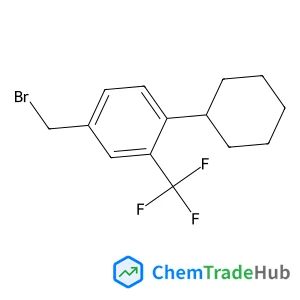
4-(Bromomethyl)-1-cyclohexyl-2-(trifluoromethyl)benzene
CAS Number:
800381-60-6
Molecular Formula:
C14H16BrF3
Recommended Suppliers




Disclaimer
This page provides academic journal information for reference and research purposes only. We are not affiliated with any journal publishers and do not handle publication submissions. For publication-related inquiries, please contact the respective journal publishers directly.
If you notice any inaccuracies in the information displayed, please contact us at support@chemtradehub.com. We will promptly review and address your concerns.