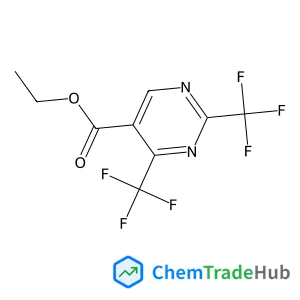
Ethyl 2,4-bis(trifluoromethyl)-5-pyrimidinecarboxylate
CAS Number:
188781-15-9
Molecular Formula:
C9H6F6N2O2
Zhigang Wu, Hongying Shen, Guowei Wang
Bottle-brush copolymers poly(2-hydroxyethyl methacrylate)(PHEMA)-g-{[(poly(acrylic acid)-g-2,2,6,6-tetramethylpiperidine-1-oxyl)]-b-poly(methyl acrylate)} (PHEMA-g-[(PAA-g-TEMPO)-b-PMA]) and PHEMA-g-(PAA-g-TEMPO) with shielding 2,2,6,6-tetramethylpiperidine-1-oxyl (TEMPO) radicals were synthesized, and their paramagnetic properties were compared in bulk and solution, respectively. Firstly, using a “grafting from” strategy, the atom transfer radical polymerization (ATRP) of tert-butylacrylate (tBA) permitted the successful synthesis of the bottle-brush copolymer PHEMA-g-PtBA from the macro-initiator poly[2-(2-bromoisobutyryloxy)ethyl methacrylate] (PBiBEMA) with a high density of initiating sites. Subsequently, following a second “grafting from” strategy and the ATRP of methyl acrylate (MA), the bottle-brush copolymer PHEMA-g-(PtBA-b-PMA) was further produced by employing PHEMA-g-PtBA as the macro-initiator. The poly(acrylic acid) (PAA) segment generated by the selective hydrolysis of the PtBA segment was used to introduce TEMPO radicals through the reaction between carboxyl groups on PAA and oxirane group on glycidoloxy-2,2,6,6-tetramethyl piperidine-1-oxyl (GTEMPO). With the shielding by the outer PMA segment in PHEMA-g-[(PAA-g-TEMPO)-b-PMA], superfine information of inner TEMPO radicals in the electron paramagnetic resonance (EPR) spectrum could be well discriminated. However, the PHEMA-g-(PAA-g-TEMPO) without any shielding showed a broad EPR spectrum, which was in accordance with a characteristic EPR spectrum of a polyradical polymer due to the strong interactions between radicals.
Yan Song, Yumin Zhang
DOI: 10.1039/D0CP00319K
Jon M. Schwantes, Jacob L. Bair, Edgar C. Buck, Ram Devanathan, Sean H. Kessler, Timothy G. Lach, Jason M. Lonergan, Bruce K. McNamara, Camille J. Palmer, Richard A. Clark
DOI: 10.1039/C9CP05363H
Niloufar Hendinejad, Qadir K. Timerghazin
DOI: 10.1039/C9CP06377C
Alexander Ostermann, Tobias M. Gasser, Thomas Loerting, Jörg Petrasch
DOI: 10.1039/C9CP04735B
Helen Benjamin, Jonathan G. Richardson, Stephen A. Moggach, Sergejs Afanasjevs, Lisette Warren, Mark R. Warren, David R. Allan, Carole A. Morrison, Konstantin V. Kamenev, Neil Robertson
DOI: 10.1039/C9CP06749C
Ankita Katiyar, Julia C. Freire Sovierzoski, Paul B. Calio, Anthony A. Vartia, Ward H. Thompson
DOI: 10.1039/C9CP06874K
Ruiqi Zhao, Yu Wang, Xinglong Gong
DOI: 10.1039/C9CP06314E
Chia-Yun Lai, Sergio Santos, Boulos Alfakes, Nitul Rajput, Tobias Boström
DOI: 10.1039/C9CP06441A
Maria de las Nieves Piña, Antonio Bauzá, Antonio Frontera
DOI: 10.1039/D0CP00114G
When handling lithium chloride hydrate (1:1:1) (CAS: 16712-20-2), it is importan...
4-(4H-1,2,4-Triazol-4-yl)piperidine is generally considered safe for use in phar...
Waste containing 1,3-Thiazole-2-carboxamide (CAS: 16733-85-0) should be collecte...
5-(Difluoromethyl)-2-fluorobenzonitrile (CAS: 934175-58-3) is subject to regulat...
Methyl 3-acetamido-2-thiophenecarboxylate can be synthesized by the reaction of ...
4-Isoquinolinecarbonitrile is a chemical compound with the CAS number 34846-65-6...
Store Methyl 1H-1,2,3-triazole-4-carboxylate (CAS: 877309-59-6) in a cool, dry p...
6-Bromo[1,3]thiazolo[5,4-b]pyridin-2-amine (CAS: 1160791-13-8) is subject to the...
(2S,3S)-2-Ammonio-3-(3,4-dihydroxyphenyl)-3-hydroxypropanoate (CAS: 23651-95-8) ...
7-Bromo-3-methyl-3,4-dihydroquinazolin-4-one is a solid with a crystalline form....

Polymer Chemistry welcomes submissions in all areas of polymer science that have a strong focus on macromolecular chemistry. Manuscripts may cover a broad range of fields, yet no direct application focus is required.
![(R)-N-[(S)-1-[2-(Diphenylphosphino)phenyl]ethyl]-2-methylpropane-2-sulfinamide structure](https://static.chemtradehub.com/structs/159/1595319-98-4-33e7.webp "(R)-N-[(S)-1-[2-(Diphenylphosphino)phenyl]ethyl]-2-methylpropane-2-sulfinamide structure")