












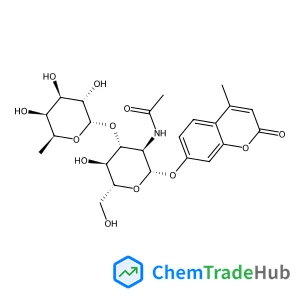
4-Methyl-2-oxo-2H-chromen-7-yl 2-acetamido-2-deoxy-3-O-(6-deoxy-alpha-L-galactopyranosyl)-beta-D-glucopyranoside
CAS Number:
383160-12-1
Molecular Formula:
C24H31NO12
Yasuhiro Kohsaka, Takumi Miyazaki, Keito Hagiwara
Polycondensation of bis[α-(halomethyl)acrylate] and dithiols, dicarboxylic acids, primary monoamines, and bisphenols via conjugate substitution yielded a series of poly(conjugated ester)s with acryloyl groups in the backbones. In the case of a dithiol monomer, a polar solvent promoted the conjugate addition (Michael addition) of a mercapto chain end into the acryloyl group in the resulting backbone to cause gelation. Therefore, kinetic control of the polymerization by the selection of nonpolar solvents and end capping with the mercapto group in the case of polar dithiols was necessary to prepare linear polymers. The monomer, bis[α-(halomethyl)acrylate], was also effective in achieving chain extension of common polyesters with phenolic hydroxyl end groups. These poly(conjugated ester)s underwent main chain scission when they were treated with benzyl mercaptan in the presence of a basic catalyst through a thiol exchange reaction via conjugate addition and substitution.
Bernhard Breit, Peter Demel, Antje Gebert
DOI: 10.1039/B311378G
Tamotsu Horiuchi, Hidetoshi Miura, Satoshi Uchida
DOI: 10.1039/B307819A
James D. Crowley, Andrew J. Goshe, B. Bosnich
DOI: 10.1039/B210957C
Min Kuang, Hongwei Duan, Jing Wang, Daoyong Chen, Ming Jiang
DOI: 10.1039/B210851H
S. A. McFarland, N. S. Finney
DOI: 10.1039/B210254D
Hideto Nakagawa, Satoshi Sakaguchi, Yasutaka Ishii
DOI: 10.1039/B212440H
Paul J. Dyson, J. Scott McIndoe, Dongbin Zhao
DOI: 10.1039/B211669C
Qian Wang, Brian Bothner, Padmaja Natarajan, M. G. Finn
DOI: 10.1039/B310533D
Natasha Djedovic, Riccardo Ferdani, Egan Harder, Jolanta Pajewska, Robert Pajewski, Paul H. Schlesinger, George W. Gokel
DOI: 10.1039/B312209N
Junjie Liu, Feng Li, David G. Evans, Xue Duan
DOI: 10.1039/B212233B
When handling lithium chloride hydrate (1:1:1) (CAS: 16712-20-2), it is importan...
4-(4H-1,2,4-Triazol-4-yl)piperidine is generally considered safe for use in phar...
Waste containing 1,3-Thiazole-2-carboxamide (CAS: 16733-85-0) should be collecte...
5-(Difluoromethyl)-2-fluorobenzonitrile (CAS: 934175-58-3) is subject to regulat...
Methyl 3-acetamido-2-thiophenecarboxylate can be synthesized by the reaction of ...
4-Isoquinolinecarbonitrile is a chemical compound with the CAS number 34846-65-6...
Store Methyl 1H-1,2,3-triazole-4-carboxylate (CAS: 877309-59-6) in a cool, dry p...
6-Bromo[1,3]thiazolo[5,4-b]pyridin-2-amine (CAS: 1160791-13-8) is subject to the...
(2S,3S)-2-Ammonio-3-(3,4-dihydroxyphenyl)-3-hydroxypropanoate (CAS: 23651-95-8) ...
7-Bromo-3-methyl-3,4-dihydroquinazolin-4-one is a solid with a crystalline form....

Polymer Chemistry welcomes submissions in all areas of polymer science that have a strong focus on macromolecular chemistry. Manuscripts may cover a broad range of fields, yet no direct application focus is required.
![tert-butyl 8-benzyl-2,8-diazaspiro[4.5]decane-2-carboxylate structure](https://static.chemtradehub.com/structs/336/336191-16-3-bb55.webp "tert-butyl 8-benzyl-2,8-diazaspiro[4.5]decane-2-carboxylate structure")
![6-(Benzyloxy)-8-(2-bromoacetyl)-2H-benzo[b][1,4]oxazin-3(4H)-one structure](https://static.chemtradehub.com/structs/926/926319-53-1-2287.webp "6-(Benzyloxy)-8-(2-bromoacetyl)-2H-benzo[b][1,4]oxazin-3(4H)-one structure")





