












Extracting the underlying effective free energy landscape from single-molecule time series—local equilibrium states and their network
Literature Information
Publication Date
2010-12-07
DOI
10.1039/C0CP00694G
Impact Factor
3.676
Authors
View Original
Abstract
We present a new self-consistent procedure to construct a multidimensional effective free energy landscape from a scalar single molecule time series, when single molecules experience the landscape within a given timescale of “observation.” The theory is based on a framework we recently developed to extract a set of local equilibrium states (LESs) and their network from a scalar time series, such as distance between dye molecules tagged in a biomolecule. We scrutinize the appropriateness of the assumptions of local equilibration and local detailed balance among LESs at the single molecule level within the given timescale, rather than postulating them a priori. The self-consistent procedure in this article incorporates the effect of local correlation of the system dynamics inside potential basins, and the effect of finiteness of the sampled data points in assigning the boundary between different LESs. We propose a new simple scheme to assign the dimensionality of the energy landscape from a single molecule time series. We also address the question of what the molecules actually “feel” from the underlying landscape at the single molecule level.
Related Literature
Paired cell for the preparation of AgI nanowires using nanoporous alumina membrane templates
Yuanzhe Piao, Hasuck Kim
2003-10-17
Communication
DOI: 10.1039/B310212B
Cooperative C–F⋯Si interaction in optically active helical polysilanes
Sun-Young Kim, Giseop Kwak, Yusuke Kawakami
2004-01-27
Communication
DOI: 10.1039/B314723A
Preparation of highly accessible mordenite coatings on ceramic monoliths at loadings exceeding 50% by weight
M. A. Ulla, E. Miro, R. Mallada, J. Coronas, J. Santamaría
2004-01-29
Communication
DOI: 10.1039/B315386J
Self-indicating amine scavenger resins
Jin Ku Cho, Peter D. White, Wolfgang Klute, Tony W. Dean, Mark Bradley
2004-01-27
Communication
DOI: 10.1039/B315426B
Nucleic acid binding properties of thyminyl and adeninyl pyrrolidine-amideoligonucleotide mimics (POM)
T. H. Samuel Tan, David T. Hickman, Jordi Morral, Ian G. Beadham, Jason Micklefield
2004-01-28
Communication
DOI: 10.1039/B315768G
First three examples of taxane-derived di-propellanes in Taxus canadensis needles
Qing Wen Shi, Françoise Sauriol, Alain Lesimple, Lolita O. Zamir
2004-02-04
Communication
DOI: 10.1039/B316051C
Structure and magnetism of a new pyrazolate bridged iron(II) spin crossover complex displaying a single HS–HS to LS–LS transition
Ben A. Leita, Boujemaa Moubaraki, Keith S. Murray, Jonathan P. Smith, John D. Cashion
2003-11-20
Communication
DOI: 10.1039/B311818E
Disc-shaped triphenylenes in a smectic organisation
Paul H. J. Kouwer, Jahan Pourzand, Georg H. Mehl
2003-11-21
Communication
DOI: 10.1039/B311919J
Synthesis and characterization of novel chiral sulfonato–salen–manganese(iii) complex in a zinc–aluminium LDH host
Samiran Bhattacharjee, James A. Anderson
2004-02-04
Communication
DOI: 10.1039/B315325H
Stabilization of D5h and C2v valence tautomers of the croconate dianion
Chi-Keung Lam, Mei-Fun Cheng, Chi-Lun Li, Jie-Peng Zhang, Xiao-Ming Chen, Wai-Kee Li, Thomas C. W. Mak
2003-12-18
Communication
DOI: 10.1039/B312545A
You might also like
Compound Q&A
How should waste containing 2-Ethyl-4-Methyl-1H-Imidazole-5-Carbaldehyde (CAS: 88634-80-4) be handled?
Waste containing 2-Ethyl-4-Methyl-1H-Imidazole-5-Carbaldehyde (CAS: 88634-80-4) ...
88634-80-42-Ethyl-4-Methyl-1H-...
Compound Q&A
What industries use Triethoxy(octyl)silane (CAS: 1385031-14-0)?
Triethoxy(octyl)silane (CAS: 1385031-14-0) is widely used in the pharmaceuticals...
1385031-14-0Triethoxy(octyl)sila...
Compound Q&A
Are there alternatives to 3-iodo-7-nitro-1H-indazole (CAS: 864724-64-1) in synthesis?
Several alternatives to 3-iodo-7-nitro-1H-indazole (CAS: 864724-64-1) exist in t...
864724-64-13-iodo-7-nitro-1H-in...
Compound Q&A
Are there alternatives to Benzene, bis[(trimethoxysilyl)ethyl] (CAS: 266317-71-9) in synthesis?
Yes, there are alternatives to Benzene, bis[(trimethoxysilyl)ethyl] (CAS: 266317...
266317-71-9Benzene, bis[(trimet...
Compound Q&A
Is Isothiazole-3-carbonitrile (CAS: 1452-17-1) safe?
Isothiazole-3-carbonitrile (CAS: 1452-17-1) is generally considered safe when us...
1452-17-1Isothiazole-3-carbon...
Compound Q&A
Is (3-Chlorophenyl)methanol (CAS: 873-63-2) safe?
(3-Chlorophenyl)methanol (CAS: 873-63-2) is considered low to moderately toxic. ...
873-63-2(3-Chlorophenyl)meth...
Compound Q&A
How is (2S,3S)-2-Hydroxy-3-({[(2-methyl-2-propanyl)oxy]carbonyl}amino)-3-(2-naphthyl)propanoic acid (CAS: 959583-98-3) typically synthesized?
(2S,3S)-2-Hydroxy-3-({[(2-methyl-2-propanyl)oxy]carbonyl}amino)-3-(2-naphthyl)pr...
959583-98-3(2S,3S)-2-Hydroxy-3-...
Compound Q&A
What precautions should be taken when handling Methyl 2-(bromomethyl)-5-methoxybenzoate (CAS: 788081-99-2)?
Proper handling of methyl 2-(bromomethyl)-5-methoxybenzoate requires the use of ...
788081-99-2Methyl 2-(bromomethy...
Compound Q&A
What is 6,8-Dibromoimidazo[1,2-a]pyridine-2-carboxylic acid (CAS: 904805-36-3)?
6,8-Dibromoimidazo[1,2-a]pyridine-2-carboxylic acid (CAS: 904805-36-3) is an aro...
904805-36-36,8-Dibromoimidazo[1...
Compound Q&A
Is 3-Amino-5-bromo-2-pyridinecarbonitrile (CAS: 573675-27-1) safe?
3-Amino-5-bromo-2-pyridinecarbonitrile is considered safe when handled under pro...
573675-27-13-Amino-5-bromo-2-py...
Source Journal
Physical Chemistry Chemical Physics

CiteScore:
5.5
Self-citation Rate:
10.3%
Articles per Year:
3036
Physical Chemistry Chemical Physics (PCCP) is an international journal co-owned by 19 physical chemistry and physics societies from around the world. This journal publishes original, cutting-edge research in physical chemistry, chemical physics and biophysical chemistry. To be suitable for publication in PCCP, articles must include significant innovation and/or insight into physical chemistry; this is the most important criterion that reviewers and Editors will judge against when evaluating submissions. The journal has a broad scope and welcomes contributions spanning experiment, theory, computation and data science. Topical coverage includes spectroscopy, dynamics, kinetics, statistical mechanics, thermodynamics, electrochemistry, catalysis, surface science, quantum mechanics, quantum computing and machine learning. Interdisciplinary research areas such as polymers and soft matter, materials, nanoscience, energy, surfaces/interfaces, and biophysical chemistry are welcomed if they demonstrate significant innovation and/or insight into physical chemistry. Joined experimental/theoretical studies are particularly appreciated when complementary and based on up-to-date approaches.
Recommended Compounds
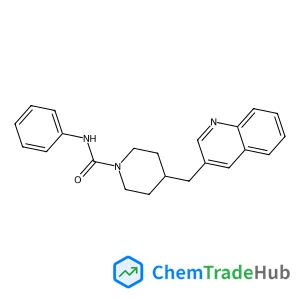
N-phenyl-4-(quinolin-3-ylmethyl)piperidine-1-carboxamide
CAS Number:
959151-50-9
Molecular Formula:
C22H23N3O
Recommended Suppliers





Disclaimer
This page provides academic journal information for reference and research purposes only. We are not affiliated with any journal publishers and do not handle publication submissions. For publication-related inquiries, please contact the respective journal publishers directly.
If you notice any inaccuracies in the information displayed, please contact us at support@chemtradehub.com. We will promptly review and address your concerns.