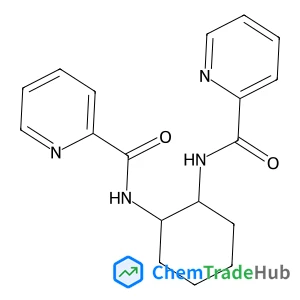
N,N'-(1R,2R)-1,2-Cyclohexanediyldi(2-pyridinecarboxamide)
CAS Number:
218290-24-5
Molecular Formula:
C18H20N4O2
Sun-Young Kim, Giseop Kwak, Yusuke Kawakami
Cooperative amplification of the C–F⋯Si weak interaction between side chains and the main chain was found to afford rigid rodlike helical polysilanes with a preferential screw sense.
Yang Su, Xin Xiao, Shentong Li, Meihan Dan, Xiaohui Wang, Wangqing Zhang
DOI: 10.1039/C3PY00995E
Christopher Waldron, Athina Anastasaki, Ronan McHale, Paul Wilson, Zaidong Li, Tim Smith, David M. Haddleton
DOI: 10.1039/C3PY01241G
Susanne Boye, Mihaela Cernescu, Hartmut Komber, Bernhard Brutschy, Dietmar Appelhans
DOI: 10.1039/C3PY01152F
Mustafa Ciftci
DOI: 10.1039/C3PY01009K
Christopher Waldron, Qiang Zhang, Zaidong Li, Vasiliki Nikolaou, Gabit Nurumbetov, Jamie Godfrey, Ronan McHale, Gokhan Yilmaz, Rajan K. Randev, Mony Girault, Kayleigh McEwan, David M. Haddleton, Martijn Droesbeke, Alice J. Haddleton, Paul Wilson, Alexandre Simula, Jennifer Collins, Danielle J. Lloyd, James A. Burns, Christopher Summers, Claudia Houben, Athina Anastasaki, Muxiu Li, C. Remzi Becer, Jenny K. Kiviaho, Nuttapol Risangud
DOI: 10.1039/C3PY01075A
Naoya Sakai, Mingoo Jin, Shin-ichiro Sato, Toshifumi Satoh, Toyoji Kakuchi
DOI: 10.1039/C3PY00972F
Li-Min Zhang, Tao Wang, Bao-Hang Han
DOI: 10.1039/C3PY00854A
Helen Willcock, Annhelen Lu, Claire F. Hansell, Emma Chapman, Ian R. Collins, Rachel K. O'Reilly
DOI: 10.1039/C3PY00998J
Joji Ohshita, Makoto Nakashima, Daiki Tanaka, Yasushi Morihara, Hiroyuki Fueno, Kazuyoshi Tanaka
DOI: 10.1039/C3PY01157G
1H-Indazole-6-carbonitrile finds applications in pharmaceuticals, where it serve...
Waste containing Dioctyl (2E)-2-butenedioate (CAS: 2997-85-5) should be collecte...
Sodium [(1,2-benzoxazol-3-ylmethyl)sulfonyl]azanide is primarily used in pharmac...
Dimethyl 4-(4,4,5,5-tetramethyl-1,3,2-dioxaborolan-2-yl)-2,6-pyridinedicarboxyla...
Waste containing 2-Fluoro-6-hydrazinopyridine (CAS: 80714-39-2) should be manage...
6-Formyl-2-pyridinecarboxylic acid is an organic compound with the molecular for...
Research trends for this compound indicate a focus on its potential applications...
9H-Tribenzo[b,d,f]azepine is typically synthesized via a multi-step process invo...
1-Cyclopropyl-7-ethoxy-6-fluoro-8-methoxy-4-oxo-1,4-dihydro-3-quinolinecarboxyli...
Waste containing Methyl 3-oxo-1,2,3,4-tetrahydro-6-quinoxalinecarboxylate (CAS: ...

ChemComm publishes urgent research which is of outstanding significance and interest to experts in the field, while also appealing to the journal’s broad chemistry readership. Our communication format is ideally suited to short, urgent studies that are of such importance that they require accelerated publication. Our scope covers all topics in chemistry, and research at the interface of chemistry and other disciplines (such as materials science, nanoscience, physics, engineering and biology) where there is a significant novelty in the chemistry aspects. Major topic areas covered include: Analytical Chemistry Catalysis Chemical Biology and medicinal chemistry Computational Chemistry and Machine Learning Energy and sustainable chemistry Environmental Chemistry Green Chemistry Inorganic Chemistry Materials Chemistry Nanoscience Organic Chemistry Physical Chemistry Polymer Chemistry Supramolecular Chemistry