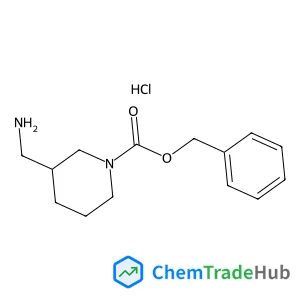
Benzyl 3-(aminomethyl)piperidine-1-carboxylate hydrochloride
CAS Number:
1186663-23-9
Molecular Formula:
C14H21ClN2O2
Yonghui Zhang, Zhen Li, Chun Chan, Jiale Ma, Chunyi Zhi, Xiaolin Cheng
Boron nitride nanosheets are novel promising nanomaterials with a lower cytotoxicity than graphene making them a better candidate for biomedical applications. However, there is no systematic study on how they interact with cell membranes. Here we employed large scale all-atom molecular dynamics simulations to provide molecular details of the structure and properties of membranes after the insertion of boron nitride nanosheets. Our results reveal that the boron nitride nanosheet can extract phospholipids from the lipid bilayers and is enveloped by the membrane. Afterwards, the acyl chains of lipid molecules re-orient and become more ordered. As a result, a fluid to gel phase transition occurs in the 1,2-dimyristoyl-sn-glycero-3-phosphocholine bilayer. Consequently, the bending moduli of the bilayers increase, and the diffusivity of the individual lipid molecule decreases. These changes will affect relevant cellular activities, such as endocytosis and signal transduction. Our study provides novel insights into the biocompatibility and cytotoxicity of boron nitride nanosheets, which may facilitate the design of safer nanocarriers, antibiotics and other bio-nanotechnology applications.
Yafen Xia, Yong Luo, Jiaolin Cui
DOI: 10.1039/D0CP00626B
Yawei Gao, Yun Kyung Shin, Daniel Martinez, Guha Manogharan, Adri C. T. van Duin
DOI: 10.1039/C9CP03585K
Björn Drobot, Moritz Schmidt, Takaya Abe, Koji Okuwaki, Florian Brulfert, Sven Falke, Sergey A. Samsonov, Yuto Komeiji, Christian Betzel, Thorsten Stumpf, Johannes Raff
DOI: 10.1039/C9CP03750K
Juran Kim, Gee Yeong Kim, Trang Thi Thu Nguyen, Seokhyun Yoon, Yoon-Koo Kim, Seung-Yong Lee, Miyoung Kim, Dae-Hyung Cho, Yong-Duck Chung, Je-Ho Lee, Maeng-Je Seong, William Jo
DOI: 10.1039/C9CP06537G
Marta G. González, Luis Rubio-Lago
DOI: 10.1039/C9CP04758A
Anthony M. S. Pembere, Chaonan Cui, Rajini Anumula, Haiming Wu, Pan An, Tongling Liang, Zhixun Luo
DOI: 10.1039/D0CP90052D
6-(3-Fluorophenyl)picolinic acid is generally considered safe for laboratory use...
(3R)-3-Pyrrolidinol is used in the pharmaceutical industry as a precursor for dr...
When handling (4R,5R)-4,5-Diethoxycarbonyl-2,2-dimethyldioxolane (CAS: 59779-75-...
1-(6-Chloroimidazo[1,2-b]pyridazin-3-yl)ethanone is often synthesized via a mult...
The market for N-Ethyl-3,4-dimethylbenzylamine (CAS: 39180-83-1) remains steady,...
Tert-butyl 3-(pyrrolidin-1-yl)azetidine-1-carboxylate is a chemical compound wit...
1-Bromo-3-chloro-2,4-dimethoxybenzene (CAS: 1228956-93-1) falls under the classi...
The safety of 8-Bromo-2-methyl-3,4-dihydroisoquinolin-1(2H)-one (CAS: 1368622-07...
Benzyl [(3S)-2,6-dioxo-3-piperidinyl]carbamate is generally safe when handled wi...
1-{[4-(4,4,5,5-Tetramethyl-1,3,2-dioxaborolan-2-yl)phenyl]sulfonyl}pyrrolidine s...

Physical Chemistry Chemical Physics (PCCP) is an international journal co-owned by 19 physical chemistry and physics societies from around the world. This journal publishes original, cutting-edge research in physical chemistry, chemical physics and biophysical chemistry. To be suitable for publication in PCCP, articles must include significant innovation and/or insight into physical chemistry; this is the most important criterion that reviewers and Editors will judge against when evaluating submissions. The journal has a broad scope and welcomes contributions spanning experiment, theory, computation and data science. Topical coverage includes spectroscopy, dynamics, kinetics, statistical mechanics, thermodynamics, electrochemistry, catalysis, surface science, quantum mechanics, quantum computing and machine learning. Interdisciplinary research areas such as polymers and soft matter, materials, nanoscience, energy, surfaces/interfaces, and biophysical chemistry are welcomed if they demonstrate significant innovation and/or insight into physical chemistry. Joined experimental/theoretical studies are particularly appreciated when complementary and based on up-to-date approaches.