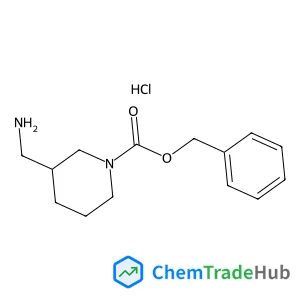
Benzyl 3-(aminomethyl)piperidine-1-carboxylate hydrochloride
CAS Number:
1186663-23-9
Molecular Formula:
C14H21ClN2O2
Lukas Jackalin, Boris B. Kharkov, Andrei V. Komolkin
Direct dipolar spin couplings are informative and sensitive probes for a wide range of dynamic processes and structural properties at atomic, molecular and supramolecular levels in liquid crystals and other anisotropic materials. Usually, heteronuclear 13C–1H dipolar couplings in liquid crystals with natural 13C abundance are measured. Recording 13C–15N NMR dipolar spectra in unlabeled materials is challenging because of the unfavorable combination of two rare isotopes. Here we design and compare various experimental strategies to measure short- and long-range heteronuclear 13C–15N dipolar couplings in liquid crystalline samples with high molecular orientational order. New techniques were developed to record 13C and 15N spectra of naturally occurring 13C–15N spin pairs with increased signal intensity and spectral resolution while suppressing the signals of the uncoupled isotopes. Highly resolved 13C–15N dipolar spectra were recorded within an experimental time of a few hours. Coupling constants in a broad range of 10–1000 Hz between spins separated by up to five chemical bonds and distances of up to 5 Å were measured. Because of their relatively low demands on radio-frequency power levels, the experiments were easy to implement using conventional high-resolution solution-state NMR hardware. Experimental data were compared to the results of density functional theory and molecular dynamics computational analyses. The presented experimental methods to characterize the dipolar couplings in unlabeled materials provide novel routes to investigate molecular structure and dynamics in mesophases.
Germán Molpeceres, Johannes Kästner
DOI: 10.1039/D0CP00250J
Emmanuelle M. M. Weber, Dennis Kurzbach, Daniel Abergel
DOI: 10.1039/C9CP03334C
Li Xiang, Lu Gong, Jiawen Zhang, Ling Zhang, Wenjihao Hu, Wenda Wang, Qingye Lu, Hongbo Zeng
DOI: 10.1039/C9CP03189H
Andrea Gardin, Alberta Ferrarini
DOI: 10.1039/D0CP90053B
Lisa Warczinski, Christof Hättig
DOI: 10.1039/C9CP04606B
DOI: 10.1039/C9CP02450F
P. S. Rukin, K. G. Komarova, B. Fresch, E. Collini, F. Remacle
DOI: 10.1039/D0CP00223B
Xiaojun Lv, Chaohong Guan, Zexun Han, Chang Chen, Qidong Sun
DOI: 10.1039/C9CP03673C
Wenyi Shao, Yang Li, Xiang Wang, Xiao Ouyang, Jiafa Cai, Chen Li, Zhengyun Wu, Qiang Xu
DOI: 10.1039/C9CP06259A
6-(3-Fluorophenyl)picolinic acid is generally considered safe for laboratory use...
(3R)-3-Pyrrolidinol is used in the pharmaceutical industry as a precursor for dr...
When handling (4R,5R)-4,5-Diethoxycarbonyl-2,2-dimethyldioxolane (CAS: 59779-75-...
1-(6-Chloroimidazo[1,2-b]pyridazin-3-yl)ethanone is often synthesized via a mult...
The market for N-Ethyl-3,4-dimethylbenzylamine (CAS: 39180-83-1) remains steady,...
Tert-butyl 3-(pyrrolidin-1-yl)azetidine-1-carboxylate is a chemical compound wit...
1-Bromo-3-chloro-2,4-dimethoxybenzene (CAS: 1228956-93-1) falls under the classi...
The safety of 8-Bromo-2-methyl-3,4-dihydroisoquinolin-1(2H)-one (CAS: 1368622-07...
Benzyl [(3S)-2,6-dioxo-3-piperidinyl]carbamate is generally safe when handled wi...
1-{[4-(4,4,5,5-Tetramethyl-1,3,2-dioxaborolan-2-yl)phenyl]sulfonyl}pyrrolidine s...

Physical Chemistry Chemical Physics (PCCP) is an international journal co-owned by 19 physical chemistry and physics societies from around the world. This journal publishes original, cutting-edge research in physical chemistry, chemical physics and biophysical chemistry. To be suitable for publication in PCCP, articles must include significant innovation and/or insight into physical chemistry; this is the most important criterion that reviewers and Editors will judge against when evaluating submissions. The journal has a broad scope and welcomes contributions spanning experiment, theory, computation and data science. Topical coverage includes spectroscopy, dynamics, kinetics, statistical mechanics, thermodynamics, electrochemistry, catalysis, surface science, quantum mechanics, quantum computing and machine learning. Interdisciplinary research areas such as polymers and soft matter, materials, nanoscience, energy, surfaces/interfaces, and biophysical chemistry are welcomed if they demonstrate significant innovation and/or insight into physical chemistry. Joined experimental/theoretical studies are particularly appreciated when complementary and based on up-to-date approaches.