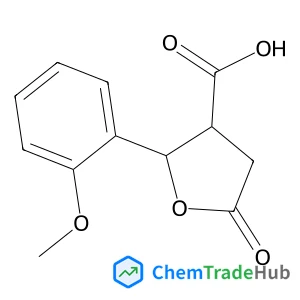
trans-2-(2-Methoxyphenyl)-5-oxotetrahydrofuran-3-carboxylic acid
CAS Number:
99226-02-5
Molecular Formula:
C12H12O5
Sung Man Park, Hong Lae Kim, Chan Ho Kwon
Crotonaldehyde is a simple α,β-unsaturated aldehyde that reacts stereochemically with nucleophilic reagents according to its conformational structure. Identifiable vibrational spectra of the cationic crotonaldehyde conformers were measured using one-photon vacuum ultraviolet mass-analysed threshold ionization (VUV-MATI) spectroscopy. From the 0–0 bands for the individual conformers confirmed by Franck–Condon (FC) simulations, the precise adiabatic ionization energies were determined to be 9.7501 ± 0.0004 eV (78 640 ± 3 cm−1), 9.7620 ± 0.0004 eV (78 736 ± 3 cm−1), 9.7122 ± 0.0004 eV (78 334 ± 3 cm−1), and 9.6480 ± 0.0004 eV (77 816 ± 3 cm−1) for the trans-s-trans (tt)-, trans-s-cis (tc)-, cis-s-trans (ct)-, and cis-s-cis (cc)-crotonaldehyde, respectively. The complete vibrational assignments were accomplished for the peaks observed in the VUV-MATI spectrum from the calculated vibrational frequencies and the FC factors according to the dipole selection rules for one-photon absorption. In addition, the composition at ambient temperature was determined to be 1.000 (93.0%): 0.037 (3.4%): 0.036 (3.4%): 0.002 (0.2%) for the tt-/tc-/ct-/cc-conformers from the relative intensities of the 0–0 bands in the MATI spectrum normalized with the calculated dipole transition probabilities as proven by the NMR data for the trans- and cis-stereoisomers. This study ascertained the existence of the s-cis conformers of crotonaldehyde for the first time.
Anthony M. S. Pembere, Chaonan Cui, Rajini Anumula, Haiming Wu, Pan An, Tongling Liang, Zhixun Luo
DOI: 10.1039/D0CP90052D
Ruihan Wang
DOI: 10.1039/C9CP04673A
Xiaojun Lv, Chaohong Guan, Zexun Han, Chang Chen, Qidong Sun
DOI: 10.1039/C9CP03673C
Mohsen Yarmohammadi, Kavoos Mirabbaszadeh
DOI: 10.1039/C9CP03655E
Xiaoran Zou, Zhonghua Sun, Hongmei Zhao, Chun-yang Zhang
DOI: 10.1039/C9CP04089G
Shijie Zhou, Lei Tong, Yinjie Liao, Juxia Yi, Yao Qi
DOI: 10.1039/C9CP02703C
Qiang Zhang, Jichong Hou, Jianfeng Fan, Shaoping Chen, Wenhao Fan, Hua Zhang, Wenxian Wang, Yucheng Wu, Bingshe Xu
DOI: 10.1039/D0CP00266F
Jun Zhong, Linan Huang, Weidong Sheng
DOI: 10.1039/C9CP06146K
Bilal Ahmad Shiekh, Damanjit Kaur, Sourav Kumar
DOI: 10.1039/C9CP03406D
6-(3-Fluorophenyl)picolinic acid is generally considered safe for laboratory use...
(3R)-3-Pyrrolidinol is used in the pharmaceutical industry as a precursor for dr...
When handling (4R,5R)-4,5-Diethoxycarbonyl-2,2-dimethyldioxolane (CAS: 59779-75-...
1-(6-Chloroimidazo[1,2-b]pyridazin-3-yl)ethanone is often synthesized via a mult...
The market for N-Ethyl-3,4-dimethylbenzylamine (CAS: 39180-83-1) remains steady,...
Tert-butyl 3-(pyrrolidin-1-yl)azetidine-1-carboxylate is a chemical compound wit...
1-Bromo-3-chloro-2,4-dimethoxybenzene (CAS: 1228956-93-1) falls under the classi...
The safety of 8-Bromo-2-methyl-3,4-dihydroisoquinolin-1(2H)-one (CAS: 1368622-07...
Benzyl [(3S)-2,6-dioxo-3-piperidinyl]carbamate is generally safe when handled wi...
1-{[4-(4,4,5,5-Tetramethyl-1,3,2-dioxaborolan-2-yl)phenyl]sulfonyl}pyrrolidine s...

Physical Chemistry Chemical Physics (PCCP) is an international journal co-owned by 19 physical chemistry and physics societies from around the world. This journal publishes original, cutting-edge research in physical chemistry, chemical physics and biophysical chemistry. To be suitable for publication in PCCP, articles must include significant innovation and/or insight into physical chemistry; this is the most important criterion that reviewers and Editors will judge against when evaluating submissions. The journal has a broad scope and welcomes contributions spanning experiment, theory, computation and data science. Topical coverage includes spectroscopy, dynamics, kinetics, statistical mechanics, thermodynamics, electrochemistry, catalysis, surface science, quantum mechanics, quantum computing and machine learning. Interdisciplinary research areas such as polymers and soft matter, materials, nanoscience, energy, surfaces/interfaces, and biophysical chemistry are welcomed if they demonstrate significant innovation and/or insight into physical chemistry. Joined experimental/theoretical studies are particularly appreciated when complementary and based on up-to-date approaches.