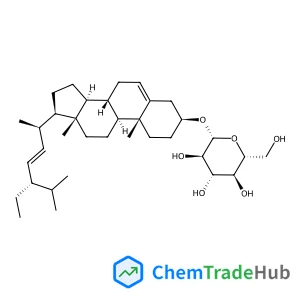
(3beta,22E)-Stigmasta-5,22-dien-3-yl beta-D-glucopyranoside
CAS Number:
19716-26-8
Molecular Formula:
C35H58O6
Anna Åkesson, Kristian Moss Bendtsen, Manja A. Beherens, Jan Skov Pedersen, Viveka Alfredsson, Marité Cárdenas Gómez
Dendrimers are polymers with unique properties that make them promising in a variety of applications such as potential drug and gene delivery systems. PAMAM dendrimers, in particular, have been widely investigated and are efficiently translocated into the cell. The mechanism of translocation, however, is still unknown. Recently it was proposed that PAMAM dendrimers are able to open holes in lipid bilayers by stealing lipid from the bilayer and forming “dendrisomes”. The present work intends to contribute in the clarification of this question: why are dendrimers able to translocate into the cell? We create simple models for cell membranes by using small lipidvesicles that present a single lipid phase at physiologically relevant conditions. We then follow the effect that dendrimers have on the structure of the vesicles by using a combination of various techniques: dynamic light scattering, cryo-TEM and small angle X-ray scattering. We discuss our results with respect to the previous findings and reflect on their possible implications for real translocation in living cells.
Jakub Goclon, Bernd Meyer
DOI: 10.1039/C3CP44546A
Florian Löw, Katrin Amann-Winkel, Thomas Loerting, Franz Fujara, Burkhard Geil
DOI: 10.1039/C3CP50818H
Maria Baias, Cory M. Widdifield, Jean-Nicolas Dumez, Hugh P. G. Thompson, Timothy G. Cooper, Elodie Salager, Sirena Bassil, Robin S. Stein, Anne Lesage, Graeme M. Day, Lyndon Emsley
DOI: 10.1039/C3CP41095A
Christophe Dehon, Satchin Soorkia, Mélanie Pedrazzani, Christophe Jouvet, Michel Barat, Jacqueline A. Fayeton, Bruno Lucas
DOI: 10.1039/C3CP50720C
Reshma Sultana, Naser Reza, Helena Woodvine, Jonathan G. Terry, Anthony J. Walton, Charlotte L. Brady, Ilka Schmueser, Andrew R. Mount
DOI: 10.1039/C3CP50759A
Kiichi Fukuhara, Masaaki Kitano, Shigenobu Hayashi, Michikazu Hara
DOI: 10.1039/C3CP43853H
Jonathan Keating, Gopinathan Sankar, Timothy I. Hyde, Shinji Kohara, Koji Ohara
DOI: 10.1039/C3CP50600B
S. Sasanka Kumar, Manoj Komath, Manoj Raama Varma, M. K. Jayaraj, K. Rajeev Kumar
DOI: 10.1039/C3CP42648C
U. Hoppe, L. Delevoye, L. Montagne, M. v. Zimmermann, A. C. Hannon
DOI: 10.1039/C2CP42772A
When handling 2-Chloro-1,2-bis(4-methylphenyl)ethanone (CAS: 71193-32-3), it is ...
4-Ethoxy-3-(5-methyl-4-oxo-7-propyl-1,4-dihydroimidazo[5,1-f][1,2,4]triazin-2-yl...
Methyl 3-Oxo-4-Androsten-17-Carboxylate (CAS: 2681-55-2) should be stored in a c...
(R)-3-Amino-4-(3-hexylphenylamino)-4-oxobutylphosphonic acid is primarily used i...
2-Methyl-2-propanyl 3-amino-3-carbamoyl-1-azetidinecarboxylate (CAS: 1254120-14-...
There are alternative reagents that can be used in synthesis instead of (E)-4-(t...
[2-(3-Chlorophenyl)-1,3-thiazol-4-yl]methanol (CAS: 121202-20-8) is a crystallin...
The market and research trends for Methyl (2S)-[(4S)-2,2-dimethyl-1,3-dioxolan-4...
The market for 1-Bromo-2-isocyanatoethane (CAS: 42865-19-0) is driven by its use...
4-Nitro-D-phenylalanine hydrochloride (CAS: 147065-06-3) is primarily used in re...

Physical Chemistry Chemical Physics (PCCP) is an international journal co-owned by 19 physical chemistry and physics societies from around the world. This journal publishes original, cutting-edge research in physical chemistry, chemical physics and biophysical chemistry. To be suitable for publication in PCCP, articles must include significant innovation and/or insight into physical chemistry; this is the most important criterion that reviewers and Editors will judge against when evaluating submissions. The journal has a broad scope and welcomes contributions spanning experiment, theory, computation and data science. Topical coverage includes spectroscopy, dynamics, kinetics, statistical mechanics, thermodynamics, electrochemistry, catalysis, surface science, quantum mechanics, quantum computing and machine learning. Interdisciplinary research areas such as polymers and soft matter, materials, nanoscience, energy, surfaces/interfaces, and biophysical chemistry are welcomed if they demonstrate significant innovation and/or insight into physical chemistry. Joined experimental/theoretical studies are particularly appreciated when complementary and based on up-to-date approaches.
![(1R)-3-Bromo-1,7,7-trimethylbicyclo[2.2.1]heptan-2-one structure](https://static.chemtradehub.com/structs/102/10293-06-8-dd8a.webp "(1R)-3-Bromo-1,7,7-trimethylbicyclo[2.2.1]heptan-2-one structure")