


Quantum chemical study of benzimidazole derivatives to tune the second-order nonlinear optical molecular switching by proton abstraction
Literature Information
Publication Date
2010-03-24
DOI
10.1039/B924241D
Impact Factor
3.676
Authors
Shabbir Muhammad, Hongliang Xu, Muhammad Ramzan Saeed Ashraf Janjua, Zhongmin Su
View Original
Abstract
A novel sequence for reversible second-order nonlinear optical (NLO) molecular switching with protonation/deprotonation has been achieved and tuned as well. The NLO switching with first hyperpolarizabilities (β0) as low as 14 × 10−30 esu (Off-phase) and as large as 1189 × 10−30 esu (On-phase) have been computed by using density functional theory (DFT). Remarkably large differences between the β0 values of benzimidazole containing chromophores and their deprotonated anions have shown their significant potential for a new type of NLO molecular switching, as (1-(4-methoxyphenyl)-2-(2-thienyl)pyrrolyl)-1,3-benzimidazole anion (1−) has a β0 value computed to be 61 × 10−30 esu, which is 4 times larger than its neutral molecule 1. This β0 value has been tuned up to 2028 × 10−30 esu by effective substitutions in the derivatives of 1− (1a−, 1b−, 1c−, and 1d−). Interestingly, the substituted compounds have illustrated robustly large off–on NLO switching with a difference in β0 values of 7, 63, 85 and 75 times larger than their neutral counterparts, respectively. TD-DFT calculations along with natural bond orbital (NBO), frontier molecular orbitals (FMOs) and molecular electrostatic potential (MEP) analyses show that the abstraction of an imido proton brings about a change in push–pull configurations resulting in a red shift for both absorption and emission spectra which subsequently leads to a high performance second-order NLO molecular switching. A similar trend of NLO switching in F− compounds of these chromophores has also been observed with significantly large β0 values having analogous electro-optical properties like deprotonated anions. Furthermore, gas-phase acidity (GPA) calculations for the neutral molecule 1 and its derivatives (1a, 1b, 1c, and 1d) have also revealed that these are rationally potent nitrogen acids and can easily be dissociated to produce stable deprotonated anions.
Recommended Journals

Organic Process Research & Development

Russian Chemical Bulletin

Current Opinion in Solid State & Materials Science

Acta Materialia

Russian Journal of Organic Chemistry

Current Opinion in Colloid & Interface Science

Russian Journal of General Chemistry

Russian Journal of Coordination Chemistry

Drug Discovery Today

Journal of Saudi Chemical Society
Related Literature
The one-electron reduction of dithiolate and diselenolate ligands
Eric A. C. Bushnell, Thomas D. Burns, Russell J. Boyd
2014-04-25
Paper
DOI: 10.1039/C4CP01105H
Interplay between the ionic and electronic transport and its effects on the reaction pattern during the electrochemical conversion in an FeF2 nanoparticle
Ying Ma, Stephen H. Garofalini
2014-05-09
Paper
DOI: 10.1039/C4CP00481G
Selective oxidation of alcohols in aqueous suspensions of rhodium ion-modified TiO2 photocatalysts under irradiation of visible light
Sho Kitano, Atsuhiro Tanaka, Keiji Hashimoto, Hiroshi Kominami
2014-05-08
Paper
DOI: 10.1039/C4CP00863D
The free energy of nanopores in tense membranes
Andrea Grafmüller, Volker Knecht
2014-04-15
Paper
DOI: 10.1039/C3CP54685C
Absolute electron total ionization cross-sections: molecular analogues of DNA and RNA nucleobase and sugar constituents
James N. Bull, Jason W. L. Lee, Claire Vallance
2014-04-03
Paper
DOI: 10.1039/C4CP00490F
Improving BiVO4 photoanodes for solar water splitting through surface passivation
Yongqi Liang, Johannes Messinger
2014-05-01
Paper
DOI: 10.1039/C4CP00674G
Structural relaxation of vapor-deposited molecular glasses and supercooled liquids
Kikujiro Ishii, Hideyuki Nakayama
2014-04-24
Perspective
DOI: 10.1039/C4CP00458B
An acetate bound cobalt oxide catalyst for water oxidation: role of monovalent anions and cations in lowering overpotential
Subal Dey, Biswajit Mondal, Abhishek Dey
2014-04-11
Paper
DOI: 10.1039/C4CP01205D
The effect of atomic ions on model σ-hole bonded complexes of AH3Y (A = C, Si, Ge; Y = F, Cl, Br)
Sean A. C. McDowell, Jerelle A. Joseph
2014-04-07
Paper
DOI: 10.1039/C4CP01074D
Concentration dependence of hydration water in a model peptide
Stefania Perticaroli, Marco Paolantoni, Paola Sassi, Silvia Corezzi, Assunta Morresi
2014-05-06
Paper
DOI: 10.1039/C4CP00840E
You might also like
Compound Q&A
What precautions should be taken when handling 2-Chloro-1,2-bis(4-methylphenyl)ethanone (CAS: 71193-32-3)?
When handling 2-Chloro-1,2-bis(4-methylphenyl)ethanone (CAS: 71193-32-3), it is ...
71193-32-32-Chloro-1,2-bis(4-m...
Compound Q&A
What industries use 4-Ethoxy-3-(5-methyl-4-oxo-7-propyl-1,4-dihydroimidazo[5,1-f][1,2,4]triazin-2-yl)benzenesulfonyl chloride (CAS: 224789-26-8)?
4-Ethoxy-3-(5-methyl-4-oxo-7-propyl-1,4-dihydroimidazo[5,1-f][1,2,4]triazin-2-yl...
224789-26-84-Ethoxy-3-(5-methyl...
Compound Q&A
How should Methyl 3-Oxo-4-Androsten-17-Carboxylate (CAS: 2681-55-2) be stored?
Methyl 3-Oxo-4-Androsten-17-Carboxylate (CAS: 2681-55-2) should be stored in a c...
2681-55-2Methyl 3-Oxo-4-Andro...
Compound Q&A
What are the main uses of (R)-3-Amino-4-(3-hexylphenylamino)-4-oxobutylphosphonic acid (CAS: 909725-61-7)?
(R)-3-Amino-4-(3-hexylphenylamino)-4-oxobutylphosphonic acid is primarily used i...
909725-61-7(R)-3-Amino-4-(3-hex...
Compound Q&A
What regulatory guidelines apply to 2-Methyl-2-propanyl 3-amino-3-carbamoyl-1-azetidinecarboxylate (CAS: 1254120-14-3)?
2-Methyl-2-propanyl 3-amino-3-carbamoyl-1-azetidinecarboxylate (CAS: 1254120-14-...
1254120-14-32-Methyl-2-propanyl ...
Compound Q&A
Are there alternatives to (E)-4-(tert-Butoxy)-4-oxobut-2-enoic acid (CAS: 135355-96-3) in synthesis?
There are alternative reagents that can be used in synthesis instead of (E)-4-(t...
135355-96-3(E)-4-(tert-Butoxy)-...
Compound Q&A
What are the physical and chemical properties of [2-(3-Chlorophenyl)-1,3-thiazol-4-yl]methanol (CAS: 121202-20-8)?
[2-(3-Chlorophenyl)-1,3-thiazol-4-yl]methanol (CAS: 121202-20-8) is a crystallin...
121202-20-8[2-(3-Chlorophenyl)-...
Compound Q&A
What is the market or research trend for Methyl (2S)-[(4S)-2,2-dimethyl-1,3-dioxolan-4-yl]{[(4-methylphenyl)sulfonyl]oxy}acetate (CAS: 166249-17-8)?
The market and research trends for Methyl (2S)-[(4S)-2,2-dimethyl-1,3-dioxolan-4...
166249-17-8Methyl (2S)-[(4S)-2,...
Compound Q&A
What is the market or research trend for 1-Bromo-2-isocyanatoethane (CAS: 42865-19-0)?
The market for 1-Bromo-2-isocyanatoethane (CAS: 42865-19-0) is driven by its use...
42865-19-01-Bromo-2-isocyanato...
Compound Q&A
What are the main uses of 4-Nitro-D-phenylalanine hydrochloride (CAS: 147065-06-3)?
4-Nitro-D-phenylalanine hydrochloride (CAS: 147065-06-3) is primarily used in re...
147065-06-34-Nitro-D-phenylalan...
Source Journal
Physical Chemistry Chemical Physics

CiteScore:
5.5
Self-citation Rate:
10.3%
Articles per Year:
3036
Physical Chemistry Chemical Physics (PCCP) is an international journal co-owned by 19 physical chemistry and physics societies from around the world. This journal publishes original, cutting-edge research in physical chemistry, chemical physics and biophysical chemistry. To be suitable for publication in PCCP, articles must include significant innovation and/or insight into physical chemistry; this is the most important criterion that reviewers and Editors will judge against when evaluating submissions. The journal has a broad scope and welcomes contributions spanning experiment, theory, computation and data science. Topical coverage includes spectroscopy, dynamics, kinetics, statistical mechanics, thermodynamics, electrochemistry, catalysis, surface science, quantum mechanics, quantum computing and machine learning. Interdisciplinary research areas such as polymers and soft matter, materials, nanoscience, energy, surfaces/interfaces, and biophysical chemistry are welcomed if they demonstrate significant innovation and/or insight into physical chemistry. Joined experimental/theoretical studies are particularly appreciated when complementary and based on up-to-date approaches.
Recommended Compounds
![2-Hydroxy-4-[({[(4-methylphenyl)sulfonyl]oxy}acetyl)amino]benzoic acid structure](https://static.chemtradehub.com/structs/501/501919-59-1-579f.webp "2-Hydroxy-4-[({[(4-methylphenyl)sulfonyl]oxy}acetyl)amino]benzoic acid structure")
2-Hydroxy-4-[({[(4-methylphenyl)sulfonyl]oxy}acetyl)amino]benzoic acid
CAS Number:
501919-59-1
Molecular Formula:
C16H15NO7S
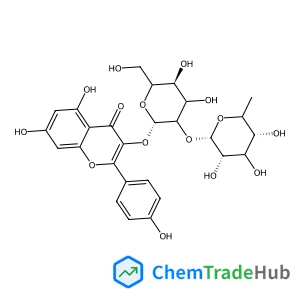
5,7-Dihydroxy-2-(4-hydroxyphenyl)-4-oxo-4H-chromen-3-yl 2-O-(6-deoxy-alpha-L-mannopyranosyl)-beta-D-glucopyranoside
CAS Number:
32602-81-6
Molecular Formula:
C27H30O15
Recommended Suppliers





Disclaimer
This page provides academic journal information for reference and research purposes only. We are not affiliated with any journal publishers and do not handle publication submissions. For publication-related inquiries, please contact the respective journal publishers directly.
If you notice any inaccuracies in the information displayed, please contact us at support@chemtradehub.com. We will promptly review and address your concerns.