












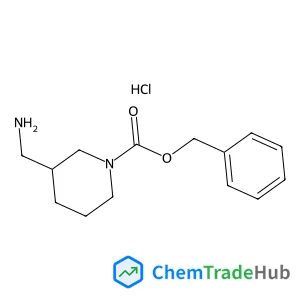
Benzyl 3-(aminomethyl)piperidine-1-carboxylate hydrochloride
CAS Number:
1186663-23-9
Molecular Formula:
C14H21ClN2O2
Pawel Rejmak, Mariusz Mitoraj, Ewa Broclawik
Ethene adsorption on isolated Cu(I) sites in two types of zeolites (faujasite and MFI) is investigated by means of the embedded cluster method. Structures, energetic stabilities and CC stretching vibrations in adsorption complexes are discussed. Furthermore, for interpretative purposes, the interaction energies are decomposed, using novel approaches based on so called natural orbitals for chemical valence. Ethene is always symmetrically bound to Cu(I) ion by both C atoms. In some cases two local minima of similar stability on the potential energy surface, differing by Cu(I) site relaxation can be found that may be simultaneously populated in equilibrium. Binding energies usually decrease with the degree of reconstruction of Cu(I) site after adsorption, however, in particular cases, a more distorted structure can be slightly more stable if favorable π* back donation overwhelms the distortion effects. Calculated values of binding energies for Cu(I)–Y zeolite (about 80 kJ mol−1) agree well with microcalorimetric data. We predict that ethene binding in MFI is over two times stronger (to the best of our knowledge no experimental data are available). The CC stretching frequency is not site specific, but depends only on the type of copper connectivity to oxygen nodes. The appearance of two CC bands in IR spectra of Cu(I)–faujasite can be explained as the effect of coexistence of two types of adsorption complexes, with Cu(I) coordinated to one or two framework tetrahedrons, respectively. In Cu(I)–MFI, only one type of adsorption complex with Cu(I) ion coordinated to a single tetrahedron exists, as only a single CC band is present in IR spectra.
K. L. Ngai, Javier Rodríguez-Viejo
DOI: 10.1039/C7CP06445D
Marcin Czapla, Jack Simons
DOI: 10.1039/C8CP04007A
D. ChangMo Yang, Jenica Marie L. Madridejos, Amir Hajibabaei, Chunggi Baig, Kwang S. Kim
DOI: 10.1039/C8CP00457A
D. Kaiser, E. Reusch, P. Hemberger, A. Bodi, E. Welz, B. Engels, I. Fischer
DOI: 10.1039/C7CP08055G
Xiao Hua Wang, Da Wei Wang, Ai Jun Yang, Nikhil Koratkar, Ji Feng Chu, Pin Lei Lv, Ming Zhe Rong
DOI: 10.1039/C7CP07906K
Christopher D. Daub, Natalie M. Cann, D. Bratko, Alenka Luzar
DOI: 10.1039/C8CP03791D
Mattis Fondell, Piter S. Miedema, Jesper Norell, Annette Pietzsch, Wilson Quevedo, Johannes Niskanen, Kristjan Kunnus
DOI: 10.1039/C8CP04341H
Xiaofei Shao, Xiaobiao Liu, Xiaoming Zhang, Junru Wang, Mingwen Zhao
DOI: 10.1039/C7CP08108A
Michael Schneider, Marie-Luise Hebestreit, Mirko Matthias Lindic, Hilda Parsian, América Yareth Torres-Boy, Leonardo Álvarez-Valtierra, W. Leo Meerts, Ralf Kühnemuth, Michael Schmitt
DOI: 10.1039/C8CP04020F
Paola Bolognesi, Alicja Domaracka, Patrick Rousseau, Mattea Carmen Castrovilli, Robert Richter, Subhojyoti Chatterjee, Feng Wang, Lorenzo Avaldi
DOI: 10.1039/C8CP03473G
6-(3-Fluorophenyl)picolinic acid is generally considered safe for laboratory use...
(3R)-3-Pyrrolidinol is used in the pharmaceutical industry as a precursor for dr...
When handling (4R,5R)-4,5-Diethoxycarbonyl-2,2-dimethyldioxolane (CAS: 59779-75-...
1-(6-Chloroimidazo[1,2-b]pyridazin-3-yl)ethanone is often synthesized via a mult...
The market for N-Ethyl-3,4-dimethylbenzylamine (CAS: 39180-83-1) remains steady,...
Tert-butyl 3-(pyrrolidin-1-yl)azetidine-1-carboxylate is a chemical compound wit...
1-Bromo-3-chloro-2,4-dimethoxybenzene (CAS: 1228956-93-1) falls under the classi...
The safety of 8-Bromo-2-methyl-3,4-dihydroisoquinolin-1(2H)-one (CAS: 1368622-07...
Benzyl [(3S)-2,6-dioxo-3-piperidinyl]carbamate is generally safe when handled wi...
1-{[4-(4,4,5,5-Tetramethyl-1,3,2-dioxaborolan-2-yl)phenyl]sulfonyl}pyrrolidine s...

Physical Chemistry Chemical Physics (PCCP) is an international journal co-owned by 19 physical chemistry and physics societies from around the world. This journal publishes original, cutting-edge research in physical chemistry, chemical physics and biophysical chemistry. To be suitable for publication in PCCP, articles must include significant innovation and/or insight into physical chemistry; this is the most important criterion that reviewers and Editors will judge against when evaluating submissions. The journal has a broad scope and welcomes contributions spanning experiment, theory, computation and data science. Topical coverage includes spectroscopy, dynamics, kinetics, statistical mechanics, thermodynamics, electrochemistry, catalysis, surface science, quantum mechanics, quantum computing and machine learning. Interdisciplinary research areas such as polymers and soft matter, materials, nanoscience, energy, surfaces/interfaces, and biophysical chemistry are welcomed if they demonstrate significant innovation and/or insight into physical chemistry. Joined experimental/theoretical studies are particularly appreciated when complementary and based on up-to-date approaches.
![2-Methyl-2-propanyl [(2S)-1-hydroxy-3-(4-hydroxyphenyl)-2-propanyl]carbamate structure](https://static.chemtradehub.com/structs/833/83345-46-4-eec2.webp "2-Methyl-2-propanyl [(2S)-1-hydroxy-3-(4-hydroxyphenyl)-2-propanyl]carbamate structure")
![4-[(2,4-Dihydroxyphenyl)diazenyl]-5-hydroxy-2,7-naphthalenedisulfonic acid structure](https://static.chemtradehub.com/structs/362/3627-01-8-79ac.webp "4-[(2,4-Dihydroxyphenyl)diazenyl]-5-hydroxy-2,7-naphthalenedisulfonic acid structure")




