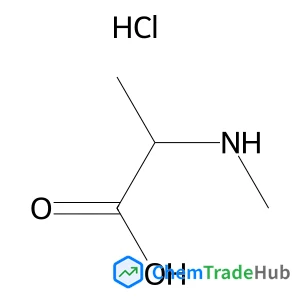
(R)-2-(Methylamino)propanoic acid hydrochloride
CAS Number:
1155878-14-0
Molecular Formula:
C4H10ClNO2
R. Dario Falcone, Juana J. Silber, N. Mariano Correa
Polar solvent–AOT interactions control non-aqueous/AOT/n-heptane reverse micelle polar core sizes.
Jun Li, Xiang Yuan Li, Chao Yuan Zhu
DOI: 10.1039/C0CP00120A
Sergio Tosoni, Joachim Sauer
DOI: 10.1039/C0CP01261K
Jia Jia, Kévin Giffard, Kyle Pellarin, Carly Hewson
DOI: 10.1039/C0CP00586J
DOI: 10.1039/B923053J
Yi-Lei Wang, Ya-Fan Zhao, Ai-Qin Wang, Tao Zhang, Jun Li
DOI: 10.1039/B921367H
G. D. Pirngruber, P. Raybaud, Y. Belmabkhout, Jiří Čejka, Arnošt Zukal
DOI: 10.1039/B927476F
Hongtao Liu, Yang Liu, Jinghong Li
DOI: 10.1039/B921469K
Moritz Winger
DOI: 10.1039/B922516C
Miroslav Gál, Magdaléna Hromadová, Jana Bulíčková, Viliam Kolivoška, Josef Cvačka, Kateřina Nováková, Ladislav Kavan, Markéta Zukalová, Lothar Dunsch
DOI: 10.1039/C0CP00986E
Jung Ho Kim, Jong-Sung Yu
DOI: 10.1039/C0CP00698J
6-(3-Fluorophenyl)picolinic acid is generally considered safe for laboratory use...
(3R)-3-Pyrrolidinol is used in the pharmaceutical industry as a precursor for dr...
When handling (4R,5R)-4,5-Diethoxycarbonyl-2,2-dimethyldioxolane (CAS: 59779-75-...
1-(6-Chloroimidazo[1,2-b]pyridazin-3-yl)ethanone is often synthesized via a mult...
The market for N-Ethyl-3,4-dimethylbenzylamine (CAS: 39180-83-1) remains steady,...
Tert-butyl 3-(pyrrolidin-1-yl)azetidine-1-carboxylate is a chemical compound wit...
1-Bromo-3-chloro-2,4-dimethoxybenzene (CAS: 1228956-93-1) falls under the classi...
The safety of 8-Bromo-2-methyl-3,4-dihydroisoquinolin-1(2H)-one (CAS: 1368622-07...
Benzyl [(3S)-2,6-dioxo-3-piperidinyl]carbamate is generally safe when handled wi...
1-{[4-(4,4,5,5-Tetramethyl-1,3,2-dioxaborolan-2-yl)phenyl]sulfonyl}pyrrolidine s...

Physical Chemistry Chemical Physics (PCCP) is an international journal co-owned by 19 physical chemistry and physics societies from around the world. This journal publishes original, cutting-edge research in physical chemistry, chemical physics and biophysical chemistry. To be suitable for publication in PCCP, articles must include significant innovation and/or insight into physical chemistry; this is the most important criterion that reviewers and Editors will judge against when evaluating submissions. The journal has a broad scope and welcomes contributions spanning experiment, theory, computation and data science. Topical coverage includes spectroscopy, dynamics, kinetics, statistical mechanics, thermodynamics, electrochemistry, catalysis, surface science, quantum mechanics, quantum computing and machine learning. Interdisciplinary research areas such as polymers and soft matter, materials, nanoscience, energy, surfaces/interfaces, and biophysical chemistry are welcomed if they demonstrate significant innovation and/or insight into physical chemistry. Joined experimental/theoretical studies are particularly appreciated when complementary and based on up-to-date approaches.