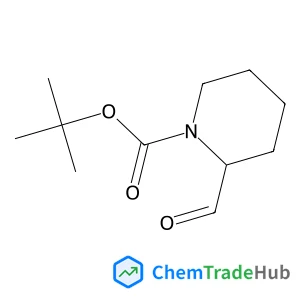
2-Methyl-2-propanyl (2R)-2-formyl-1-piperidinecarboxylate
CAS Number:
134526-69-5
Molecular Formula:
C11H19NO3
Lijuan Wang, Rico Tabor, Julian Eastoe, Xuefeng Li, Richard K. Heenan, Jinfeng Dong
A simple, low-energy two-step dilution process has been applied with binary mixtures of ionic–nonionic surfactants to prepare nanoemulsions. The systems consist of water/DDAB-C12E5/decane. Nanoemulsions were obtained by dilution of concentrates located in bicontinuous microemulsion or lamellar liquid crystal phase regions. The nanoemulsions generated were investigated both by contrast-variation small-angle neutron scattering (SANS) and dynamic light scattering (DLS). The SANS profiles show that C12E5 nanodroplets suffer essentially no structural change on incorporation of the cationic DDAB surfactant, except for increased electrostatic repulsive interactions. Interestingly, SANS indicated that the preferred droplet sizes were hardly affected by the surfactant mixture composition (up to a DDAB molar ratio (mDDAB/(mDDAB + mC12E5) of 0.40) and droplet volume fraction, ϕ, between 0.006 and 0.120. No notable changes in the structure or radius of nanoemulsion droplets were observed by SANS over the test period of 1 d, although the droplet number intensity decreased significantly in systems stabilized by C12E5 only. However, the DLS sizing shows a marked increase with time, with higher droplet volume fractions giving rise to the largest changes. The discrepancy between apparent nanoemulsion droplet size determined by DLS and SANS data can be attributed to long-range droplet interactions occurring outside of the SANS sensitivity range. The combined SANS and DLS results suggest flocculation is the main mechanism of instability for these nanoemulsions. The flocculation rate is shown to be significantly retarded by addition of the charged DDAB, which may be due to enhanced electrostatic repulsive forces between droplets, leading to improved stability of the nanoemulsions.
Moritz Winger
DOI: 10.1039/B922516C
Tatiana Korona
DOI: 10.1039/C0CP00474J
Zhiping Wang, Liang Zhang, Robert I. Cukier, Yuxiang Bu
DOI: 10.1039/B921104G
Jung Ho Kim, Jong-Sung Yu
DOI: 10.1039/C0CP00698J
Mercedes Boronat, Patricia Concepción, Avelino Corma, María Teresa Navarro, Michael Renz, Susana Valencia
DOI: 10.1039/B821297J
Dage Sundholm, Stefan Taubert, Fabio Pichierri
DOI: 10.1039/B922175A
J. Brendt, D. Samuelis, T. E. Weirich, M. Martin
DOI: 10.1039/B901819K
Jin Yang, Xudong Chen, Ruowen Fu, Wei-ang Luo, Yunbo Li, Mingqiu Zhang
DOI: 10.1039/B918069A
Shiping Huang, Vincent Finsy, Jeroen Persoons, Mark T.F. Telling, Gino V. Baron, Joeri F.M. Denayer
DOI: 10.1039/B819334G
6-(3-Fluorophenyl)picolinic acid is generally considered safe for laboratory use...
(3R)-3-Pyrrolidinol is used in the pharmaceutical industry as a precursor for dr...
When handling (4R,5R)-4,5-Diethoxycarbonyl-2,2-dimethyldioxolane (CAS: 59779-75-...
1-(6-Chloroimidazo[1,2-b]pyridazin-3-yl)ethanone is often synthesized via a mult...
The market for N-Ethyl-3,4-dimethylbenzylamine (CAS: 39180-83-1) remains steady,...
Tert-butyl 3-(pyrrolidin-1-yl)azetidine-1-carboxylate is a chemical compound wit...
1-Bromo-3-chloro-2,4-dimethoxybenzene (CAS: 1228956-93-1) falls under the classi...
The safety of 8-Bromo-2-methyl-3,4-dihydroisoquinolin-1(2H)-one (CAS: 1368622-07...
Benzyl [(3S)-2,6-dioxo-3-piperidinyl]carbamate is generally safe when handled wi...
1-{[4-(4,4,5,5-Tetramethyl-1,3,2-dioxaborolan-2-yl)phenyl]sulfonyl}pyrrolidine s...

Physical Chemistry Chemical Physics (PCCP) is an international journal co-owned by 19 physical chemistry and physics societies from around the world. This journal publishes original, cutting-edge research in physical chemistry, chemical physics and biophysical chemistry. To be suitable for publication in PCCP, articles must include significant innovation and/or insight into physical chemistry; this is the most important criterion that reviewers and Editors will judge against when evaluating submissions. The journal has a broad scope and welcomes contributions spanning experiment, theory, computation and data science. Topical coverage includes spectroscopy, dynamics, kinetics, statistical mechanics, thermodynamics, electrochemistry, catalysis, surface science, quantum mechanics, quantum computing and machine learning. Interdisciplinary research areas such as polymers and soft matter, materials, nanoscience, energy, surfaces/interfaces, and biophysical chemistry are welcomed if they demonstrate significant innovation and/or insight into physical chemistry. Joined experimental/theoretical studies are particularly appreciated when complementary and based on up-to-date approaches.
![[4-Chloro-3-(diethylcarbamoyl)phenyl]boronic acid structure](https://static.chemtradehub.com/structs/871/871332-68-2-0e3b.webp "[4-Chloro-3-(diethylcarbamoyl)phenyl]boronic acid structure")
![(2E)-4-[(1R,2S,8R,19S,21R)-14-Hydroxy-11-isopropenyl-8,23,23-trimethyl-5-(3-methyl-2-buten-1-yl)-16,20-dioxo-3,7,22-trioxaheptacyclo[17.4.1.1~8,12~.0~2,17~.0~2,21~.0~4,15~.0~6,13~]pentacosa-4(15),5,13
,17-tetraen-21-yl]-2-methyl-2-butenoic acid structure](https://static.chemtradehub.com/structs/173/173867-04-4-d2d3.webp "(2E)-4-[(1R,2S,8R,19S,21R)-14-Hydroxy-11-isopropenyl-8,23,23-trimethyl-5-(3-methyl-2-buten-1-yl)-16,20-dioxo-3,7,22-trioxaheptacyclo[17.4.1.1~8,12~.0~2,17~.0~2,21~.0~4,15~.0~6,13~]pentacosa-4(15),5,13
,17-tetraen-21-yl]-2-methyl-2-butenoic acid structure")
![Benzyl spiro[indole-3,4'-piperidine]-1(2H)-carboxylate hydrochloride (1:1) structure](https://static.chemtradehub.com/structs/159/159635-46-8-8de0.webp "Benzyl spiro[indole-3,4'-piperidine]-1(2H)-carboxylate hydrochloride (1:1) structure")