













Metal-free hydrogenactivation and hydrogenation of imines by 1,8-bis(dipentafluorophenylboryl)naphthalene
Literature Information
Publication Date
2009-08-17
DOI
10.1039/B909620E
Impact Factor
6.222
Authors
Chunfang Jiang, Olivier Blacque, Heinz Berke
View Original
Abstract
In the presence of 2,2,6,6-tetramethylpiperidine (TMP) 1,8-bis(dipentafluorophenylboryl)naphthalene has been found to activate H2 and to hydrogenate various imines under mild conditions.
Related Literature
Block copolymers containing organic semiconductor segments by RAFT polymerization‡
Ming Chen, Matthias Häussler, Graeme Moad, Ezio Rizzardo
2011-06-10
Paper
DOI: 10.1039/C1OB05276D
Multiple convergence in polyketide biosynthesis: a third folding mode to the anthraquinonechrysophanol‡
Gerhard Bringmann, Tobias A. M. Gulder, Andreas Hamm, Michael Goodfellow, Hans-Peter Fiedler
2009-10-05
Communication
DOI: 10.1039/B910501H
Intrinsic acidity and electrophilicity of gaseous propargyl/allenyl carbocations
Priscila M. Lalli, Yuri E. Corilo, Patrícia V. Abdelnur, Marcos N. Eberlin
2010-03-29
Paper
DOI: 10.1039/C001985B
The influence of a 1,1-diarylvinyl moiety on the photochromism of naphthopyrans
Christopher D. Gabbutt, B. Mark Heron, Colin Kilner, Suresh B. Kolla
2010-08-16
Paper
DOI: 10.1039/C0OB00141D
Tin(ii) chloride assisted synthesis of N-protected γ-amino β-keto esters through semipinacol rearrangement
Anupam Bandyopadhyay, Neha Agrawal, Sachitanand M. Mali, Sandip V. Jadhav, Hosahudya N. Gopi
2010-08-24
Paper
DOI: 10.1039/C0OB00199F
Solution-processable semiconducting thin-film transistors using single-walled carbon nanotubes chemically modified by organic radical initiators
Chun Wei Lee, Xuanding Han, Fuming Chen, Yanping Xu, Yizhong Huang, Mary B. Chan-Park, Peng Chen, Lain-Jong Li
2009-10-27
Communication
DOI: 10.1039/B915508B
Understanding the mechanism of stereoselective synthesis of cyclopentenes viaN-heterocyclic carbene catalyzed reactions of enals with enones
Luis R. Domingo, Ramón J. Zaragozá, Manuel Arnó
2010-08-26
Paper
DOI: 10.1039/C0OB00088D
Synthesis of homogeneous antifreeze glycopeptidesvia a ligation–desulfurisation strategy
James Garner, Katrina A. Jolliffe, Margaret M. Harding, Richard J. Payne
2009-10-21
Communication
DOI: 10.1039/B918021D
Asymmetric synthesis of a tricyclic benzofuran motif: a privileged core structure in biologically active molecules
Henrik Sundén
2010-09-08
Communication
DOI: 10.1039/C0OB00331J
Pyrophosphate selective fluorescent chemosensors based on coumarin–DPA–Cu(ii) complexes
Min Jung Kim, Kyung Mi Lee, Arun R. Jagdale, Youngmee Kim, Sung-Jin Kim, Kyung Ho Yoo
2009-10-22
Communication
DOI: 10.1039/B913809A
You might also like
Compound Q&A
What industries use (1R,3S)-1,3-Cyclopentanediol (CAS: 16326-97-9)?
(1R,3S)-1,3-Cyclopentanediol finds applications in various industries. In the ph...
16326-97-9(1R,3S)-1,3-Cyclopen...
Compound Q&A
What precautions should be taken when handling N'-[4-(Dimethylamino)phenyl]-N,N-dimethyl-1,4-benzenediamine (CAS: 637-31-0)?
When handling N'-[4-(Dimethylamino)phenyl]-N,N-dimethyl-1,4-benzenediamine, it i...
637-31-0N'-[4-(Dimethylamino...
Compound Q&A
Are there alternatives to 5-(2,4-Difluorophenyl)-2-methoxypyrimidine (CAS: 1352318-16-1) in synthesis?
There are several alternatives to 5-(2,4-Difluorophenyl)-2-methoxypyrimidine in ...
1352318-16-15-(2,4-Difluoropheny...
Compound Q&A
What regulatory guidelines apply to 1-(3-Methoxyphenoxy)propan-2-ol (CAS: 382141-68-6)?
1-(3-Methoxyphenoxy)propan-2-ol (CAS: 382141-68-6) must comply with the Globally...
382141-68-61-(3-Methoxyphenoxy)...
Compound Q&A
Is Tetrodotoxin Citrate (CAS: 18660-81-6) safe?
Tetrodotoxin Citrate is extremely dangerous and should be handled with extreme c...
18660-81-6Tetrodotoxin Citrate
Compound Q&A
What are the main uses of 2-Methyl-2-propanyl [(1R,3S)-3-hydroxycyclopentyl]carbamate (CAS: 225641-84-9)?
2-Methyl-2-propanyl [(1R,3S)-3-hydroxycyclopentyl]carbamate (CAS: 225641-84-9) i...
225641-84-92-Methyl-2-propanyl ...
Compound Q&A
How should waste containing 4-(2-Hydroxyhexafluoroisopropyl)Benzoic Acid (CAS: 16261-80-6) be handled?
Waste containing 4-(2-Hydroxyhexafluoroisopropyl)Benzoic Acid (CAS: 16261-80-6) ...
16261-80-64-(2-Hydroxyhexafluo...
Compound Q&A
How is 2-Methyl-2-proanyl {(2S)-1-[(benzyloxy)amino]-3-hydroxy-3-methyl-1-oxo-2-butanyl}carbamate (CAS: 102507-19-7) typically synthesized?
2-Methyl-2-proanyl {(2S)-1-[(benzyloxy)amino]-3-hydroxy-3-methyl-1-oxo-2-butanyl...
102507-19-72-Methyl-2-propanyl ...
Compound Q&A
What is Benzeneethanamine, α-ethyl-, hydrochloride (1:1) (CAS: 20735-15-3)?
Benzeneethanamine, α-ethyl-, hydrochloride (1:1) is an organic compound with the...
20735-15-3Benzeneethanamine, α...
Compound Q&A
Are there alternatives to 3-{(E)-[4-(Dimethylamino)phenyl]diazenyl}benzoic acid (CAS: 20691-84-3) in synthesis?
In the synthesis of compounds similar to 3-{(E)-[4-(Dimethylamino)phenyl]diazeny...
20691-84-33-{(E)-[4-(Dimethyla...
Source Journal
Chemical Communications

CiteScore:
8.6
Self-citation Rate:
4.7%
Articles per Year:
2458
ChemComm publishes urgent research which is of outstanding significance and interest to experts in the field, while also appealing to the journal’s broad chemistry readership. Our communication format is ideally suited to short, urgent studies that are of such importance that they require accelerated publication. Our scope covers all topics in chemistry, and research at the interface of chemistry and other disciplines (such as materials science, nanoscience, physics, engineering and biology) where there is a significant novelty in the chemistry aspects. Major topic areas covered include: Analytical Chemistry Catalysis Chemical Biology and medicinal chemistry Computational Chemistry and Machine Learning Energy and sustainable chemistry Environmental Chemistry Green Chemistry Inorganic Chemistry Materials Chemistry Nanoscience Organic Chemistry Physical Chemistry Polymer Chemistry Supramolecular Chemistry
Recommended Compounds
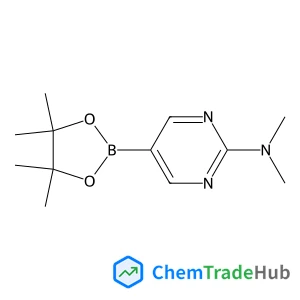
N,N-Dimethyl-5-(4,4,5,5-tetramethyl-1,3,2-dioxaborolan-2-yl)-2-pyrimidinamine
CAS Number:
1032759-30-0
Molecular Formula:
C12H20BN3O2
Recommended Suppliers






Disclaimer
This page provides academic journal information for reference and research purposes only. We are not affiliated with any journal publishers and do not handle publication submissions. For publication-related inquiries, please contact the respective journal publishers directly.
If you notice any inaccuracies in the information displayed, please contact us at support@chemtradehub.com. We will promptly review and address your concerns.