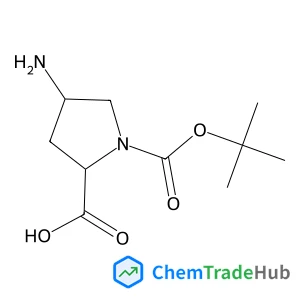
(2R,4R)-1-Boc-4-Aminopyrrolidine-2-carboxylic acid
CAS Number:
132622-98-1
Molecular Formula:
C10H18N2O4
Chun Wei Lee, Xuanding Han, Fuming Chen, Yanping Xu, Yizhong Huang, Mary B. Chan-Park, Peng Chen, Lain-Jong Li
The reactivity of organic radicals produced by 1,1′-azobis(cyanocyclohexane) (ACN) is tuned to selectively suppress electrical conduction of small diameter single-walled carbon nanotubes, and the modified tubes are able to produce high-mobility (∼10 cm2 V−1 s−1) and solution-processable thin-film transistors with full semiconductor device yield, promising applications in high-performance printable electronics.
Hassan A. Alabdrabalameer, Juho Kauppinen, Toni Pikkarainen
DOI: 10.1039/D0SE00155D
Fernanda dos Santos Depoi, Tiago Charão de Oliveira, Diogo Pompéu de Moraes, Dirce Pozebon
DOI: 10.1039/C1AY05246B
Hao Liu, Huaizhi Gao, Jun Lin, Tasawar Hayat, Ahmed Alsaedi, Zhan'ao Tan
DOI: 10.1039/D0SE00206B
Ping Zhou, Bo Liu, Mingming Luan, Na Li, Bo Tang
DOI: 10.1039/D1BM00619C
(1R,3S)-1,3-Cyclopentanediol finds applications in various industries. In the ph...
When handling N'-[4-(Dimethylamino)phenyl]-N,N-dimethyl-1,4-benzenediamine, it i...
There are several alternatives to 5-(2,4-Difluorophenyl)-2-methoxypyrimidine in ...
1-(3-Methoxyphenoxy)propan-2-ol (CAS: 382141-68-6) must comply with the Globally...
Tetrodotoxin Citrate is extremely dangerous and should be handled with extreme c...
2-Methyl-2-propanyl [(1R,3S)-3-hydroxycyclopentyl]carbamate (CAS: 225641-84-9) i...
Waste containing 4-(2-Hydroxyhexafluoroisopropyl)Benzoic Acid (CAS: 16261-80-6) ...
2-Methyl-2-proanyl {(2S)-1-[(benzyloxy)amino]-3-hydroxy-3-methyl-1-oxo-2-butanyl...
Benzeneethanamine, α-ethyl-, hydrochloride (1:1) is an organic compound with the...
In the synthesis of compounds similar to 3-{(E)-[4-(Dimethylamino)phenyl]diazeny...

ChemComm publishes urgent research which is of outstanding significance and interest to experts in the field, while also appealing to the journal’s broad chemistry readership. Our communication format is ideally suited to short, urgent studies that are of such importance that they require accelerated publication. Our scope covers all topics in chemistry, and research at the interface of chemistry and other disciplines (such as materials science, nanoscience, physics, engineering and biology) where there is a significant novelty in the chemistry aspects. Major topic areas covered include: Analytical Chemistry Catalysis Chemical Biology and medicinal chemistry Computational Chemistry and Machine Learning Energy and sustainable chemistry Environmental Chemistry Green Chemistry Inorganic Chemistry Materials Chemistry Nanoscience Organic Chemistry Physical Chemistry Polymer Chemistry Supramolecular Chemistry