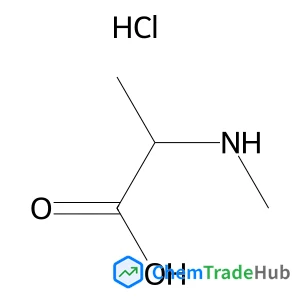
(R)-2-(Methylamino)propanoic acid hydrochloride
CAS Number:
1155878-14-0
Molecular Formula:
C4H10ClNO2
Rüdiger-A. Eichel, Ebru Erünal, Michael D. Drahus, Donald M. Smyth, Johan van Tol, Jérôme Acker, Hans Kungl, Michael J. Hoffmann
Cu2+-doped Pb[Zr0.54Ti0.46]O3 (PZT) and Cu2+-doped [K0.5Na0.5]NbO3 (KNN) ferroelectrics with a dopant concentration of 0.25 mol% were investigated by means of multi-frequency and multi-pulse electron paramagnetic resonance (EPR) spectroscopy. Through the use of high magnetic fields and pulsed microwave fields an enhanced resolution was achieved yielding valuable information about the structural distortion at the dopant site. The results obtained suggest that Cu2+ substitutes for both systems as an acceptor centre for the perovskite B-site. For reasons of local charge compensation, different kinds of defect associates invoking one and two oxygen vacancies are formed. These two kinds of extended defects differ in their electric and elastic properties. The results obtained are analyzed in order to characterize differences of the local structure in the Cu2+-defect center for morphotropic phase boundary compositions between the two systems. In particular, it is found that Cu2+-doping in KNN creates 50% more oxygen vacancies than the same amount of copper in PZT. Furthermore, local differences in covalent and ionic bonding are monitored.

Angewandte Chemie International Edition

Photochemical & Photobiological Sciences

European Journal of Organic Chemistry

Journal of Enzyme inhibition and Medicinal Chemistry

Foundations of Chemistry

Advanced Engineering Materials

Journal of Medical Biochemistry

Mini-Reviews in Medicinal Chemistry

Molecular Diversity

Environmental Toxicology and Pharmacology
Jonathan Clayden, Ulrich Hennecke, Mark A. Vincent, Ian H. Hillier, Madeleine Helliwell
DOI: 10.1039/C0CP00571A
Gregory Favaro, Anna Radko, Abraham Jacob Domb, Daniel Mandler
DOI: 10.1039/C0CP00601G
Jing Hua Liu, Min Ku Jeon, Ki Rak Lee, Seong Ihl Woo
DOI: 10.1039/C0CP00370K
David M. Laughman, Radha D. Banhatti, Klaus Funke
DOI: 10.1039/C0CP00765J
G. D. Pirngruber, P. Raybaud, Y. Belmabkhout, Jiří Čejka, Arnošt Zukal
DOI: 10.1039/B927476F
Ibrahim Abou Hamad, D. O. Wipf, P. A. Rikvold
DOI: 10.1039/B920970K
Céline Merlet, Paul A. Madden, Mathieu Salanne
DOI: 10.1039/C0CP01412E
Masaoki Iwasaki, Hirofumi Shinjoh
DOI: 10.1039/B923938C
Gábor Peintler, György Csekő, Andrea Petz, Attila K. Horváth
DOI: 10.1039/B920618C
Angus Gray-Weale, James K. Beattie
DOI: 10.1039/C0CP00688B
6-(3-Fluorophenyl)picolinic acid is generally considered safe for laboratory use...
(3R)-3-Pyrrolidinol is used in the pharmaceutical industry as a precursor for dr...
When handling (4R,5R)-4,5-Diethoxycarbonyl-2,2-dimethyldioxolane (CAS: 59779-75-...
1-(6-Chloroimidazo[1,2-b]pyridazin-3-yl)ethanone is often synthesized via a mult...
The market for N-Ethyl-3,4-dimethylbenzylamine (CAS: 39180-83-1) remains steady,...
Tert-butyl 3-(pyrrolidin-1-yl)azetidine-1-carboxylate is a chemical compound wit...
1-Bromo-3-chloro-2,4-dimethoxybenzene (CAS: 1228956-93-1) falls under the classi...
The safety of 8-Bromo-2-methyl-3,4-dihydroisoquinolin-1(2H)-one (CAS: 1368622-07...
Benzyl [(3S)-2,6-dioxo-3-piperidinyl]carbamate is generally safe when handled wi...
1-{[4-(4,4,5,5-Tetramethyl-1,3,2-dioxaborolan-2-yl)phenyl]sulfonyl}pyrrolidine s...

Physical Chemistry Chemical Physics (PCCP) is an international journal co-owned by 19 physical chemistry and physics societies from around the world. This journal publishes original, cutting-edge research in physical chemistry, chemical physics and biophysical chemistry. To be suitable for publication in PCCP, articles must include significant innovation and/or insight into physical chemistry; this is the most important criterion that reviewers and Editors will judge against when evaluating submissions. The journal has a broad scope and welcomes contributions spanning experiment, theory, computation and data science. Topical coverage includes spectroscopy, dynamics, kinetics, statistical mechanics, thermodynamics, electrochemistry, catalysis, surface science, quantum mechanics, quantum computing and machine learning. Interdisciplinary research areas such as polymers and soft matter, materials, nanoscience, energy, surfaces/interfaces, and biophysical chemistry are welcomed if they demonstrate significant innovation and/or insight into physical chemistry. Joined experimental/theoretical studies are particularly appreciated when complementary and based on up-to-date approaches.
![[4-Chloro-3-(diethylcarbamoyl)phenyl]boronic acid structure](https://static.chemtradehub.com/structs/871/871332-68-2-0e3b.webp "[4-Chloro-3-(diethylcarbamoyl)phenyl]boronic acid structure")