












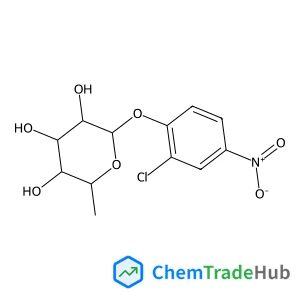
2-Chloro-4-nitrophenyl 6-deoxy-alpha-L-galactopyranoside
CAS Number:
157843-41-9
Molecular Formula:
C12H14ClNO7
Rachael E. H. Miles, Marc Guillon, Laura Mitchem, David McGloin, Jonathan P. Reid
The time-dependent evolution in the equilibrium size of an optically trapped aqueous sodium chloride droplet (>2 μm radius) within an environment of varying relative humidity (RH) is shown to depend on both the depression in vapour pressure due to the presence of the solute and the elevation in temperature due to optical absorption. In particular, the level of optical absorption is highly dependent on the size of the droplet relative to the wavelength of the absorbed light. Thus, as the droplet size tunes into a Mie resonance at the trapping laser wavelength, the increased level of optical absorption leads to an elevation in droplet temperature. This increase in resonant heating can balance a continual increase in RH, leading to only marginal growth in droplet size and change in solute concentration. Once the RH is sufficiently high that the resonance condition can be surpassed, the droplet cools instantaneously and the solute concentration again dominates in determining the vapour pressure, with a rapid increase in size and a decrease in solute concentration returning the droplet to equilibrium with the gas phase RH. Thus, a growing droplet is observed to pass through periods of apparent size stability followed by instantaneous growth, consistent with the variation in absorption efficiency with droplet size. This provides a clear example of the coupling between the optical and physical properties of an aerosol and their influence on the equilibrium state.
Oliver L. G. Alderman, Dinu Iuga, Andrew P. Howes, Diane Holland, Ray Dupree
DOI: 10.1039/C3CP50772F
Johannes Auerswald, Bernd Engels, Ingo Fischer, Thiemo Gerbich, Jörg Herterich, Anke Krueger, Melanie Lang, Hans-Christian Schmitt, Christof Schon, Christof Walter
DOI: 10.1039/C3CP44271C
Damien Thompson, Mateusz Sikora, Piotr Szymczak, Marek Cieplak
DOI: 10.1039/C3CP50523E
Oliver L. G. Alderman, Alex C. Hannon, Diane Holland, Steve Feller, Gloria Lehr, Adam J. Vitale, Uwe Hoppe, Martin v. Zimmerman, Anke Watenphul
DOI: 10.1039/C3CP51348C
Uttam Anand, Saptarshi Mukherjee
DOI: 10.1039/C3CP50207D
Maria Baias, Cory M. Widdifield, Jean-Nicolas Dumez, Hugh P. G. Thompson, Timothy G. Cooper, Elodie Salager, Sirena Bassil, Robin S. Stein, Anne Lesage, Graeme M. Day, Lyndon Emsley
DOI: 10.1039/C3CP41095A
V. Petkov, Y. Ren, S. Kabekkodu, D. Murphy
DOI: 10.1039/C2CP43378H
Jakub Goclon, Bernd Meyer
DOI: 10.1039/C3CP44546A
Christophe Dehon, Satchin Soorkia, Mélanie Pedrazzani, Christophe Jouvet, Michel Barat, Jacqueline A. Fayeton, Bruno Lucas
DOI: 10.1039/C3CP50720C
Vankayala Kiran, Kancharlapalli Srinivasu, Srinivasan Sampath
DOI: 10.1039/C3CP50731A
When handling 2-Chloro-1,2-bis(4-methylphenyl)ethanone (CAS: 71193-32-3), it is ...
4-Ethoxy-3-(5-methyl-4-oxo-7-propyl-1,4-dihydroimidazo[5,1-f][1,2,4]triazin-2-yl...
Methyl 3-Oxo-4-Androsten-17-Carboxylate (CAS: 2681-55-2) should be stored in a c...
(R)-3-Amino-4-(3-hexylphenylamino)-4-oxobutylphosphonic acid is primarily used i...
2-Methyl-2-propanyl 3-amino-3-carbamoyl-1-azetidinecarboxylate (CAS: 1254120-14-...
There are alternative reagents that can be used in synthesis instead of (E)-4-(t...
[2-(3-Chlorophenyl)-1,3-thiazol-4-yl]methanol (CAS: 121202-20-8) is a crystallin...
The market and research trends for Methyl (2S)-[(4S)-2,2-dimethyl-1,3-dioxolan-4...
The market for 1-Bromo-2-isocyanatoethane (CAS: 42865-19-0) is driven by its use...
4-Nitro-D-phenylalanine hydrochloride (CAS: 147065-06-3) is primarily used in re...

Physical Chemistry Chemical Physics (PCCP) is an international journal co-owned by 19 physical chemistry and physics societies from around the world. This journal publishes original, cutting-edge research in physical chemistry, chemical physics and biophysical chemistry. To be suitable for publication in PCCP, articles must include significant innovation and/or insight into physical chemistry; this is the most important criterion that reviewers and Editors will judge against when evaluating submissions. The journal has a broad scope and welcomes contributions spanning experiment, theory, computation and data science. Topical coverage includes spectroscopy, dynamics, kinetics, statistical mechanics, thermodynamics, electrochemistry, catalysis, surface science, quantum mechanics, quantum computing and machine learning. Interdisciplinary research areas such as polymers and soft matter, materials, nanoscience, energy, surfaces/interfaces, and biophysical chemistry are welcomed if they demonstrate significant innovation and/or insight into physical chemistry. Joined experimental/theoretical studies are particularly appreciated when complementary and based on up-to-date approaches.
![2-Hydroxy-4-[({[(4-methylphenyl)sulfonyl]oxy}acetyl)amino]benzoic acid structure](https://static.chemtradehub.com/structs/501/501919-59-1-579f.webp "2-Hydroxy-4-[({[(4-methylphenyl)sulfonyl]oxy}acetyl)amino]benzoic acid structure")






