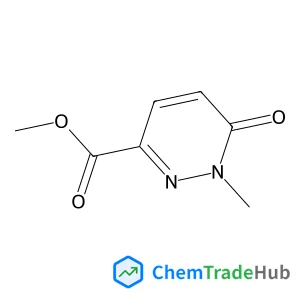
Methyl 1-methyl-6-oxo-1,6-dihydro-3-pyridazinecarboxylate
CAS Number:
74173-58-3
Molecular Formula:
C7H8N2O3
The first page of this article is displayed as the abstract.
Masoud Aryanpour, Nassim Rafiefard, Seyed Hossein Hosseini-Shokouh, Somayeh Fardindoost
DOI: 10.1039/C8CP05026K
L. D. Earl, C. Do, Y. Wang, C. W. Abney
DOI: 10.1039/C8CP02198H
C. Ennis, D. R. T. Appadoo, E. G. Robertson
DOI: 10.1039/C8CP04219E
L. Del Bianco, F. Spizzo, Tian Li, R. Adhikari, A. Bonanni
DOI: 10.1039/C8CP04475A
Po-Yu Yang, Hsing-Yin Chen, Chia-Lin Chang, Gao-Shee Leu, Che-Hsin Lin
DOI: 10.1039/C8CP02777C
Rachel Pflieger, Manuel Lejeune, Cédric Noel, Thierry Belmonte, Sergey I. Nikitenko, Micheline Draye
DOI: 10.1039/C8CP06967K
Jiaqing Huang, Yijie Mo, Yao Yao
DOI: 10.1039/C8CP06467A
Seth Olsen
DOI: 10.1039/C8CP04160A
Shovan Dan, S. Mukherjee, Chandan Mazumdar, R. Ranganathan
DOI: 10.1039/C8CP06222F
3-(2-Bromoimidazo[2,1-b]thiazol-6-yl)propanoic acid hydrochloride is typically s...
2-Isopropyl-1,3-dioxane-5-carboxylic acid is typically synthesized by the carbox...
Alisporivir (CAS: 254435-95-5) is an antiviral medication used in the treatment ...
[1,2,4]triazolo[3,4-a]phthalazine (CAS: 234-80-0) is a crystalline compound with...
Regulatory guidelines for (2S)-5-Hydroxy-2-(4-hydroxyphenyl)-4-oxo-3,4-dihydro-2...
2,2-Difluorocyclohexanamine hydrochloride is generally safe when handled under p...
3-Nitro-2-phenylthiophene is primarily used in the synthesis of other organic co...
1-(Trifluoroacetyl)-4-piperidinecarbonitrile (CAS: 77940-79-5) is a colorless to...
Research and market trends for 1,3,6,8-Tetranitro-9H-carbazole (CAS: 4543-33-3) ...
Waste containing Dibenzo[b,d]thiophen-1-ylboronic acid (CAS: 1245943-60-5) shoul...

Physical Chemistry Chemical Physics (PCCP) is an international journal co-owned by 19 physical chemistry and physics societies from around the world. This journal publishes original, cutting-edge research in physical chemistry, chemical physics and biophysical chemistry. To be suitable for publication in PCCP, articles must include significant innovation and/or insight into physical chemistry; this is the most important criterion that reviewers and Editors will judge against when evaluating submissions. The journal has a broad scope and welcomes contributions spanning experiment, theory, computation and data science. Topical coverage includes spectroscopy, dynamics, kinetics, statistical mechanics, thermodynamics, electrochemistry, catalysis, surface science, quantum mechanics, quantum computing and machine learning. Interdisciplinary research areas such as polymers and soft matter, materials, nanoscience, energy, surfaces/interfaces, and biophysical chemistry are welcomed if they demonstrate significant innovation and/or insight into physical chemistry. Joined experimental/theoretical studies are particularly appreciated when complementary and based on up-to-date approaches.