












Catalytic polymerization of naphthalene by HF/BF3 super acid: an ab initio density functional theory study
Literature Information
Publication Date
2018-08-18
DOI
10.1039/C8CP02777C
Impact Factor
3.676
Authors
Po-Yu Yang, Hsing-Yin Chen, Chia-Lin Chang, Gao-Shee Leu, Che-Hsin Lin
View Original
Abstract
Mesophase pitch fabricated through polymerization of polycyclic aromatic hydrocarbons (PAHs) is highly aromatic and of high quality, and it can be used as a raw material to produce other carbon-based materials. Hydrofluoride/boron trifluoride (HF/BF3) is currently an efficient reagent to catalyze the PAH polymerization to produce mesophase pitch. In this study, density functional theory (DFT) calculations are performed to propose a mechanism for naphthalene catalytic polymerization using HF/BF3. The overall reaction mechanism can be conceptualized as having two stages: activation, followed by polymerization. During activation, HF/BF3 acts a proton donor to activate naphthalene, whose then-protonated form can promote the formation of a C–C bond with another naphthalene molecule via electrophilic addition. We also propose a catalyst recovery pathway, which can stabilize the intermediate products. In the polymerization stage, two types of pathways are proposed, those of chain elongation and intramolecular cyclization. According to the proposed catalytic mechanism in this study, the predicted mesophase product shows highly aliphatic hydrogens, which is consistent with the experimental results. We propose the full catalytic mechanism using DFT calculations. Our results provide a better understanding of how to develop novel and green catalysts, which can replace the HF/BF3 reagent in future applications.
Related Literature
Study of entropic characteristics of strongly correlated systems using VO2 as a model case
Asaya Fujita, Yoshiaki Kinemuchi, Wataru Yamaguchi
2016-10-18
Paper
DOI: 10.1039/C6CP06200H
Low energy electron catalyst: the electronic origin of catalytic strategies‡
Daly Davis, Y. Sajeev
2016-09-12
Communication
DOI: 10.1039/C6CP05480C
Energetics and transition-state dynamics of the F + HOCH3 → HF + OCH3 reaction
Amelia W. Ray, Jay Agarwal, Ben B. Shen, H. F. Schaefer, III, Robert E. Continetti
2016-10-21
Paper
DOI: 10.1039/C6CP06409D
The influences of operating conditions and design configurations on the performance of symmetric electrochemical capacitors
Sunny E. Iyuke
2016-09-23
Paper
DOI: 10.1039/C6CP06214H
The influence of the dianhydride precursor in hyper-cross-linked hybrid polyPOSS-imide networks
Michiel J. T. Raaijmakers, Nieck E. Benes
2016-09-30
Paper
DOI: 10.1039/C6CP06184B
Crystal structure, luminescence properties, energy transfer and thermal properties of a novel color-tunable, white light-emitting phosphor Ca9−x−yCe(PO4)7:xEu2+,yMn2+
Chao Wang, Panlai Li, Zhijun Wang, Yuansheng Sun, Jinge Cheng, Zhenling Li, Miaomiao Tian, Zhiping Yang
2016-09-20
Paper
DOI: 10.1039/C6CP05490K
Correction: Theory of solid effect and cross effect dynamic nuclear polarization with half-integer high-spin metal polarizing agents in rotating solids
2016-10-13
Correction
DOI: 10.1039/C6CP90249A
Effects of extending the π-conjugation of the acetylide ligand on the photophysics and reverse saturable absorption of Pt(ii) bipyridine bisacetylide complexes
Taotao Lu, Chengzhe Wang, Levi Lystrom, Chengkui Pei, Svetlana Kilina, Wenfang Sun
2016-09-19
Paper
DOI: 10.1039/C6CP02628A
Tuning the vibrational coupling of H3O+ by changing its solvation environment
Cheng-chau Chiu, Hsin-Yi Liao, Hai Thi Huynh
2016-10-14
Paper
DOI: 10.1039/C6CP06326H
You might also like
Compound Q&A
Are there alternatives to 1-(4-Chlorophenyl)-N-hydroxymethanimine (CAS: 3848-36-0) in synthesis?
When considering alternatives to 1-(4-Chlorophenyl)-N-hydroxymethanimine (CAS: 3...
3848-36-01-(4-Chlorophenyl)-N...
Compound Q&A
How should (1R,9S,10S,12S,14E,16S,19R,20R,21S,22R)-3,9,21-Trihydroxy-5,10,12,14,16,20,22-heptamethyl-23,24-dioxatetracyclo[17.3.1.1~6,9~.0~2,7~]tetracosa-2,5,7,14-tetraen-4-one (CAS: 183202-73-5) be stored?
This compound should be stored in a cool, dry place away from direct sunlight. I...
183202-73-5(1R,9S,10S,12S,14E,1...
Compound Q&A
How is 3-(4-Bromophenyl)-5-(2-fluorophenyl)-1,2,4-oxadiazole (CAS: 419553-16-5) typically synthesized?
3-(4-Bromophenyl)-5-(2-fluorophenyl)-1,2,4-oxadiazole is synthesized through a m...
419553-16-53-(4-Bromophenyl)-5-...
Compound Q&A
How is 5-Chloro-2-(4-chlorophenyl)-4-methyl-6-[3-(1-piperidinyl)propoxy]pyrimidine (CAS: 1639220-19-1) typically synthesized?
5-Chloro-2-(4-chlorophenyl)-4-methyl-6-[3-(1-piperidinyl)propoxy]pyrimidine (CAS...
1639220-19-15-Chloro-2-(4-chloro...
Compound Q&A
What industries use 2-Chloro-4-(difluoromethoxy)pyridine (CAS: 1206978-15-5)?
2-Chloro-4-(difluoromethoxy)pyridine is used in the pharmaceutical industry for ...
1206978-15-52-Chloro-4-(difluoro...
Compound Q&A
What regulatory guidelines apply to 3-Chloro-6-methylpyridazine (CAS: 1121-79-5)?
3-Chloro-6-methylpyridazine (CAS: 1121-79-5) is classified under the Globally Ha...
1121-79-53-Chloro-6-methylpyr...
Compound Q&A
Are there alternatives to Methyl 4,5-dimethyl-2-nitrobenzoate in synthesis?
Several alternatives can be used in the synthesis of Methyl 4,5-dimethyl-2-nitro...
90922-74-0Methyl 4,5-dimethyl-...
Compound Q&A
Are there alternatives to (2E,2'E)-3,3'-(1,4-Phenylene)bisacrylaldehyde in synthesis?
Alternatives to (2E,2'E)-3,3'-(1,4-Phenylene)bisacrylaldehyde include other acry...
63405-68-5(2E,2'E)-3,3'-(1,4-P...
Compound Q&A
What is 3-Amino-5-chloropyridin-2-ol hydrochloride (CAS: 1261906-29-9)?
3-Amino-5-chloropyridin-2-ol hydrochloride is an organic compound with the CAS n...
1261906-29-93-Amino-5-chloropyri...
Compound Q&A
What precautions should be taken when handling 6,7-Difluoro-2,3-dihydro-4H-chromen-4-one (CAS: 1092349-93-3)?
When handling 6,7-Difluoro-2,3-dihydro-4H-chromen-4-one, it is essential to wear...
1092349-93-36,7-Difluoro-2,3-dih...
Source Journal
Physical Chemistry Chemical Physics

CiteScore:
5.5
Self-citation Rate:
10.3%
Articles per Year:
3036
Physical Chemistry Chemical Physics (PCCP) is an international journal co-owned by 19 physical chemistry and physics societies from around the world. This journal publishes original, cutting-edge research in physical chemistry, chemical physics and biophysical chemistry. To be suitable for publication in PCCP, articles must include significant innovation and/or insight into physical chemistry; this is the most important criterion that reviewers and Editors will judge against when evaluating submissions. The journal has a broad scope and welcomes contributions spanning experiment, theory, computation and data science. Topical coverage includes spectroscopy, dynamics, kinetics, statistical mechanics, thermodynamics, electrochemistry, catalysis, surface science, quantum mechanics, quantum computing and machine learning. Interdisciplinary research areas such as polymers and soft matter, materials, nanoscience, energy, surfaces/interfaces, and biophysical chemistry are welcomed if they demonstrate significant innovation and/or insight into physical chemistry. Joined experimental/theoretical studies are particularly appreciated when complementary and based on up-to-date approaches.
Recommended Compounds
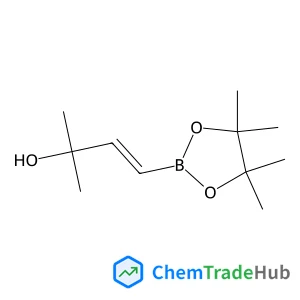
(E)-2-methyl-4-(4,4,5,5-tetramethyl-1,3,2-dioxaborolan-2-yl)but-3-en-2-ol
CAS Number:
581802-26-8
Molecular Formula:
C11H21BO3
Recommended Suppliers







Disclaimer
This page provides academic journal information for reference and research purposes only. We are not affiliated with any journal publishers and do not handle publication submissions. For publication-related inquiries, please contact the respective journal publishers directly.
If you notice any inaccuracies in the information displayed, please contact us at support@chemtradehub.com. We will promptly review and address your concerns.