












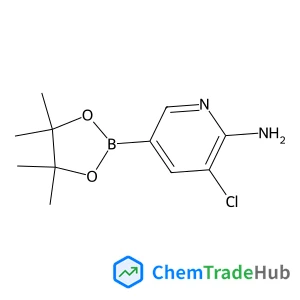
3-Chloro-5-(4,4,5,5-tetramethyl-1,3,2-dioxaborolan-2-yl)-2-pyridinamine
CAS Number:
1032758-99-8
Molecular Formula:
C11H16BClN2O2
Narinder Singh, Ray C. Mulrooney, Navneet Kaur, John F. Callan
Quantum Dot–Schiff base conjugate 2 displays selectivity for Cu2+ and Fe3+ enabling the simultaneous detection of these ions in semi-aqueous solution; in contrast, the Schiff base itself displayed no selectivity.
Antenor J. Paulista Neto, Eudes E. Fileti
DOI: 10.1039/C8CP00797G
Masahiro Shibuta, Toshiki Niikura, Toshiaki Kamoshida, Hironori Tsunoyama
DOI: 10.1039/C8CP05580G
Shmuel Zilberg, Amir Mizrahi, Haya Kornweitz
DOI: 10.1039/C7CP08240A
Josep M. Anglada, Albert Solé
DOI: 10.1039/C8CP04486D
Yuannan Chen, Aimin Ren, Zhongyue Yang, Tengfei He, Xiaoli Ding, Hongxing Zhang, Luyi Zou
DOI: 10.1039/C8CP00525G
Abhay N. Singh, Harsha Devnani, Shwetambara Jha, Pravin P. Ingole
DOI: 10.1039/C8CP05170D
Yan Zhao, Lixue Xia, Xiaobin Liao, Qiu He, Maria X. Zhao, Donald G. Truhlar
DOI: 10.1039/C8CP04973D
Komsilp Kotmool, Suttichai Assabumrungrat
DOI: 10.1039/C7CP07293G
Vyacheslav Kuzmin, Kajum Safiullin, Gleb Dolgorukov, Andrey Stanislavovas, Egor Alakshin, Sergei Orlinskii, Alexander Klochkov
DOI: 10.1039/C8CP05801F
Pritesh M. Tailor, Richard J. Wheatley, Nicholas A. Besley
DOI: 10.1039/C8CP05908J
This compound is mainly used as an intermediate in the synthesis of antipsychoti...
Waste containing 1-(D-Ribofuranosyl)-1,4-dihydro-3-pyridinecarboxamide (CAS: 191...
2-Methyl-2-propanyl 3-bromo-3-(hydroxymethyl)-1-azetidinecarboxylate (CAS: 20079...
N-(4-Chloro-2-pyridinyl)acetamide (CAS: 245056-66-0) is a chemical compound with...
5-Chloro-2-hydroxybenzoic acid, also known as 5-chlorosalicylic acid, is an arom...
When handling 1,1-Dichloro-1-fluoroethane (CAS: 1717-00-6), it is important to u...
Fmoc-(2S,3R)-3-phenylpyrrolidine-2-carboxylic acid is a white crystalline solid ...
4-Amino-5-bromo-2-pyridinecarboxylic acid is primarily used as a precursor in th...
Handling this compound should be done with personal protective equipment (PPE) i...
When handling 8-bromo-2,2-dimethyl-3,4-dihydro-2H-1,4-benzoxazin-3-one, use prop...

ChemComm publishes urgent research which is of outstanding significance and interest to experts in the field, while also appealing to the journal’s broad chemistry readership. Our communication format is ideally suited to short, urgent studies that are of such importance that they require accelerated publication. Our scope covers all topics in chemistry, and research at the interface of chemistry and other disciplines (such as materials science, nanoscience, physics, engineering and biology) where there is a significant novelty in the chemistry aspects. Major topic areas covered include: Analytical Chemistry Catalysis Chemical Biology and medicinal chemistry Computational Chemistry and Machine Learning Energy and sustainable chemistry Environmental Chemistry Green Chemistry Inorganic Chemistry Materials Chemistry Nanoscience Organic Chemistry Physical Chemistry Polymer Chemistry Supramolecular Chemistry

![tert-Butyl N-[(2-chloropyridin-4-yl)methyl]carbamate structure](https://static.chemtradehub.com/structs/916/916210-27-0-9f95.webp "tert-Butyl N-[(2-chloropyridin-4-yl)methyl]carbamate structure")
![2,6-Bis({(2R)-2-[hydroxy(diphenyl)methyl]-1-pyrrolidinyl}methyl)-4-methylphenol structure](https://static.chemtradehub.com/structs/877/877395-58-9-70bf.webp "2,6-Bis({(2R)-2-[hydroxy(diphenyl)methyl]-1-pyrrolidinyl}methyl)-4-methylphenol structure")





