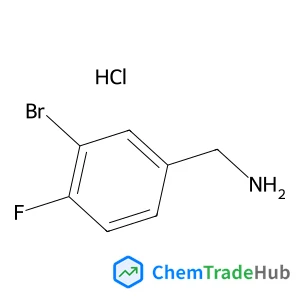
1-(3-Bromo-4-fluorophenyl)methanamine hydrochloride (1:1)
CAS Number:
202865-68-7
Molecular Formula:
C7H8BrClFN
Yucheng Wang, Yuming Zhang, Tiqiang Pang, Jie Xu, Ziyang Hu, Yuejin Zhu, Xiaoyan Tang, Suzhen Luan, Renxu Jia
Organic–inorganic metal halide perovskites are promising semiconductors for optoelectronic applications. Despite the achievements in device performance, the electrical properties of perovskites have stagnated. Ion migration is speculated to be the main contributing factor for the many unusual electrical phenomena in perovskite-based devices. Here, to understand the intrinsic electrical behavior of perovskites, we constructed metal-oxide-semiconductor (MOS) capacitors based on perovskite films and performed capacitance–voltage (C–V) and current–voltage (I–V) measurements of the capacitors. The results provide direct evidence for the mixed ionic–electronic transport behavior within perovskite films. In the dark, there is electrical hysteresis in both the C–V and I–V curves because the mobile negative ions take part in charge transport despite frequency modulation. However, under illumination, the large amount of photoexcited free carriers screens the influence of the mobile ions with a low concentration, which is responsible for the normal C–V properties. Validation of ion migration for the gate-control ability of MOS capacitors is also helpful for the investigation of perovskite MOS transistors and other gate-control photovoltaic devices.

Russian Journal of Applied Chemistry

Russian Journal of Coordination Chemistry

Russian Journal of Organic Chemistry

Organic Process Research & Development

Journal of Natural Medicines

Journal of Peptide Science

Crystallography Reports

Russian Journal of Bioorganic Chemistry

Russian Chemical Bulletin

Current Opinion in Solid State & Materials Science
DOI: 10.1039/C8TB90177E
Natalia N. Shlenskaya, Nikolai A. Belich, Michael Grätzel
DOI: 10.1039/C7TA10217H
Ryousuke Hara, Kangcheng Chen, Nobutaka Endo, Mitsuru Higa, Ken-ichi Okamoto, Lianjun Wang
DOI: 10.1039/C3TA11190C
Stephen G. Newman, Lei Gu, Christoph Lesniak, Georg Victor, Frank Meschke, Lahbib Abahmane, Klavs F. Jensen
DOI: 10.1039/C3GC41942H
Zhaojun Ding, Bin Yao, Jinkui Feng, Jianxin Zhang
DOI: 10.1039/C3TA12227A
Jie Liu, Zhiwei Jiang, Xuecheng Chen, Xin Wen, Ewa Mijowska, Nana Tian, Tao Tang
DOI: 10.1039/C3TA10316A
Rachael E. H. Miles, Jim S. Walker, Daniel R. Burnham, Jonathan P. Reid
DOI: 10.1039/C2CP23999J
Gabriella A. Tosado, Erjin Zheng, Qiuming Yu
DOI: 10.1039/D0MA00520G
Raheleh Mohammadpour, Azam Iraji zad, Anders Hagfeldt, Gerrit Boschloo
DOI: 10.1039/C1CP21517E
When considering alternatives to 1-(4-Chlorophenyl)-N-hydroxymethanimine (CAS: 3...
This compound should be stored in a cool, dry place away from direct sunlight. I...
3-(4-Bromophenyl)-5-(2-fluorophenyl)-1,2,4-oxadiazole is synthesized through a m...
5-Chloro-2-(4-chlorophenyl)-4-methyl-6-[3-(1-piperidinyl)propoxy]pyrimidine (CAS...
2-Chloro-4-(difluoromethoxy)pyridine is used in the pharmaceutical industry for ...
3-Chloro-6-methylpyridazine (CAS: 1121-79-5) is classified under the Globally Ha...
Several alternatives can be used in the synthesis of Methyl 4,5-dimethyl-2-nitro...
Alternatives to (2E,2'E)-3,3'-(1,4-Phenylene)bisacrylaldehyde include other acry...
3-Amino-5-chloropyridin-2-ol hydrochloride is an organic compound with the CAS n...
When handling 6,7-Difluoro-2,3-dihydro-4H-chromen-4-one, it is essential to wear...

Physical Chemistry Chemical Physics (PCCP) is an international journal co-owned by 19 physical chemistry and physics societies from around the world. This journal publishes original, cutting-edge research in physical chemistry, chemical physics and biophysical chemistry. To be suitable for publication in PCCP, articles must include significant innovation and/or insight into physical chemistry; this is the most important criterion that reviewers and Editors will judge against when evaluating submissions. The journal has a broad scope and welcomes contributions spanning experiment, theory, computation and data science. Topical coverage includes spectroscopy, dynamics, kinetics, statistical mechanics, thermodynamics, electrochemistry, catalysis, surface science, quantum mechanics, quantum computing and machine learning. Interdisciplinary research areas such as polymers and soft matter, materials, nanoscience, energy, surfaces/interfaces, and biophysical chemistry are welcomed if they demonstrate significant innovation and/or insight into physical chemistry. Joined experimental/theoretical studies are particularly appreciated when complementary and based on up-to-date approaches.