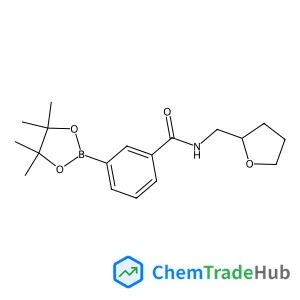
N-(Tetrahydro-2-furanylmethyl)-3-(4,4,5,5-tetramethyl-1,3,2-dioxaborolan-2-yl)benzamide
CAS Number:
1073355-06-2
Molecular Formula:
C18H26BNO4
Christopher D. Daub, Alenka Luzar
We study the behavior of ambient temperature water under the combined effects of nanoscale confinement and applied electric field. Using molecular simulations we analyze the thermodynamic causes of field-induced expansion at some conditions, and contraction at others. Repulsion among parallel water dipoles and mild weakening of interactions between partially aligned water molecules prove sufficient to destabilize the aqueous liquid phase in isobaric systems in which all water molecules are permanently exposed to a uniform electric field. At the same time, simulations reveal comparatively weak field-induced perturbations of water structure upheld by flexible hydrogen bonding. In open systems with fixed chemical potential, these perturbations do not suffice to offset attraction of water into the field; additional water is typically driven from the unperturbed bulk phase to the field-exposed region. In contrast to recent theoretical predictions in the literature, our analysis and simulations confirm that classical electrostriction characterizes usual electrowetting behavior in nanoscale channels and nanoporous materials.
Itziar Zubieta, Pablo Llombart, Carlos Vega, Eva G. Noya
DOI: 10.1039/C8CP04964E
E. M. Neeman, T. R. Huet
DOI: 10.1039/C8CP04011G
Raul Morales-Salvador, Ángel Morales-García, Francesc Viñes, Francesc Illas
DOI: 10.1039/C8CP91852J
Xiaolin Guo, Zhihuan Qiu, Jianxin Mao, Renxian Zhou
DOI: 10.1039/C8CP03696A
Hang Zhai, Zhen Qin, Dan Sun, Jianyun Wang, Chang Liu, Nan Min, Quan Li
DOI: 10.1039/C8CP04271C
Sujeet Dutta, S. Krishna Prasad
DOI: 10.1039/C8CP03603A
Qinye Li, Siyao Qiu, Lizhong He, Xiwang Zhang
DOI: 10.1039/C8CP04474K
Sergey Y. Ketkov, Elena A. Rychagova, Sheng-Yuan Tzeng, Wen-Bih Tzeng
DOI: 10.1039/C8CP04845B
Akram Mirehi, Ebrahim Heidari-Semiromi
DOI: 10.1039/C8CP05041D
Shu R. Huang, Yang Liu, František Tureček
DOI: 10.1039/C8CP06893C
3-(2-Bromoimidazo[2,1-b]thiazol-6-yl)propanoic acid hydrochloride is typically s...
2-Isopropyl-1,3-dioxane-5-carboxylic acid is typically synthesized by the carbox...
Alisporivir (CAS: 254435-95-5) is an antiviral medication used in the treatment ...
[1,2,4]triazolo[3,4-a]phthalazine (CAS: 234-80-0) is a crystalline compound with...
Regulatory guidelines for (2S)-5-Hydroxy-2-(4-hydroxyphenyl)-4-oxo-3,4-dihydro-2...
2,2-Difluorocyclohexanamine hydrochloride is generally safe when handled under p...
3-Nitro-2-phenylthiophene is primarily used in the synthesis of other organic co...
1-(Trifluoroacetyl)-4-piperidinecarbonitrile (CAS: 77940-79-5) is a colorless to...
Research and market trends for 1,3,6,8-Tetranitro-9H-carbazole (CAS: 4543-33-3) ...
Waste containing Dibenzo[b,d]thiophen-1-ylboronic acid (CAS: 1245943-60-5) shoul...

Physical Chemistry Chemical Physics (PCCP) is an international journal co-owned by 19 physical chemistry and physics societies from around the world. This journal publishes original, cutting-edge research in physical chemistry, chemical physics and biophysical chemistry. To be suitable for publication in PCCP, articles must include significant innovation and/or insight into physical chemistry; this is the most important criterion that reviewers and Editors will judge against when evaluating submissions. The journal has a broad scope and welcomes contributions spanning experiment, theory, computation and data science. Topical coverage includes spectroscopy, dynamics, kinetics, statistical mechanics, thermodynamics, electrochemistry, catalysis, surface science, quantum mechanics, quantum computing and machine learning. Interdisciplinary research areas such as polymers and soft matter, materials, nanoscience, energy, surfaces/interfaces, and biophysical chemistry are welcomed if they demonstrate significant innovation and/or insight into physical chemistry. Joined experimental/theoretical studies are particularly appreciated when complementary and based on up-to-date approaches.