












A versatile method for quantification of DNA and PCR products based on time-resolved Euiii luminescence
Literature Information
Publication Date
2008-09-05
DOI
10.1039/B807959E
Impact Factor
4.616
Authors
Bo Song, Caroline D. B. Vandevyver, Emmanuel Deiters, Anne-Sophie Chauvin, Ilkka Hemmilä, Jean-Claude G. Bünzli
View Original
Abstract
A versatile and robust method for the determination of DNA and PCR products (<500 bp) is presented, based on a mix of an EuIII chelate and acridine orange (AO). The nucleic acid selective stains acridine orange (AO) and ethidium bromide (EB) quench the luminescence of the bimetallic [Eu2(LC2)3] and of other monometallic chelates such as the macrocyclic complex [Eu(Lkel)], even at very low molar ratios. Stern–Volmer plots of the metal-centered emission intensities (F0/F) and Eu(5D0) lifetimes (τ0/τ) show the AO quenching being purely dynamic with KD = 6.7 × 10⁵ M−1 for [Eu2(LC2)3] and 1.6 × 10⁶ M−1 for [Eu(Lkel)], and bimolecular rate constants kq = 2.7 × 10⁸ M−1 s−1 and 3.4 × 10⁹ M−1 s−1, respectively. On the other hand, EB quenching is due to both dynamic and static mechanisms. In the presence of various types of DNA > 0.1 ng μL−1 (dsDNA, ssDNA or circular DNA), the quenched luminescence is reinstated, AO and EB intercalating into DNA, which removes the interaction with the EuIII complexes. The best results are obtained with [Eu2(LC2)3]/AO with detections limits in the range 0.18–0.66 ng μL−1; detection limits for the [Eu(Lkel)]/AO system are slightly larger; simpler monometallic EuIII complexes with dipicolinate derivatives do not follow suit in that they decompose in the presence of DNA. The EuIII/AO method is shown to be pH insensitive in the range 3–10; furthermore it is essentially insensitive to 1000-fold excesses of potential interfering substances, e.g. BSA, glucose, chelating agents and anions, alkaline earth and transition metal cations, variations in luminescence intensity being < 5%, (10 analytes) or 5–10% (4 analytes); only CoII and CuII interfere substantially.
Recommended Journals
Related Literature
Investigation of proton dynamics and the proton transport pathway in choline dihydrogen phosphate using solid-state NMR
Lindsay S. Cahill, Usman Ali Rana, Maria Forsyth, Mark E. Smith
2010-04-08
Paper
DOI: 10.1039/B916422G
Defect structure in lithium-doped polymer-derived SiCN ceramics characterized by Raman and electron paramagnetic resonance spectroscopy
Armin Schulz, Verena Liebau-Kunzmann, Claudia Fasel, Ralf Riedel
2009-05-05
Paper
DOI: 10.1039/B822457A
A fast redox-induced switching mechanism in a conformationally controllable molecular thread in solution‡
Costantino Zazza, Andrea Amadei, Nico Sanna, Massimiliano Aschi
2010-03-05
Communication
DOI: 10.1039/B926627E
Surface photochemistry: alloxazine within nanochannels of Na+ and H+ ZSM-5 zeolites
L. F. Vieira Ferreira, A. M. Botelho do Rego, E. Sikorska, M. Sikorski
2009-05-13
Paper
DOI: 10.1039/B903013A
Dimerisation of nitrile oxides: a quantum-chemical study
Tibor Pasinszki, Balázs Havasi, Nicholas P. C. Westwood
2009-04-17
Paper
DOI: 10.1039/B823406J
Tailoring the synthesis of supported Pdcatalysts towards desired structure and size of metal particles
Gatla Suresh, Jörg Radnik, Venkata Narayana Kalevaru, Marga-Martina Pohl, Matthias Schneider, Bernhard Lücke, Andreas Martin, Neetika Madaan, Angelika Brückner
2010-03-23
Paper
DOI: 10.1039/B920464D
Effect of substituents on the excited-state dynamics of the modified DNA bases 2,4-diaminopyrimidine and 2,6-diaminopurine
Zsolt Gengeliczki, Michael P. Callahan, Nathan Svadlenak, Csaba István Pongor, Leo Meerts, Dana Nachtigallová, Pavel Hobza, Mario Barbatti, Mattanjah S. de Vries
2010-04-08
Paper
DOI: 10.1039/B917852J
The gas-phase reaction between silylene and 2-butyne: kinetics, isotope studies, pressure dependence studies and quantum chemical calculations
Rosa Becerra, J. Pat Cannady, Guy Dormer, Robin Walsh
2009-04-17
Paper
DOI: 10.1039/B823109E
Role of van der Waals interaction in forming molecule-metal junctions: flat organic molecules on the Au(111) surface
M. Mura, A. Gulans, T. Thonhauser, L. Kantorovich
2010-03-17
Paper
DOI: 10.1039/B920121A
You might also like
Compound Q&A
What precautions should be taken when handling 2-Chloro-1,2-bis(4-methylphenyl)ethanone (CAS: 71193-32-3)?
When handling 2-Chloro-1,2-bis(4-methylphenyl)ethanone (CAS: 71193-32-3), it is ...
71193-32-32-Chloro-1,2-bis(4-m...
Compound Q&A
What industries use 4-Ethoxy-3-(5-methyl-4-oxo-7-propyl-1,4-dihydroimidazo[5,1-f][1,2,4]triazin-2-yl)benzenesulfonyl chloride (CAS: 224789-26-8)?
4-Ethoxy-3-(5-methyl-4-oxo-7-propyl-1,4-dihydroimidazo[5,1-f][1,2,4]triazin-2-yl...
224789-26-84-Ethoxy-3-(5-methyl...
Compound Q&A
How should Methyl 3-Oxo-4-Androsten-17-Carboxylate (CAS: 2681-55-2) be stored?
Methyl 3-Oxo-4-Androsten-17-Carboxylate (CAS: 2681-55-2) should be stored in a c...
2681-55-2Methyl 3-Oxo-4-Andro...
Compound Q&A
What are the main uses of (R)-3-Amino-4-(3-hexylphenylamino)-4-oxobutylphosphonic acid (CAS: 909725-61-7)?
(R)-3-Amino-4-(3-hexylphenylamino)-4-oxobutylphosphonic acid is primarily used i...
909725-61-7(R)-3-Amino-4-(3-hex...
Compound Q&A
What regulatory guidelines apply to 2-Methyl-2-propanyl 3-amino-3-carbamoyl-1-azetidinecarboxylate (CAS: 1254120-14-3)?
2-Methyl-2-propanyl 3-amino-3-carbamoyl-1-azetidinecarboxylate (CAS: 1254120-14-...
1254120-14-32-Methyl-2-propanyl ...
Compound Q&A
Are there alternatives to (E)-4-(tert-Butoxy)-4-oxobut-2-enoic acid (CAS: 135355-96-3) in synthesis?
There are alternative reagents that can be used in synthesis instead of (E)-4-(t...
135355-96-3(E)-4-(tert-Butoxy)-...
Compound Q&A
What are the physical and chemical properties of [2-(3-Chlorophenyl)-1,3-thiazol-4-yl]methanol (CAS: 121202-20-8)?
[2-(3-Chlorophenyl)-1,3-thiazol-4-yl]methanol (CAS: 121202-20-8) is a crystallin...
121202-20-8[2-(3-Chlorophenyl)-...
Compound Q&A
What is the market or research trend for Methyl (2S)-[(4S)-2,2-dimethyl-1,3-dioxolan-4-yl]{[(4-methylphenyl)sulfonyl]oxy}acetate (CAS: 166249-17-8)?
The market and research trends for Methyl (2S)-[(4S)-2,2-dimethyl-1,3-dioxolan-4...
166249-17-8Methyl (2S)-[(4S)-2,...
Compound Q&A
What is the market or research trend for 1-Bromo-2-isocyanatoethane (CAS: 42865-19-0)?
The market for 1-Bromo-2-isocyanatoethane (CAS: 42865-19-0) is driven by its use...
42865-19-01-Bromo-2-isocyanato...
Compound Q&A
What are the main uses of 4-Nitro-D-phenylalanine hydrochloride (CAS: 147065-06-3)?
4-Nitro-D-phenylalanine hydrochloride (CAS: 147065-06-3) is primarily used in re...
147065-06-34-Nitro-D-phenylalan...
Source Journal
Analyst

CiteScore:
7.8
Self-citation Rate:
5.6%
Articles per Year:
653
Analyst publishes analytical and bioanalytical research that reports premier fundamental discoveries and inventions, and the applications of those discoveries, unconfined by traditional discipline barriers.
Recommended Compounds
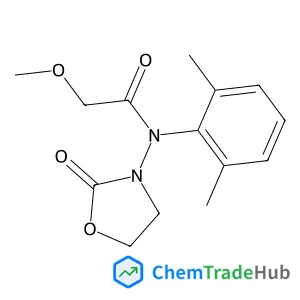
N-(2,6-Dimethylphenyl)-2-methoxy-N-(2-oxo-1,3-oxazolidin-3-yl)acetamide
CAS Number:
77732-09-3
Molecular Formula:
C14H18N2O4
Recommended Suppliers




Disclaimer
This page provides academic journal information for reference and research purposes only. We are not affiliated with any journal publishers and do not handle publication submissions. For publication-related inquiries, please contact the respective journal publishers directly.
If you notice any inaccuracies in the information displayed, please contact us at support@chemtradehub.com. We will promptly review and address your concerns.