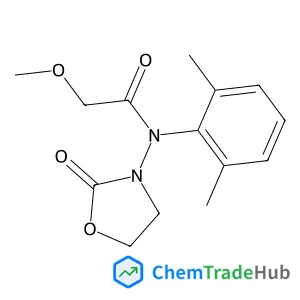
N-(2,6-Dimethylphenyl)-2-methoxy-N-(2-oxo-1,3-oxazolidin-3-yl)acetamide
CAS Number:
77732-09-3
Molecular Formula:
C14H18N2O4
Lindsay S. Cahill, Usman Ali Rana, Maria Forsyth, Mark E. Smith
Choline dihydrogen phosphate has previously been shown to be a good ionic conductor as well as an excellent host for acid doping, leading to high proton conductivities required for e.g., electrochemical devices including proton membrane fuel cells and sensors. A combination of variable-temperature 1H solid-state NMR and 2D NMR pulse sequences, including 31P and 13C CODEX and 1H BaBa, show that the proton conduction mechanism primarily involves assisted transport via a restricted three-site motion of the phosphate unit around the P–O bond that is hydrogen bonded to the choline and exchange of protons between these anions. In other words, proton transport at ambient temperatures appears to occur most favorably along the crystallographic b axis, from phosphate dimer to dimer. At elevated temperatures exchange between the protons of the hydroxyl group on the choline cation and the hydrogen-bonded dihydrogen phosphate groups also contributes to the structural diffusion of the protons in this solid state conductor.
DOI: 10.1039/C3CP55397C
X. F. Yang, Y. S. Liu, X. Zhang, L. P. Zhou, X. F. Wang, F. Chi, J. F. Feng
DOI: 10.1039/C4CP00390J
Michael Nolan
DOI: 10.1039/C4CP01309C
K. Zberecki, R. Swirkowicz, M. Wierzbicki
DOI: 10.1039/C4CP01039F
Robert L. Whetten, Xóchitl López-Lozano
DOI: 10.1039/C4CP01277A
Branka Kovač, Ivan Ljubić, Antti Kivimäki, Marcello Coreno, Igor Novak
DOI: 10.1039/C4CP00867G
Anne-Marie Manke, Karen Geisel, Anne Fetzer, Philipp Kurz
DOI: 10.1039/C3CP55023K
P. Madhusudhana Reddy, R. Umapathi, P. Venkatesu
DOI: 10.1039/C4CP00010B
Volker Hartmann, Tim Kothe, Sascha Pöller, Eithar El-Mohsnawy, Marc M. Nowaczyk, Nicolas Plumeré, Wolfgang Schuhmann, Matthias Rögner
DOI: 10.1039/C4CP00380B
N. Ottosson, M. Pastorczak, Sietse T. van der Post, Huib J. Bakker
DOI: 10.1039/C4CP00671B
When handling 2-Chloro-1,2-bis(4-methylphenyl)ethanone (CAS: 71193-32-3), it is ...
4-Ethoxy-3-(5-methyl-4-oxo-7-propyl-1,4-dihydroimidazo[5,1-f][1,2,4]triazin-2-yl...
Methyl 3-Oxo-4-Androsten-17-Carboxylate (CAS: 2681-55-2) should be stored in a c...
(R)-3-Amino-4-(3-hexylphenylamino)-4-oxobutylphosphonic acid is primarily used i...
2-Methyl-2-propanyl 3-amino-3-carbamoyl-1-azetidinecarboxylate (CAS: 1254120-14-...
There are alternative reagents that can be used in synthesis instead of (E)-4-(t...
[2-(3-Chlorophenyl)-1,3-thiazol-4-yl]methanol (CAS: 121202-20-8) is a crystallin...
The market and research trends for Methyl (2S)-[(4S)-2,2-dimethyl-1,3-dioxolan-4...
The market for 1-Bromo-2-isocyanatoethane (CAS: 42865-19-0) is driven by its use...
4-Nitro-D-phenylalanine hydrochloride (CAS: 147065-06-3) is primarily used in re...

Physical Chemistry Chemical Physics (PCCP) is an international journal co-owned by 19 physical chemistry and physics societies from around the world. This journal publishes original, cutting-edge research in physical chemistry, chemical physics and biophysical chemistry. To be suitable for publication in PCCP, articles must include significant innovation and/or insight into physical chemistry; this is the most important criterion that reviewers and Editors will judge against when evaluating submissions. The journal has a broad scope and welcomes contributions spanning experiment, theory, computation and data science. Topical coverage includes spectroscopy, dynamics, kinetics, statistical mechanics, thermodynamics, electrochemistry, catalysis, surface science, quantum mechanics, quantum computing and machine learning. Interdisciplinary research areas such as polymers and soft matter, materials, nanoscience, energy, surfaces/interfaces, and biophysical chemistry are welcomed if they demonstrate significant innovation and/or insight into physical chemistry. Joined experimental/theoretical studies are particularly appreciated when complementary and based on up-to-date approaches.
![4-[2-(Trichlorosilyl)ethyl]benzenesulfonyl chloride structure](https://static.chemtradehub.com/structs/797/79793-00-3-de16.webp "4-[2-(Trichlorosilyl)ethyl]benzenesulfonyl chloride structure")