


Split hybridisation probes for electrochemical typing of single-nucleotide polymorphisms
Literature Information
Publication Date
2008-10-18
DOI
10.1039/B806514D
Impact Factor
4.616
Authors
Fausto Lucarelli, Silvia Capponcelli, Giovanna Marrazza, Luca Sangiorgi, Marco Mascini
View Original
Abstract
This paper describes the development of a highly selective single-nucleotide polymorphisms (SNPs) typing method based on the use of split hybridisation probes and demonstrates the concept through the electrochemical analysis of single-base mutations in actual patient samples. The requirement that two probes hybridised adjacent to one another to allow for stabilisation (via base-stacking) and binding of the allele-specific oligonucleotide (ASO), imparted highly stringent selectivity criteria to the assay. Simple rules for tuning the characteristics of such stacking/ASO probe pairs and achieve full mismatch discrimination at ambient conditions (with no need to strictly control the temperature) are provided. All genotyping experiments were indeed performed at room temperature, using the planar surface of disposable probe-modified gold electrodes as the genosensing platform. The ability to detect nanomolar amounts of a synthetic target even within a vast excess of single-base substituted sequences gave strong evidence of the specificity of the split probes assay. Proving the general validity of this genotyping approach, application of the analytical pathway was further demonstrated for clinical targets (amplified from the human TP53gene) whose mutational site was poorly accessible, being part of a thermodynamically stable hairpin. In combination with use of auxiliary oligonucleotides (which restored the availability of each pre-defined hybridisation site), the assay demonstrated the ability to fully discriminate single-base mutations with detection limits in the high picomolar range (total analysis time: 60 min). Our specific probe design, hybridisation and signal transduction paths make the analytical process remarkably simple, relatively low cost and, thus, well suited for low throughput analysis of clinically relevant samples.
Recommended Journals

Journal of Heterocyclic Chemistry

Journal of Physics and Chemistry of Solids

Russian Chemical Reviews

Proceedings of the National Academy of Sciences of the United States of America

European Journal of Wood and Wood Products

Planta Medica

Science Progress

Science

Molecular Pharmacology

Journal of Medicinal Chemistry
Related Literature
A comparison of metallophilic attraction in (X–M–PH3)2 (M = Cu, Ag, Au; X = H, Cl)
Lilia Magnko, Marcus Schweizer, Guntram Rauhut, Martin Schütz, Hermann Stoll, Hans-Joachim Werner
2002-02-14
Paper
DOI: 10.1039/B110624D
Rate constants for the reaction of HO2 radicals with cyclopentane and propane between 673 and 783 K
S. M. Handford-Styring, R. W. Walker
2002-01-21
Paper
DOI: 10.1039/B108578F
From degeneration to damping of electrochemical oscillation induced by temperature controlling of heat-compensation type
Jinglei Lei, Jiuli Luo
2002-02-19
Paper
DOI: 10.1039/B108572G
Solvent effects in the photodenitrogenation of the azoalkane diazabicyclo[2.2.1]hept-2-ene: viscosity- and polarity-controlled stereoselectivity in housane formation from the diazenyl diradical
Waldemar Adam, Manfred Diedering
2002-02-13
Paper
DOI: 10.1039/B110562K
On the response of simple reactors to regular trains of pulses
2002-03-12
Paper
DOI: 10.1039/B109522F
Phase equilibria of hydrogel systems
Andreas Hüther, Bernd Schäfer, Xiaoping Xu, Gerd Maurer
2002-02-14
Paper
DOI: 10.1039/B108496H
Quasiclassical trajectory calculations of collisional energy transfer in propane systems: Multiple direct-encounter hard-sphere model
Apichart Linhananta, Kieran F. Lim
2002-01-16
Paper
DOI: 10.1039/B109074G
On the enthalpic contribution to the redox energetics of SrFeO3−δ
Camilla Haavik, Tooru Atake, Svein Stølen
2002-02-08
Paper
DOI: 10.1039/B109683D
Elementary reactions of the antioxidant action of trans-stilbene derivatives: resveratrol, pinosylvin and 4-hydroxystilbene
Sandra Stojanović, Ortwin Brede
2002-01-29
Paper
DOI: 10.1039/B109063C
Oscillatory clusters in a reaction–diffusion system switching between excitable and unexcitable states
2002-03-13
Paper
DOI: 10.1039/B109391F
You might also like
Compound Q&A
What regulatory guidelines apply to 6-Bromo-2-methylimidazo[1,2-a]pyrimidine (CAS: 1111638-05-1)?
6-Bromo-2-methylimidazo[1,2-a]pyrimidine (CAS: 1111638-05-1) falls under various...
1111638-05-16-Bromo-2-methylimid...
Compound Q&A
Are there alternatives to 1-Pyrrolidineethanol, β-methyl-α-phenyl-, (αS,βR) (CAS: 123620-80-4) in synthesis?
While there are no direct alternatives, similar compounds like 1-Pyrrolidineetha...
123620-80-41-Pyrrolidineethanol...
Compound Q&A
Is 4-Methyl-2,6-bis(2-methyl-2-propanyl)phenyl methylcarbamate (CAS: 1918-11-2) safe?
4-Methyl-2,6-bis(2-methyl-2-propanyl)phenyl methylcarbamate (CAS: 1918-11-2) is ...
1918-11-24-Methyl-2,6-bis(2-m...
Compound Q&A
How should 2-(3-Bromo-4-fluorophenyl)-1,3-dioxolane (CAS: 77771-04-1) be stored?
2-(3-Bromo-4-fluorophenyl)-1,3-dioxolane (CAS: 77771-04-1) should be stored in a...
77771-04-12-(3-Bromo-4-fluorop...
Compound Q&A
What are the physical and chemical properties of 4,5,6,7-Tetrahydro-1H-indazole hydrochloride (CAS: 18161-11-0)?
4,5,6,7-Tetrahydro-1H-indazole hydrochloride is a white crystalline solid with a...
18161-11-04,5,6,7-Tetrahydro-1...
Compound Q&A
What is (2R)-1-Methoxy-3-phenyl-2-propanamine (CAS: 59919-07-2)?
(2R)-1-Methoxy-3-phenyl-2-propanamine is a chiral organic compound with the CAS ...
59919-07-2(2R)-1-Methoxy-3-phe...
Compound Q&A
What industries use Ethyl 1-(1-phenylethyl)-1H-imidazole-5-carboxylate (CAS: 56649-47-9)?
Ethyl 1-(1-phenylethyl)-1H-imidazole-5-carboxylate is used in various industries...
56649-47-9Ethyl 1-(1-phenyleth...
Compound Q&A
What regulatory guidelines apply to 4-[(1E,3S)-1-(4-Hydroxyphenyl)-1,4-pentadien-3-yl]phenol (CAS: 17676-24-3)?
4-[(1E,3S)-1-(4-Hydroxyphenyl)-1,4-pentadien-3-yl]phenol (CAS: 17676-24-3) falls...
17676-24-34-[(1E,3S)-1-(4-Hydr...
Compound Q&A
What industries use (S)-3-Amino-5-phenylpentanoic acid hydrochloride (CAS: 331846-97-0)?
(S)-3-Amino-5-phenylpentanoic acid hydrochloride is primarily used in the pharma...
331846-97-0(S)-3-Amino-5-phenyl...
Compound Q&A
How is 7-methoxy-1-benzothiophene-2-carboxylic acid (CAS: 88791-07-5) typically synthesized?
7-Methoxy-1-benzothiophene-2-carboxylic acid is typically synthesized by reactin...
88791-07-57-methoxy-1-benzothi...
Source Journal
Analyst

CiteScore:
7.8
Self-citation Rate:
5.6%
Articles per Year:
653
Analyst publishes analytical and bioanalytical research that reports premier fundamental discoveries and inventions, and the applications of those discoveries, unconfined by traditional discipline barriers.
Recommended Compounds
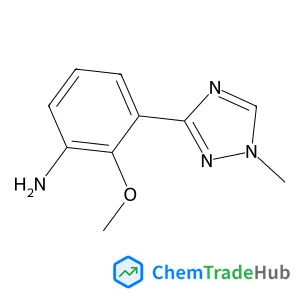
2-Methoxy-3-(1-methyl-1H-1,2,4-triazol-3-yl)aniline
CAS Number:
1609394-10-6
Molecular Formula:
C10H12N4O
![9H-Fluoren-9-ylmethyl {15-[(2,5-dioxo-1-pyrrolidinyl)oxy]-15-oxo-3,6,9,12-tetraoxapentadec-1-yl}carbamate structure](https://static.chemtradehub.com/structs/131/1314378-14-7-4316.webp "9H-Fluoren-9-ylmethyl {15-[(2,5-dioxo-1-pyrrolidinyl)oxy]-15-oxo-3,6,9,12-tetraoxapentadec-1-yl}carbamate structure")
9H-Fluoren-9-ylmethyl {15-[(2,5-dioxo-1-pyrrolidinyl)oxy]-15-oxo-3,6,9,12-tetraoxapentadec-1-yl}carbamate
CAS Number:
1314378-14-7
Molecular Formula:
C30H36N2O10
Recommended Suppliers






Disclaimer
This page provides academic journal information for reference and research purposes only. We are not affiliated with any journal publishers and do not handle publication submissions. For publication-related inquiries, please contact the respective journal publishers directly.
If you notice any inaccuracies in the information displayed, please contact us at support@chemtradehub.com. We will promptly review and address your concerns.