












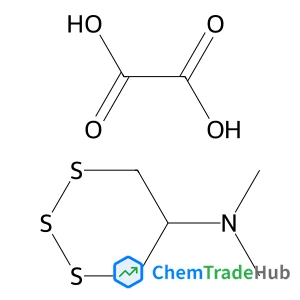
Oxalic acid compound with cyclohexylsulfamothioic O-acid (11)
CAS Number:
31895-22-4
Molecular Formula:
C7H13NO4S3
S. M. Handford-Styring, R. W. Walker
Studies have been made of the separate addition of cyclopentane (c-C5H10) and propane (C3H8) to mixtures of O2 and tetramethylbutane (TMB) between 673 and 783 K in aged boric-acid-coated vessels to obtain kinetic data for the reaction of HO2 radicals with each of the additives. The contribution by OH radicals to the removal of c-C5H10 and C3H8 has been minimised by use of a total pressure of 15 Torr and by measurements well within 5% consumption of TMB and the additives. A full product analysis was carried out for each kinetic data point which shows that at least 85% of the radicals produced from c-C5H10 and C3H8 give conjugate alkene + HO2 and which permits a precise correction for the small percentage of OH radicals formed. From measurements of the relative rates of consumption of TMB and the additives, values of k12p/k71/2 and k12c/k71/2 were obtained at each temperature used and were shown by sensitivity analysis to be relatively insensitive to any other parameter associated with the mechanism. HO2 + C3H8 → H2O2 + C3H7(12p)HO2 + c-C5H10 → H2O2 + c-C5H9(12c)HO2 + HO2 → H2O2 + O2(7) Values of E12p − 1/2E7 = 75.6 ± 5.8 kJ mol−1, log[(A12p/A71/2)/(dm3 mol−1 s−1)1/2] = 5.53 ± 0.52 and E12c − 1/2E7 = 71.2 ± 3.9 kJ mol−1, log[(A12c/A71/2)/(dm3 mol−1 s−1)1/2] = 5.58 ± 0.40 were obtained which with k7 = 1.87 × 10⁹ exp(− 775/T) dm3 mol−1 s−1 give E12p = 78.8 ± 6.6 kJ mol−1, log(A12p/dm3 mol−1s−1) = 10.17 ± 0.57 and E12c = 74.4 ± 4.7 kJ mol−1, log(A12c/dm3 mol−1 s−1) = 10.22 ± 0.45. The parameters for reaction (12c) are in excellent agreement with E = 73.2 ± 5.0 kJ mol−1, log(A/dm3 mol−1 s−1) = 10.23 ± 0.49 obtained in a previous study for the reaction of HO2 radicals with cyclohexane. For use outside the temperature range of this study, the three-parameter function k = AT2.5exp(−B/T) is recommended. From a combination of the data obtained for c-C5H10 and cyclohexane, values of A = 7.9 dm3 mol−1 s−1 K−2.5 and B = 6970 K are recommended for the abstraction by HO2 radicals of a single secondary H atom from alkanes with a carbon number larger than 4. Use has been made of all the available data for HO2 + alkane reactions to derive a data base for HO2 attack at primary, secondary, and tertiary C–H sites in alkanes with an accuracy expressed as Δlog = ± 0.15 between 600 and 800 K rising to ± 0.3 at 1200 K.
Xian Huang, Waygen Thor, Xiangyu Feng, Liangliang Kang, Min Yang, Chi-Sing Lee, Yuen-Kit Cheng, Shuzhong He
DOI: 10.1039/C9QO01349K
Jimei Liu, Xiaona Jia, Jinlian Zhao, Jiamin Feng, Minghua Chen, Ridao Chen, Kebo Xie, Dawei Chen, Yan Li, Dan Zhang, Ying Peng, Shuyi Si, Jungui Dai
DOI: 10.1039/C9QO01284B
Yong Zen, Qian Liu, Hengshan Wang
DOI: 10.1039/C9QO00926D
Shengqing Ye, Kaida Zhou, Pornchai Rojsitthisak
DOI: 10.1039/C9QO01274E
Huayue Song, Lin Liu, Mingyang Yang, Guangmiao Wu, Peng Chen, Xingang Xie, Xuegong She
DOI: 10.1039/C9QO01027K
Mei-Hua Shen, Yu-Mei Zhang, Chun Jiang, Hua-Dong Xu, Defeng Xu
DOI: 10.1039/C9QO01258C
Fan-Xiao Meng, Ruo-Nan Wang, Hong-Li Huang, Shu-Wen Gong, Qian-Li Li, Shao-Liang Zhang, Chun-Lin Ma, Chen-Zhong Li, Ji-Yuan Du
DOI: 10.1039/C9QO01196J
Svatava Voltrová, Petr Slavíček, Petr Beier
DOI: 10.1039/C9QO01295H
Matthias Bremer, Thibault Reynaldo, Janek Buhl, Paul J. Gates, Frank D. Sönnichsen, Muriel Hissler, Martina Gerken
DOI: 10.1039/C9QO00947G
Gérard Audran, Lionel Bosco, Paul Brémond, Natacha Jugniot, Sylvain R. A. Marque, Philippe Massot, Tataye Moussounda Moussounda Koumba, Elodie Parzy, Angélique Rivot, Eric Thiaudière, Pierre Voisin, Carina Wedl, Toshihide Yamasaki
DOI: 10.1039/C9QO00899C
Waste containing (6-Bromo-2-naphthyl)oxy](dimethyl)(2-methyl-2-propanyl)silane (...
7-Fluoro-4-isoquinolinecarboxylic acid can be synthesized via a multi-step proce...
2,3,5,6-Tetrabromothieno[3,2-b]thiophene is a crystalline compound with a high m...
1-[4-(Benzylamino)-7,8-dihydro-5H-pyrano[4,3-d]pyrimidin-2-yl]-2-methyl-1H-indol...
The market for imidazo[5,1-d]-1,2,3,5-tetrazine-8-carboxylic acid, 3,4-dihydro-3...
3-(Triisopropylsilyl)propiolaldehyde is a synthetic organic compound with the CA...
6-Nitro-2H-1,4-benzoxazin-3(4H)-one (CAS: 81721-87-1) is subject to various regu...
Waste containing (3-Fluorophenyl)(4-{[(2-methyl-2-propanyl)oxy]carbonyl}-1-piper...
N,N'-4,4'-Biphenyldiyldiisonicotinamide is a white crystalline solid with a mole...
6-Bromo-8-fluoro-2-quinazolinol is primarily used in the pharmaceutical industry...

Physical Chemistry Chemical Physics (PCCP) is an international journal co-owned by 19 physical chemistry and physics societies from around the world. This journal publishes original, cutting-edge research in physical chemistry, chemical physics and biophysical chemistry. To be suitable for publication in PCCP, articles must include significant innovation and/or insight into physical chemistry; this is the most important criterion that reviewers and Editors will judge against when evaluating submissions. The journal has a broad scope and welcomes contributions spanning experiment, theory, computation and data science. Topical coverage includes spectroscopy, dynamics, kinetics, statistical mechanics, thermodynamics, electrochemistry, catalysis, surface science, quantum mechanics, quantum computing and machine learning. Interdisciplinary research areas such as polymers and soft matter, materials, nanoscience, energy, surfaces/interfaces, and biophysical chemistry are welcomed if they demonstrate significant innovation and/or insight into physical chemistry. Joined experimental/theoretical studies are particularly appreciated when complementary and based on up-to-date approaches.
![2,2'-{2,2-Propanediylbis[(2,6-dibromo-4,1-phenylene)oxy]}diethanol structure](https://static.chemtradehub.com/structs/416/4162-45-2-b3d6.webp "2,2'-{2,2-Propanediylbis[(2,6-dibromo-4,1-phenylene)oxy]}diethanol structure")
![10-(1-Azabicyclo[2.2.2]oct-3-ylmethyl)-10H-phenothiazine structure](https://static.chemtradehub.com/structs/292/29216-28-2-1d81.webp "10-(1-Azabicyclo[2.2.2]oct-3-ylmethyl)-10H-phenothiazine structure")
![2,9-Dichloro-5,12-dihydroquinolino[2,3-b]acridine-7,14-dione structure](https://static.chemtradehub.com/structs/308/3089-17-6-750b.webp "2,9-Dichloro-5,12-dihydroquinolino[2,3-b]acridine-7,14-dione structure")





