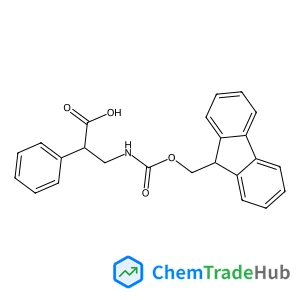
(S)-3-((((9H-Fluoren-9-yl)methoxy)carbonyl)amino)-2-phenylpropanoic acid
CAS Number:
1217663-60-9
Molecular Formula:
C24H21NO4
Delphine Moraleda, David Gatineau, David Martin, Laurent Giordano, Gérard Buono
We report a simple one-pot synthesis of enantiomerically enriched alkyl- and arylphenylphosphinous acid–borane starting from readily available (RP)-(−)-menthylhydrogenophenylphosphinate and organolithium reagents.
Emilia Sicilia, Gloria Mazzone, Adriana Pérez-González, Jenny Pirillo, Annia Galano, Thomas Heine, Nino Russo
DOI: 10.1039/C7CP01833A
Milan Ončák, Juraj Fedor, Jaroslav Kočišek, Andriy Pysanenko, Martin K. Beyer, Michal Fárník
DOI: 10.1039/C7CP01205E
Zhongqiao Hu, Jun Wei
DOI: 10.1039/C7CP01542A
Ya-Nan Zhu, Zhi-Feng Xu, Li-Min Liu
DOI: 10.1039/C7CP02659E
Cang Lang Yao, Jian Chen Li, Wang Gao, Qing Jiang
DOI: 10.1039/C7CP01881A
Akarsh Verma, Avinash Parashar
DOI: 10.1039/C7CP02366A
Jay R. Walton, Luis A. Rivera-Rivera, Robert R. Lucchese, John W. Bevan
DOI: 10.1039/C7CP02407J
Puspal Mukherjee, Pratik Sen
DOI: 10.1039/C7CP01387F
M. Florek-Wojciechowska, R. Jakubas, D. Kruk
DOI: 10.1039/C7CP00788D
When considering alternatives to 1-(4-Chlorophenyl)-N-hydroxymethanimine (CAS: 3...
This compound should be stored in a cool, dry place away from direct sunlight. I...
3-(4-Bromophenyl)-5-(2-fluorophenyl)-1,2,4-oxadiazole is synthesized through a m...
5-Chloro-2-(4-chlorophenyl)-4-methyl-6-[3-(1-piperidinyl)propoxy]pyrimidine (CAS...
2-Chloro-4-(difluoromethoxy)pyridine is used in the pharmaceutical industry for ...
3-Chloro-6-methylpyridazine (CAS: 1121-79-5) is classified under the Globally Ha...
Several alternatives can be used in the synthesis of Methyl 4,5-dimethyl-2-nitro...
Alternatives to (2E,2'E)-3,3'-(1,4-Phenylene)bisacrylaldehyde include other acry...
3-Amino-5-chloropyridin-2-ol hydrochloride is an organic compound with the CAS n...
When handling 6,7-Difluoro-2,3-dihydro-4H-chromen-4-one, it is essential to wear...

ChemComm publishes urgent research which is of outstanding significance and interest to experts in the field, while also appealing to the journal’s broad chemistry readership. Our communication format is ideally suited to short, urgent studies that are of such importance that they require accelerated publication. Our scope covers all topics in chemistry, and research at the interface of chemistry and other disciplines (such as materials science, nanoscience, physics, engineering and biology) where there is a significant novelty in the chemistry aspects. Major topic areas covered include: Analytical Chemistry Catalysis Chemical Biology and medicinal chemistry Computational Chemistry and Machine Learning Energy and sustainable chemistry Environmental Chemistry Green Chemistry Inorganic Chemistry Materials Chemistry Nanoscience Organic Chemistry Physical Chemistry Polymer Chemistry Supramolecular Chemistry