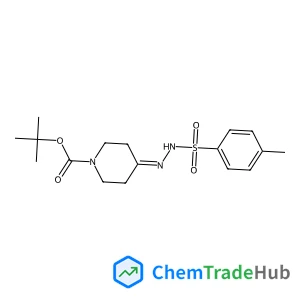
tert-Butyl 4-(2-(p-Tolylsulfonyl)hydrazono)piperidine-1-carboxylate
CAS Number:
1046478-89-0
Molecular Formula:
C17H25N3O4S
A graphical abstract is available for this content

Journal of the Indian Institute of Science

Main Group Chemistry

Colloid Journal

Chinese Journal of Chemistry

Bioorganic & Medicinal Chemistry Letters

Journal of Asian Natural Products Research

Atomization and Sprays

Herald of the Russian Academy of Sciences

Journal of Chemical Sciences

Polycyclic Aromatic Compounds
Xiaoding Lou, Jingui Qin, Zhen Li
DOI: 10.1039/B903076J
Hao Xu, Jun Peng, Hong-Wu Tang, Ying Li, Qiong-Shui Wu, Zhi-Ling Zhang, Gang Zhou, Chuang Chen, Yan Li
DOI: 10.1039/B807251E
Michelle W. Li, R. Scott Martin
DOI: 10.1039/B807093H
F. Bonnier, D. Bertrand, L. Ventéo, M. Pluot, B. Baehrel, M. Manfait, G. D. Sockalingum
DOI: 10.1039/B717164A
A. Zwielly, G. Brkic, S. Mordechai
DOI: 10.1039/B805223A
Anees A. Ansari, Renu Singh, G. Sumana, B. D. Malhotra
DOI: 10.1039/B817562D
Fausto Lucarelli, Silvia Capponcelli, Giovanna Marrazza, Luca Sangiorgi, Marco Mascini
DOI: 10.1039/B806514D
Yuze Sun, Jing Liu, Greg Frye-Mason, Shiou-jyh Ja, Aaron K. Thompson, Xudong Fan
DOI: 10.1039/B900050J
D. Ruhlig, H. Gugel, A. Schulte, W. Theisen, W. Schuhmann
DOI: 10.1039/B804718A
When considering alternatives to 1-(4-Chlorophenyl)-N-hydroxymethanimine (CAS: 3...
This compound should be stored in a cool, dry place away from direct sunlight. I...
3-(4-Bromophenyl)-5-(2-fluorophenyl)-1,2,4-oxadiazole is synthesized through a m...
5-Chloro-2-(4-chlorophenyl)-4-methyl-6-[3-(1-piperidinyl)propoxy]pyrimidine (CAS...
2-Chloro-4-(difluoromethoxy)pyridine is used in the pharmaceutical industry for ...
3-Chloro-6-methylpyridazine (CAS: 1121-79-5) is classified under the Globally Ha...
Several alternatives can be used in the synthesis of Methyl 4,5-dimethyl-2-nitro...
Alternatives to (2E,2'E)-3,3'-(1,4-Phenylene)bisacrylaldehyde include other acry...
3-Amino-5-chloropyridin-2-ol hydrochloride is an organic compound with the CAS n...
When handling 6,7-Difluoro-2,3-dihydro-4H-chromen-4-one, it is essential to wear...

Physical Chemistry Chemical Physics (PCCP) is an international journal co-owned by 19 physical chemistry and physics societies from around the world. This journal publishes original, cutting-edge research in physical chemistry, chemical physics and biophysical chemistry. To be suitable for publication in PCCP, articles must include significant innovation and/or insight into physical chemistry; this is the most important criterion that reviewers and Editors will judge against when evaluating submissions. The journal has a broad scope and welcomes contributions spanning experiment, theory, computation and data science. Topical coverage includes spectroscopy, dynamics, kinetics, statistical mechanics, thermodynamics, electrochemistry, catalysis, surface science, quantum mechanics, quantum computing and machine learning. Interdisciplinary research areas such as polymers and soft matter, materials, nanoscience, energy, surfaces/interfaces, and biophysical chemistry are welcomed if they demonstrate significant innovation and/or insight into physical chemistry. Joined experimental/theoretical studies are particularly appreciated when complementary and based on up-to-date approaches.