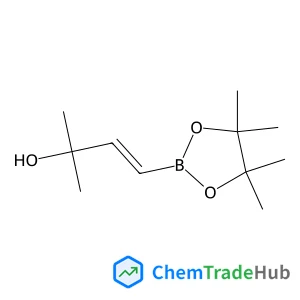
(E)-2-methyl-4-(4,4,5,5-tetramethyl-1,3,2-dioxaborolan-2-yl)but-3-en-2-ol
CAS Number:
581802-26-8
Molecular Formula:
C11H21BO3
Zhongqiao Hu, Jun Wei
Emerging two-dimensional (2D) ultra-thin nanomaterials are ideal candidates for next-generation high-throughput membranes. 2D carbon nitride C2N possesses intrinsic regular and uniformly distributed sub-nanometer pores which probably allow a high permeation flux. This work reports on the investigation of seawater pervaporation through a single-layered C2N membrane via a combined approach of first-principles calculations and molecular dynamics simulations. The C2N layer remains stable when the strain is less than a threshold point of 12% at which the pore size is enlarged by 50%. The strained C2N membrane only allows water molecules from seawater to permeate, and the water flux in C2N is enhanced by one to four orders of magnitude compared to that in other membranes. The water flux exhibits an Arrhenius-type relation with temperature. The hydrogen-bonding interaction among water molecules in C2N is weaker and decays faster than that in bulk water, which is because it is energetically unfavorable for water molecules to enter C2N. This proof-of-concept study suggests that C2N might be an appealing membrane material for seawater pervaporation.

Russian Journal of General Chemistry

Nature Medicine

New Journal of Chemistry

Journal of Natural Medicines

Journal of Peptide Science

Chemistry Education Research and Practice

Current Opinion in Colloid & Interface Science

Russian Journal of Bioorganic Chemistry

Saudi Pharmaceutical Journal

Drug Discovery Today
Huayu Tian, Jianxun Ding, Jie Chen, Xuesi Chen
DOI: 10.1039/C3PY01781H
Bobing Hu, Yunlong Wang, Zhuoying Zhu, Changrong Xia
DOI: 10.1039/C5TA00510H
Sebastian Schaubach, Xiao-Yan Wang, Jun-Fang Li, Xiu-Li Sun, Sunewang R. Wang, Yong Tang
DOI: 10.1039/C8PY00953H
Hao Su, Yiwen Li, Kan Yue, Zhao Wang, Pengtao Lu, Xueyan Feng, Xue-Hui Dong, Shuo Zhang, Stephen Z. D. Cheng
DOI: 10.1039/C4PY00107A
Jonas Altnöder, Juhyon J. Lee, Katharina E. Otto, Martin A. Suhm
DOI: 10.1039/C3CP50708D
Xinyu Hu, Liandong Feng, Aming Xie, Wei Wei, Shiming Wang, Jianfa Zhang, Wei Dong
DOI: 10.1039/C3TB21711F
Leian Bartolome, Muhammad Imran, Kyoung G. Lee, Arvin Sangalang, Jeong Keun Ahn, Do Hyun Kim
DOI: 10.1039/C3GC41834K
Sabrina Aufar Salma, Dong Woo Kim, Cuong Minh Quoc Le, Byung-Hyun Ahn, Gun-Do Kim, Kwon Taek Lim
DOI: 10.1039/C8PY00961A
When considering alternatives to 1-(4-Chlorophenyl)-N-hydroxymethanimine (CAS: 3...
This compound should be stored in a cool, dry place away from direct sunlight. I...
3-(4-Bromophenyl)-5-(2-fluorophenyl)-1,2,4-oxadiazole is synthesized through a m...
5-Chloro-2-(4-chlorophenyl)-4-methyl-6-[3-(1-piperidinyl)propoxy]pyrimidine (CAS...
2-Chloro-4-(difluoromethoxy)pyridine is used in the pharmaceutical industry for ...
3-Chloro-6-methylpyridazine (CAS: 1121-79-5) is classified under the Globally Ha...
Several alternatives can be used in the synthesis of Methyl 4,5-dimethyl-2-nitro...
Alternatives to (2E,2'E)-3,3'-(1,4-Phenylene)bisacrylaldehyde include other acry...
3-Amino-5-chloropyridin-2-ol hydrochloride is an organic compound with the CAS n...
When handling 6,7-Difluoro-2,3-dihydro-4H-chromen-4-one, it is essential to wear...

Physical Chemistry Chemical Physics (PCCP) is an international journal co-owned by 19 physical chemistry and physics societies from around the world. This journal publishes original, cutting-edge research in physical chemistry, chemical physics and biophysical chemistry. To be suitable for publication in PCCP, articles must include significant innovation and/or insight into physical chemistry; this is the most important criterion that reviewers and Editors will judge against when evaluating submissions. The journal has a broad scope and welcomes contributions spanning experiment, theory, computation and data science. Topical coverage includes spectroscopy, dynamics, kinetics, statistical mechanics, thermodynamics, electrochemistry, catalysis, surface science, quantum mechanics, quantum computing and machine learning. Interdisciplinary research areas such as polymers and soft matter, materials, nanoscience, energy, surfaces/interfaces, and biophysical chemistry are welcomed if they demonstrate significant innovation and/or insight into physical chemistry. Joined experimental/theoretical studies are particularly appreciated when complementary and based on up-to-date approaches.