












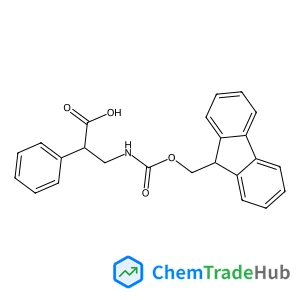
(S)-3-((((9H-Fluoren-9-yl)methoxy)carbonyl)amino)-2-phenylpropanoic acid
CAS Number:
1217663-60-9
Molecular Formula:
C24H21NO4
Amit Basak, Debarati Mitra, Moumita Kar, Kumar Biradha
Designed azobenzene-based enediyne-amino acid C2-symmetric hybrids have been synthesized and the role of amino acid linker in stabilizing the Z form has been demonstrated; DNA-binding and cleavage studies have established higher reactivity of the Z-isomers.
Josep M. Anglada, Ramon Crehuet, Marilia Martins-Costa, Joseph S. Francisco, Manuel Ruiz-López
DOI: 10.1039/C7CP01976A
DOI: 10.1039/C7CP01945A
DOI: 10.1039/C7CP01103B
Kai-Cheng Zhang, Yong Liu, Yan Zhu, Li-Bin Shi
DOI: 10.1039/C7CP01641G
Woon Yong Sohn, Sana Habka, Eric Gloaguen, Michel Mons
DOI: 10.1039/C7CP03058D
H. Mendil-Jakani, I. Zamanillo López, V. H. Mareau, L. Gonon
DOI: 10.1039/C7CP00087A
Liangshuai Zhong, Xiaofang Chen, Jingshan Qi
DOI: 10.1039/C7CP00964J
Jie Pan, Vladimir Chorošajev, Mikas Vengris, S. Seckin Senlik, Jian-Ren Shen, Darius Abramavicius, Jennifer P. Ogilvie
DOI: 10.1039/C7CP01673E
Dage Sundholm
DOI: 10.1039/C7CP00624A
When considering alternatives to 1-(4-Chlorophenyl)-N-hydroxymethanimine (CAS: 3...
This compound should be stored in a cool, dry place away from direct sunlight. I...
3-(4-Bromophenyl)-5-(2-fluorophenyl)-1,2,4-oxadiazole is synthesized through a m...
5-Chloro-2-(4-chlorophenyl)-4-methyl-6-[3-(1-piperidinyl)propoxy]pyrimidine (CAS...
2-Chloro-4-(difluoromethoxy)pyridine is used in the pharmaceutical industry for ...
3-Chloro-6-methylpyridazine (CAS: 1121-79-5) is classified under the Globally Ha...
Several alternatives can be used in the synthesis of Methyl 4,5-dimethyl-2-nitro...
Alternatives to (2E,2'E)-3,3'-(1,4-Phenylene)bisacrylaldehyde include other acry...
3-Amino-5-chloropyridin-2-ol hydrochloride is an organic compound with the CAS n...
When handling 6,7-Difluoro-2,3-dihydro-4H-chromen-4-one, it is essential to wear...

ChemComm publishes urgent research which is of outstanding significance and interest to experts in the field, while also appealing to the journal’s broad chemistry readership. Our communication format is ideally suited to short, urgent studies that are of such importance that they require accelerated publication. Our scope covers all topics in chemistry, and research at the interface of chemistry and other disciplines (such as materials science, nanoscience, physics, engineering and biology) where there is a significant novelty in the chemistry aspects. Major topic areas covered include: Analytical Chemistry Catalysis Chemical Biology and medicinal chemistry Computational Chemistry and Machine Learning Energy and sustainable chemistry Environmental Chemistry Green Chemistry Inorganic Chemistry Materials Chemistry Nanoscience Organic Chemistry Physical Chemistry Polymer Chemistry Supramolecular Chemistry
![2-{[(1R,2S)-2-Aminocyclohexyl]amino}-4-{[3-(2H-1,2,3-triazol-2-yl)phenyl]amino}-5-pyrimidinecarboxamide structure](https://static.chemtradehub.com/structs/137/1370261-96-3-40df.webp "2-{[(1R,2S)-2-Aminocyclohexyl]amino}-4-{[3-(2H-1,2,3-triazol-2-yl)phenyl]amino}-5-pyrimidinecarboxamide structure")





