


Contents
Literature Information
Publication Date
DOI
10.1039/B702928B
Impact Factor
6.222
Authors
View Original
Abstract
The first page of this article is displayed as the abstract.
Recommended Journals

Bioorganic & Medicinal Chemistry Letters

Critical Reviews in Solid State and Materials Sciences

Cellulose

Journal of Asian Natural Products Research

Journal of the Indian Institute of Science

Bioorganic & Medicinal Chemistry

Polycyclic Aromatic Compounds

NDT & E International

Medicinal Chemistry Research

Journal of Chemical Sciences
Related Literature
Enhanced dihydrogen adsorption in symmetry-lowered metal–porphyrin-containing frameworks
Y. Y. Sun, Woon Ih Choi, Joongoo Kang, S. B. Zhang
2009-09-25
Paper
DOI: 10.1039/B913711D
Chirality transition in the epoxidation of (−)-α-pinene and successive hydrolysis studied by Raman optical activity and DFT
Zhaochi Feng, Can Li
2010-02-09
Paper
DOI: 10.1039/B919993D
Low-coverage adsorption properties of the metal–organic framework MIL-47 studied by pulse chromatography and Monte Carlo simulations
Vincent Finsy, Sofia Calero, Elena García-Pérez, Patrick J. Merkling, Gill Vedts, Dirk E. De Vos, Gino V. Baron, Joeri F. M. Denayer
2009-03-02
Paper
DOI: 10.1039/B822247A
In situSTM investigation of the lithium underpotential deposition on Au(111) in the air- and water-stable ionic liquid 1-butyl-1-methylpyrrolidinium bis(trifluoromethylsulfonyl)amide
N. Bocchi
2009-10-20
Paper
DOI: 10.1039/B916809E
Physical properties of nanocomposites prepared by in situpolymerization of high-density polyethylene on multiwalled carbon nanotubes
Jihun Kim, Soon Man Hong, Soonjong Kwak, Yongsok Seo
2009-09-23
Paper
DOI: 10.1039/B913527H
On the low volatility of cyclic esters: an infrared spectroscopy comparison between dimers of γ-butyrolactone and methyl propionate
Susanne Hesse, Martin A. Suhm
2009-11-05
Paper
DOI: 10.1039/B915419A
An investigation of slow charge separation in a Tyrosine M210 to Tryptophan mutant of the Rhodobacter sphaeroidesreaction center by femtosecond mid-infrared spectroscopy
Natalia P. Pawlowicz, Ivo H. M. van Stokkum, Jacques Breton, Rienk van Grondelle, Michael R. Jones
2010-01-28
Paper
DOI: 10.1039/B905934B
Photoinduced multi-electron transfer in the Dn–A system consisting of multi-phthalocyanines linked to one carbon nanotube
Xiaofeng Cui, Qiang Liu, Fushi Zhang
2009-03-13
Paper
DOI: 10.1039/B819521H
You might also like
Compound Q&A
What precautions should be taken when handling 2-Chloro-1,2-bis(4-methylphenyl)ethanone (CAS: 71193-32-3)?
When handling 2-Chloro-1,2-bis(4-methylphenyl)ethanone (CAS: 71193-32-3), it is ...
71193-32-32-Chloro-1,2-bis(4-m...
Compound Q&A
What industries use 4-Ethoxy-3-(5-methyl-4-oxo-7-propyl-1,4-dihydroimidazo[5,1-f][1,2,4]triazin-2-yl)benzenesulfonyl chloride (CAS: 224789-26-8)?
4-Ethoxy-3-(5-methyl-4-oxo-7-propyl-1,4-dihydroimidazo[5,1-f][1,2,4]triazin-2-yl...
224789-26-84-Ethoxy-3-(5-methyl...
Compound Q&A
How should Methyl 3-Oxo-4-Androsten-17-Carboxylate (CAS: 2681-55-2) be stored?
Methyl 3-Oxo-4-Androsten-17-Carboxylate (CAS: 2681-55-2) should be stored in a c...
2681-55-2Methyl 3-Oxo-4-Andro...
Compound Q&A
What are the main uses of (R)-3-Amino-4-(3-hexylphenylamino)-4-oxobutylphosphonic acid (CAS: 909725-61-7)?
(R)-3-Amino-4-(3-hexylphenylamino)-4-oxobutylphosphonic acid is primarily used i...
909725-61-7(R)-3-Amino-4-(3-hex...
Compound Q&A
What regulatory guidelines apply to 2-Methyl-2-propanyl 3-amino-3-carbamoyl-1-azetidinecarboxylate (CAS: 1254120-14-3)?
2-Methyl-2-propanyl 3-amino-3-carbamoyl-1-azetidinecarboxylate (CAS: 1254120-14-...
1254120-14-32-Methyl-2-propanyl ...
Compound Q&A
Are there alternatives to (E)-4-(tert-Butoxy)-4-oxobut-2-enoic acid (CAS: 135355-96-3) in synthesis?
There are alternative reagents that can be used in synthesis instead of (E)-4-(t...
135355-96-3(E)-4-(tert-Butoxy)-...
Compound Q&A
What are the physical and chemical properties of [2-(3-Chlorophenyl)-1,3-thiazol-4-yl]methanol (CAS: 121202-20-8)?
[2-(3-Chlorophenyl)-1,3-thiazol-4-yl]methanol (CAS: 121202-20-8) is a crystallin...
121202-20-8[2-(3-Chlorophenyl)-...
Compound Q&A
What is the market or research trend for Methyl (2S)-[(4S)-2,2-dimethyl-1,3-dioxolan-4-yl]{[(4-methylphenyl)sulfonyl]oxy}acetate (CAS: 166249-17-8)?
The market and research trends for Methyl (2S)-[(4S)-2,2-dimethyl-1,3-dioxolan-4...
166249-17-8Methyl (2S)-[(4S)-2,...
Compound Q&A
What is the market or research trend for 1-Bromo-2-isocyanatoethane (CAS: 42865-19-0)?
The market for 1-Bromo-2-isocyanatoethane (CAS: 42865-19-0) is driven by its use...
42865-19-01-Bromo-2-isocyanato...
Compound Q&A
What are the main uses of 4-Nitro-D-phenylalanine hydrochloride (CAS: 147065-06-3)?
4-Nitro-D-phenylalanine hydrochloride (CAS: 147065-06-3) is primarily used in re...
147065-06-34-Nitro-D-phenylalan...
Source Journal
Chemical Communications

CiteScore:
8.6
Self-citation Rate:
4.7%
Articles per Year:
2458
ChemComm publishes urgent research which is of outstanding significance and interest to experts in the field, while also appealing to the journal’s broad chemistry readership. Our communication format is ideally suited to short, urgent studies that are of such importance that they require accelerated publication. Our scope covers all topics in chemistry, and research at the interface of chemistry and other disciplines (such as materials science, nanoscience, physics, engineering and biology) where there is a significant novelty in the chemistry aspects. Major topic areas covered include: Analytical Chemistry Catalysis Chemical Biology and medicinal chemistry Computational Chemistry and Machine Learning Energy and sustainable chemistry Environmental Chemistry Green Chemistry Inorganic Chemistry Materials Chemistry Nanoscience Organic Chemistry Physical Chemistry Polymer Chemistry Supramolecular Chemistry
Recommended Compounds
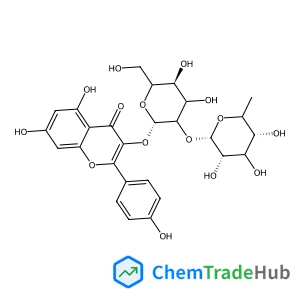
5,7-Dihydroxy-2-(4-hydroxyphenyl)-4-oxo-4H-chromen-3-yl 2-O-(6-deoxy-alpha-L-mannopyranosyl)-beta-D-glucopyranoside
CAS Number:
32602-81-6
Molecular Formula:
C27H30O15
Recommended Suppliers





Disclaimer
This page provides academic journal information for reference and research purposes only. We are not affiliated with any journal publishers and do not handle publication submissions. For publication-related inquiries, please contact the respective journal publishers directly.
If you notice any inaccuracies in the information displayed, please contact us at support@chemtradehub.com. We will promptly review and address your concerns.