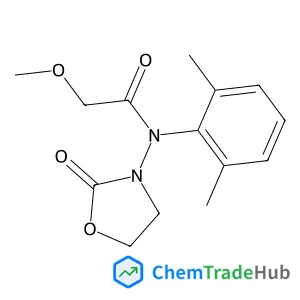
N-(2,6-Dimethylphenyl)-2-methoxy-N-(2-oxo-1,3-oxazolidin-3-yl)acetamide
CAS Number:
77732-09-3
Molecular Formula:
C14H18N2O4
Natalia P. Pawlowicz, Ivo H. M. van Stokkum, Jacques Breton, Rienk van Grondelle, Michael R. Jones
Energy and electron transfer in a tyrosine M210 to tryptophan (YM210W) mutant of the Rhodobacter sphaeroides reaction center (RC) were investigated through time-resolved visible pump/mid-infrared (mid-IR) probe spectroscopy at room temperature, with the aim to further characterize the primary charge separated states in the RC. This mutant is known to display slow and multi-exponential charge separation, and was used in earlier work to prove the existence of an alternative route for charge separation starting from the accessory bacteriochlorophyll in the active branch, BL. The mutant RCs were excited at 860 nm (direct excitation of the primary donor (P) BChls (PL/PM)), 600 nm (unselective excitation), 805 nm (direct excitation of both accessory bacteriochlorophyll cofactors BL and BM) and 795 nm (direct excitation of BL). Absorption changes associated with carbonyl (CO) stretch vibrational modes of the cofactors and protein were recorded in the region between 1600 and 1775 cm−1, and both a sequential analysis and simultaneous target analysis of the data were performed. The decay of P* in the YM210W mutant was multi-exponential with lifetimes of 29 and 63.5 ps. The decay of P+BL− state was ∼10 times longer in the YM210W RC than in the R-26 RC (∼7 ps vs. ∼0.7 ps), and in the mid-IR difference absorption spectrum of P+BL− the stretching frequency of the 9-keto CO group of BL in the ground state was located around 1675–1680 cm−1, consistent with the presence of a hydrogen bond donated by an adjacent water molecule. Excitation at 795 nm produced a small amount of BL*-driven charge separation, as assessed from the excitation wavelength dependence of the raw difference spectra recorded during the first few ps after excitation. This process led to the formation of P+BL−. Only the relaxed form of the P+HL− radical pair was observed in the YM210W mutant, and the mid-IR difference absorption spectra of P+HL− and P+BL− showed a change in the relative amplitude of the PL+ and PM+ bands when compared to equivalent spectra for the R-26 RC. This indicates that the YM210W mutation causes an increased localization of the electron hole on the PM half of the dimer. The absorbance difference spectrum of P+HL− in the R-26 RC contains a feature attributable to a Stark shift of one or more amide CO oscillators. This feature was shifted to lower frequency by ∼5 cm−1 in the YM210W RC, and consideration of the limited structural changes in this RC indicates that this feature arises from an amide CO group in the immediate vicinity of the M210 residue, most probably that of the adjacent M209 amino acid.
Shinichi Enami, Michael R. Hoffmann, Agustín J. Colussi
DOI: 10.1039/C6CP06652F
Ayyanar Karuppasamy, Kesavan Stalindurai, Jia-De Peng, Kuo-Chuan Ho, Chennan Ramalingan
DOI: 10.1039/C6CP05722E
Dhananjay Dey, Subhrajyoti Bhandary, Sajesh P. Thomas, Mark A. Spackman, Deepak Chopra
DOI: 10.1039/C6CP05917A
Julian Michalowsky, Birgit Fischer, Jens Smiatek
DOI: 10.1039/C6CP05991K
Y. Cui, K. D. Fulfer, J. Ma, T. K. Weldeghiorghis, D. G. Kuroda
DOI: 10.1039/C6CP06318G
Richard Dawes, Hua Guo
DOI: 10.1039/C6CP06232F
B. B. Xiao, X. B. Jiang, X. L. Yang, Q. Jiang
DOI: 10.1039/C6CP05869H
Alexander Rosu-Finsen, Demian Marchione, Tara L. Salter, James W. Stubbing, Wendy A. Brown, Martin R. S. McCoustra
DOI: 10.1039/C6CP05751A
Rémi Pétuya, Fabio Busnengo
DOI: 10.1039/C6CP06222A
Mouritz N. Svenson, Randall E. Youngman, Yuanzheng Yue, Sylwester J. Rzoska, Michal Bockowski, Lars R. Jensen, Morten M. Smedskjaer
DOI: 10.1039/C6CP06341A
(3.beta.)-3-Hydroxy-N,N-dimethyl-chol-5-en-24-amide (CAS: 79066-03-8) is primari...
5-(Aminomethyl)-2-methoxyphenol (CAS: 89702-89-6) is classified under GHS as a s...
Thieno[2,3-c]pyridin-7(6H)-one (CAS: 28981-13-7) is a heterocyclic organic compo...
1-[(6-Methoxy-3-pyridinyl)methyl]-4-piperidinamine dihydrochloride is generally ...
[(2E)-3-Phenyl-2-propen-1-yl]phosphonic acid (CAS: 146404-58-2) is regulated und...
6-Bromo-7-methoxyquinoline (CAS: 1620515-86-7) falls under the scope of the Glob...
This compound is primarily used in the pharmaceutical industry for the developme...
1-Ethyl-7-[2-methyl-6-(4H-1,2,4-triazol-3-yl)-3-pyridinyl]-3,5-dihydropyrazino[2...
Alternative reagents such as 2-[(dimethylamino)methyl]phenylboronic acid or rela...
3-(Piperidin-4-yloxy)pyridine (CAS: 310881-48-2) is an organic compound with the...

Physical Chemistry Chemical Physics (PCCP) is an international journal co-owned by 19 physical chemistry and physics societies from around the world. This journal publishes original, cutting-edge research in physical chemistry, chemical physics and biophysical chemistry. To be suitable for publication in PCCP, articles must include significant innovation and/or insight into physical chemistry; this is the most important criterion that reviewers and Editors will judge against when evaluating submissions. The journal has a broad scope and welcomes contributions spanning experiment, theory, computation and data science. Topical coverage includes spectroscopy, dynamics, kinetics, statistical mechanics, thermodynamics, electrochemistry, catalysis, surface science, quantum mechanics, quantum computing and machine learning. Interdisciplinary research areas such as polymers and soft matter, materials, nanoscience, energy, surfaces/interfaces, and biophysical chemistry are welcomed if they demonstrate significant innovation and/or insight into physical chemistry. Joined experimental/theoretical studies are particularly appreciated when complementary and based on up-to-date approaches.