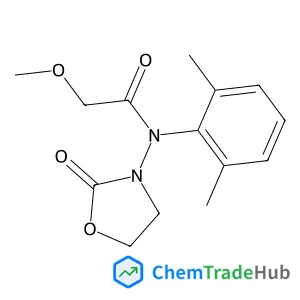
N-(2,6-Dimethylphenyl)-2-methoxy-N-(2-oxo-1,3-oxazolidin-3-yl)acetamide
CAS Number:
77732-09-3
Molecular Formula:
C14H18N2O4
Vincent Finsy, Sofia Calero, Elena García-Pérez, Patrick J. Merkling, Gill Vedts, Dirk E. De Vos, Gino V. Baron, Joeri F. M. Denayer
Low-coverage adsorption properties of the metal–organic framework MIL-47 were determined by a combined experimental and simulation study. Henry constants and low coverage adsorption enthalpies of C5–C8 linear and branched alkanes, cyclohexane and benzene were measured from 120 to 240 °C using pulse gas chromatography. An adapted force field for linear and branched alkanes in MIL-47 was used to compute the adsorption properties of those molecules. A new set of charges was developed for simulations with benzene in MIL-47. The adsorption enthalpy of linear alkanes increases with about 7.6 kJ mol−1 per additional –CH2– group. Henry adsorption constants of iso-alkanes are slightly lower than those of the linear chains but the MIL-47 framework is not imposing steric constraints on the branched chains. Benzene and cyclohexane are adsorbed less strongly than n-hexane as they have less hydrogen atoms. For the studied non-polar molecules, the adsorption energies are dominated by van der Waals interactions and benzene adsorption is additionally influenced by Coulombic interactions. The simulated tendencies are in good agreement with the experiments.
Marat R. Talipov, Esther Steiner
DOI: 10.1039/C9CP02271F
Christopher Päslack, Matthias Heyden, Lars V. Schäfer
DOI: 10.1039/C9CP01431D
Isabel Gonzalo, Miguel A. Antón
DOI: 10.1039/C8CP07764A
A. Hult Roos, J. Andersson, M. Wallner, R. J. Squibb, R. Feifel
DOI: 10.1039/C9CP01415B
Yoshihiro Koyama, Kiyoto Matsuishi, Takahiro Takekiyo, Hiroshi Abe, Yukihiro Yoshimura
DOI: 10.1039/C9CP01730E
Bhaskar Chilukuri, Ursula Mazur, K. W. Hipps
DOI: 10.1039/C9CP01774G
Wei-Dong Li
DOI: 10.1039/C9CP01702J
Matthew G. Quesne, Alberto Roldan, Nora H. de Leeuw, C. Richard A. Catlow
DOI: 10.1039/C9CP00924H
Sérgio R. S. Veloso, Carlos A. B. Magalhães, Ana Rita O. Rodrigues, H. Vilaça, Maria-João R. P. Queiroz, J. A. Martins, Paulo J. G. Coutinho, Paula M. T. Ferreira, Elisabete M. S. Castanheira
DOI: 10.1039/C9CP00352E
Rachel A. Krueger, Guillaume Blanquart
DOI: 10.1039/C9CP02027F
When handling 2-Chloro-1,2-bis(4-methylphenyl)ethanone (CAS: 71193-32-3), it is ...
4-Ethoxy-3-(5-methyl-4-oxo-7-propyl-1,4-dihydroimidazo[5,1-f][1,2,4]triazin-2-yl...
Methyl 3-Oxo-4-Androsten-17-Carboxylate (CAS: 2681-55-2) should be stored in a c...
(R)-3-Amino-4-(3-hexylphenylamino)-4-oxobutylphosphonic acid is primarily used i...
2-Methyl-2-propanyl 3-amino-3-carbamoyl-1-azetidinecarboxylate (CAS: 1254120-14-...
There are alternative reagents that can be used in synthesis instead of (E)-4-(t...
[2-(3-Chlorophenyl)-1,3-thiazol-4-yl]methanol (CAS: 121202-20-8) is a crystallin...
The market and research trends for Methyl (2S)-[(4S)-2,2-dimethyl-1,3-dioxolan-4...
The market for 1-Bromo-2-isocyanatoethane (CAS: 42865-19-0) is driven by its use...
4-Nitro-D-phenylalanine hydrochloride (CAS: 147065-06-3) is primarily used in re...

Physical Chemistry Chemical Physics (PCCP) is an international journal co-owned by 19 physical chemistry and physics societies from around the world. This journal publishes original, cutting-edge research in physical chemistry, chemical physics and biophysical chemistry. To be suitable for publication in PCCP, articles must include significant innovation and/or insight into physical chemistry; this is the most important criterion that reviewers and Editors will judge against when evaluating submissions. The journal has a broad scope and welcomes contributions spanning experiment, theory, computation and data science. Topical coverage includes spectroscopy, dynamics, kinetics, statistical mechanics, thermodynamics, electrochemistry, catalysis, surface science, quantum mechanics, quantum computing and machine learning. Interdisciplinary research areas such as polymers and soft matter, materials, nanoscience, energy, surfaces/interfaces, and biophysical chemistry are welcomed if they demonstrate significant innovation and/or insight into physical chemistry. Joined experimental/theoretical studies are particularly appreciated when complementary and based on up-to-date approaches.