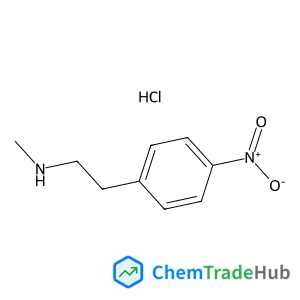
N-Methyl-2-(4-nitrophenyl)ethanamine hydrochloride (1:1)
CAS Number:
166943-39-1
Molecular Formula:
C9H13ClN2O2
Susanne Hesse, Martin A. Suhm
The dramatically lower volatility of γ-butyrolactone compared to its open chain analog methyl propionate is analyzed at the molecular dimer level using FTIR spectroscopy in supersonic jets. It is found that the spectral shifts from the monomer to the dimer are about three times more pronounced in the lactone at low temperatures. The spectra are consistent with sandwich-like dimers optimizing their strong dipole–dipole interaction, possibly augmented by specific C–H⋯OC hydrogen bond contacts. The spectra show significant evolution from the dimer to the condensed phase, indicative of secondary interactions with the ester oxygen and long range forces. The reduced dipole moment in the open chain ester leads to less specific interactions, unless a trans conformation of the ester group as in the lactones is enforced. The latter is not energetically accessible in open chain esters because it would bring the molecular CO and C–O–C dipole moments into an unfavorable near-parallel orientation, thus their higher volatility.
Indranil Chakraborty, Urmila Saha, Dipika Mandal, Suprabhat Mukherjee, Nikhilesh Joardar, Santi P. Sinha Babu, Gopinatha Suresh Kumar, Kalyan Mandal
DOI: 10.1039/C9CP01877H
Irina Ritsch, Henrik Hintz, Gunnar Jeschke, Adelheid Godt, Maxim Yulikov
DOI: 10.1039/C8CP06573J
Hans-Joachim Werner, Daniel Kats, Samuel Lenz, Guntram Rauhut, Hermann Stoll, Joris van Slageren
DOI: 10.1039/C9CP00785G
Marat R. Talipov, Esther Steiner
DOI: 10.1039/C9CP02271F
Ping Li, Zhixiang Wang, Houyu Zhang
DOI: 10.1039/C9CP00779B
P. A. Manojkumar, Nanda Gopala Krishna, G. Mangamma, S. K. Albert
DOI: 10.1039/C9CP02165E
Qiang Wang, Xiao Huang, Wei Guo
DOI: 10.1039/C9CP01600G
C. J. Cobos, K. Hintzer, L. Sölter, E. Tellbach, A. Thaler
DOI: 10.1039/C9CP01142K
DOI: 10.1039/C9CP00581A
When handling 2-Chloro-1,2-bis(4-methylphenyl)ethanone (CAS: 71193-32-3), it is ...
4-Ethoxy-3-(5-methyl-4-oxo-7-propyl-1,4-dihydroimidazo[5,1-f][1,2,4]triazin-2-yl...
Methyl 3-Oxo-4-Androsten-17-Carboxylate (CAS: 2681-55-2) should be stored in a c...
(R)-3-Amino-4-(3-hexylphenylamino)-4-oxobutylphosphonic acid is primarily used i...
2-Methyl-2-propanyl 3-amino-3-carbamoyl-1-azetidinecarboxylate (CAS: 1254120-14-...
There are alternative reagents that can be used in synthesis instead of (E)-4-(t...
[2-(3-Chlorophenyl)-1,3-thiazol-4-yl]methanol (CAS: 121202-20-8) is a crystallin...
The market and research trends for Methyl (2S)-[(4S)-2,2-dimethyl-1,3-dioxolan-4...
The market for 1-Bromo-2-isocyanatoethane (CAS: 42865-19-0) is driven by its use...
4-Nitro-D-phenylalanine hydrochloride (CAS: 147065-06-3) is primarily used in re...

Physical Chemistry Chemical Physics (PCCP) is an international journal co-owned by 19 physical chemistry and physics societies from around the world. This journal publishes original, cutting-edge research in physical chemistry, chemical physics and biophysical chemistry. To be suitable for publication in PCCP, articles must include significant innovation and/or insight into physical chemistry; this is the most important criterion that reviewers and Editors will judge against when evaluating submissions. The journal has a broad scope and welcomes contributions spanning experiment, theory, computation and data science. Topical coverage includes spectroscopy, dynamics, kinetics, statistical mechanics, thermodynamics, electrochemistry, catalysis, surface science, quantum mechanics, quantum computing and machine learning. Interdisciplinary research areas such as polymers and soft matter, materials, nanoscience, energy, surfaces/interfaces, and biophysical chemistry are welcomed if they demonstrate significant innovation and/or insight into physical chemistry. Joined experimental/theoretical studies are particularly appreciated when complementary and based on up-to-date approaches.