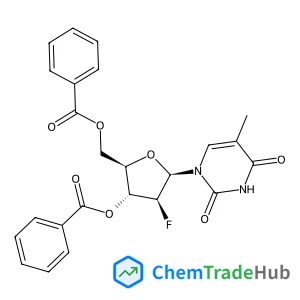
1-(3',5'-Di-O-benzoyl-2'-deoxy-2'-fluoro-b-D-arabinofuranosyl)thymine
CAS Number:
97614-47-6
Molecular Formula:
C24H21FN2O7
The first page of this article is displayed as the abstract.
Suitao Qi, Kevin J. Smith, Yiming Zhou
DOI: 10.1039/D2RE00345G
Shiqing Wang, Xiaocheng Lan, Shiyong Xing, Babar Ali, Tiefeng Wang
DOI: 10.1039/D2RE00055E
Nat Phongprueksathat, Thanakorn Thanasujaree, Thirasak Rirksomboon
DOI: 10.1039/D1RE00561H
Liping Zhou
DOI: 10.1039/D2RE00286H
Qiang Geng, Guoqiang Huang
DOI: 10.1039/D1RE00569C
Chaoqiang Wu, Chengyong Wang, Kequan Chen, Fei Cao, Pingkai Ouyang
DOI: 10.1039/D2RE00118G
Yuuki Mochizuki, Javzandolgor Bud, Enkhsaruul Byambajav, Naoto Tsubouchi
DOI: 10.1039/D2RE00003B
Flavio Tollini, Alice Occhetta, Francesca Broglia, Vincenzo Calemma, Stefano Carminati, Giuseppe Storti, Mattia Sponchioni, Davide Moscatelli
DOI: 10.1039/D2RE00191H
(3.beta.)-3-Hydroxy-N,N-dimethyl-chol-5-en-24-amide (CAS: 79066-03-8) is primari...
5-(Aminomethyl)-2-methoxyphenol (CAS: 89702-89-6) is classified under GHS as a s...
Thieno[2,3-c]pyridin-7(6H)-one (CAS: 28981-13-7) is a heterocyclic organic compo...
1-[(6-Methoxy-3-pyridinyl)methyl]-4-piperidinamine dihydrochloride is generally ...
[(2E)-3-Phenyl-2-propen-1-yl]phosphonic acid (CAS: 146404-58-2) is regulated und...
6-Bromo-7-methoxyquinoline (CAS: 1620515-86-7) falls under the scope of the Glob...
This compound is primarily used in the pharmaceutical industry for the developme...
1-Ethyl-7-[2-methyl-6-(4H-1,2,4-triazol-3-yl)-3-pyridinyl]-3,5-dihydropyrazino[2...
Alternative reagents such as 2-[(dimethylamino)methyl]phenylboronic acid or rela...
3-(Piperidin-4-yloxy)pyridine (CAS: 310881-48-2) is an organic compound with the...

ChemComm publishes urgent research which is of outstanding significance and interest to experts in the field, while also appealing to the journal’s broad chemistry readership. Our communication format is ideally suited to short, urgent studies that are of such importance that they require accelerated publication. Our scope covers all topics in chemistry, and research at the interface of chemistry and other disciplines (such as materials science, nanoscience, physics, engineering and biology) where there is a significant novelty in the chemistry aspects. Major topic areas covered include: Analytical Chemistry Catalysis Chemical Biology and medicinal chemistry Computational Chemistry and Machine Learning Energy and sustainable chemistry Environmental Chemistry Green Chemistry Inorganic Chemistry Materials Chemistry Nanoscience Organic Chemistry Physical Chemistry Polymer Chemistry Supramolecular Chemistry