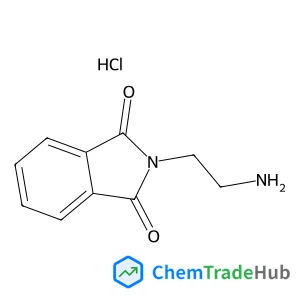
2-(2-Aminoethyl)-1H-isoindole-1,3(2H)-dione hydrochloride (1:1)
CAS Number:
30250-67-0
Molecular Formula:
C10H11ClN2O2
The first page of this article is displayed as the abstract.
A. Bellili, M. C. Gazeau, Y. Bénilan, N. Fray, J. C. Guillemin, M. Hochlaf, M. Schwell
DOI: 10.1039/C9CP04310A
Xingbin Zhao, Li Li, Kuo Bao, Pinwen Zhu, Qiang Tao, Shuailing Ma, Bo Liu, Yufei Ge, Da Li
DOI: 10.1039/D0CP03380D
Julian M. Schmidt-Engler, Larissa Blankenburg, Rene Zangl, Jan Hoffmann, Nina Morgner, Jens Bredenbeck
DOI: 10.1039/D0CP04307A
Bernard Ryan
DOI: 10.1039/D0CP04053C
Wenhui Hu, Fan Yang, Nick Pietraszak, Jing Gu, Jier Huang
DOI: 10.1039/D0CP03995K
Huilong Dong, Yujin Ji, Lifeng Ding, Youyong Li
DOI: 10.1039/C9CP04284A
Yongshuai Wen, Qingchang Liu, Yongshou Liu
DOI: 10.1039/D0CP03834B
Jinjie Gu, Xilong Qu
DOI: 10.1039/D0CP04565A
Natalia Bushlanova, Yurii Uspenskii
DOI: 10.1039/D0CP05139J
Waste containing 2-Ethyl-4-Methyl-1H-Imidazole-5-Carbaldehyde (CAS: 88634-80-4) ...
Triethoxy(octyl)silane (CAS: 1385031-14-0) is widely used in the pharmaceuticals...
Several alternatives to 3-iodo-7-nitro-1H-indazole (CAS: 864724-64-1) exist in t...
Yes, there are alternatives to Benzene, bis[(trimethoxysilyl)ethyl] (CAS: 266317...
Isothiazole-3-carbonitrile (CAS: 1452-17-1) is generally considered safe when us...
(3-Chlorophenyl)methanol (CAS: 873-63-2) is considered low to moderately toxic. ...
(2S,3S)-2-Hydroxy-3-({[(2-methyl-2-propanyl)oxy]carbonyl}amino)-3-(2-naphthyl)pr...
Proper handling of methyl 2-(bromomethyl)-5-methoxybenzoate requires the use of ...
6,8-Dibromoimidazo[1,2-a]pyridine-2-carboxylic acid (CAS: 904805-36-3) is an aro...
3-Amino-5-bromo-2-pyridinecarbonitrile is considered safe when handled under pro...

Reaction Chemistry & Engineering is an interdisciplinary journal reporting cutting-edge research focused on enhancing the understanding and efficiency of reactions. Reaction engineering leverages the interface where fundamental molecular chemistry meets chemical engineering and technology. Challenges in chemistry can be overcome by the application of new technologies, while engineers may find improved solutions for process development from the latest developments in reaction chemistry. Reaction Chemistry & Engineering is a unique forum for researchers whose interests span the broad areas of chemical engineering and chemical sciences to come together in solving problems of importance to wider society. All papers should be written to be approachable by readers across the engineering and chemical sciences. Papers that consider multiple scales, from the laboratory up to and including plant scale, are particularly encouraged.