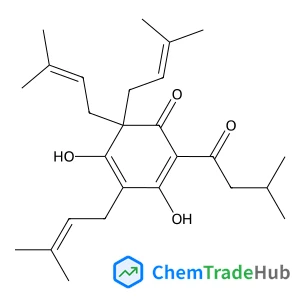
3,5-Dihydroxy-4-(3-methylbutanoyl)-2,6,6-tris(3-methyl-2-buten-1-yl)-2,4-cyclohexadien-1-one
CAS Number:
468-28-0
Molecular Formula:
C26H38O4
Takahiro Kojima, Jun-ichi Nishida, Shizuo Tokito, Hirokazu Tada, Yoshiro Yamashita
New oligomers containing a pyrazine unit have been prepared: the bithienyl derivatives afforded p-type FET devices whereas the trifluoromethylphenyl derivatives showed n-type FET behavior.
Daoqing Xiao, Dan Yu, Xiling Xu, Zijun Yu, Min Cheng, Yikui Du, Weijun Zheng, Qihe Zhu, Cunhao Zhang
DOI: 10.1039/B818688J
Harry L. Tuller, Scott J. Litzelman, WooChul Jung
DOI: 10.1039/B901906E
Maria Grazia Giorgini, Hajime Torii, Maurizio Musso
DOI: 10.1039/B912164A
S. Fleutot, J. C. Dupin, I. Baraille, C. Forano, G. Renaudin, F. Leroux, D. Gonbeau, H. Martinez
DOI: 10.1039/B818730D
Ali Hussain Reshak, Dalibor Stys, S. Auluck, I. V. Kityk
DOI: 10.1039/B920743K
Gonzalo García, Marc T. M. Koper
DOI: 10.1039/B914013A
P. Träskelin, T. L. Kuhl, R. Faller
DOI: 10.1039/B911311H
When handling 2-Chloro-1,2-bis(4-methylphenyl)ethanone (CAS: 71193-32-3), it is ...
4-Ethoxy-3-(5-methyl-4-oxo-7-propyl-1,4-dihydroimidazo[5,1-f][1,2,4]triazin-2-yl...
Methyl 3-Oxo-4-Androsten-17-Carboxylate (CAS: 2681-55-2) should be stored in a c...
(R)-3-Amino-4-(3-hexylphenylamino)-4-oxobutylphosphonic acid is primarily used i...
2-Methyl-2-propanyl 3-amino-3-carbamoyl-1-azetidinecarboxylate (CAS: 1254120-14-...
There are alternative reagents that can be used in synthesis instead of (E)-4-(t...
[2-(3-Chlorophenyl)-1,3-thiazol-4-yl]methanol (CAS: 121202-20-8) is a crystallin...
The market and research trends for Methyl (2S)-[(4S)-2,2-dimethyl-1,3-dioxolan-4...
The market for 1-Bromo-2-isocyanatoethane (CAS: 42865-19-0) is driven by its use...
4-Nitro-D-phenylalanine hydrochloride (CAS: 147065-06-3) is primarily used in re...

ChemComm publishes urgent research which is of outstanding significance and interest to experts in the field, while also appealing to the journal’s broad chemistry readership. Our communication format is ideally suited to short, urgent studies that are of such importance that they require accelerated publication. Our scope covers all topics in chemistry, and research at the interface of chemistry and other disciplines (such as materials science, nanoscience, physics, engineering and biology) where there is a significant novelty in the chemistry aspects. Major topic areas covered include: Analytical Chemistry Catalysis Chemical Biology and medicinal chemistry Computational Chemistry and Machine Learning Energy and sustainable chemistry Environmental Chemistry Green Chemistry Inorganic Chemistry Materials Chemistry Nanoscience Organic Chemistry Physical Chemistry Polymer Chemistry Supramolecular Chemistry