













Theoretical and REMPI spectroscopic study on phenylhydrazine and phenylhydrazine–(Ar)n (n = 1, 2) van der Waals complexes
Literature Information
Publication Date
2009-02-27
DOI
10.1039/B818688J
Impact Factor
3.676
Authors
Daoqing Xiao, Dan Yu, Xiling Xu, Zijun Yu, Min Cheng, Yikui Du, Weijun Zheng, Qihe Zhu, Cunhao Zhang
View Original
Abstract
Phenylhydrazine and its van der Waals complexes with one or two argon atoms were investigated with theoretical calculations and resonant two photon ionization (R2PI) spectroscopy. The ab initio and DFT calculations found a conversion of the orbital hybridization of the Nβ atom from sp3-like in the S0 state to sp2-like in the S1 state, suggesting that the lone pair electrons of the Nβ atom are involved in a super p-p–π conjugation over the skeleton of phenylhydrazine in the S1 state. The structural change of the hydrazino group in the S1← S0 electronic transition was reflected by the vibrational excitations of the hydrazino group observed in the 1C-R2PI spectrum. The band origin of the S1← S0 transition is determined to be 33610 cm−1 and the adiabatic ionization energy (IE) of phenylhydrazine, measured by 2C-R2PI spectroscopy, is 62829 ± 15 cm−1. The S1← S0 electronic transitions of phenylhydrazine–Ar and phenylhydrazine–Ar2 complexes were also observed in the 1C-R2PI spectrum, and their band origins are, respectively, red-shifted by 39 and 80 cm−1 from that of phenylhydrazine.
Related Literature
The molecular mechanism of structural changes in the antimicrobial peptide CM15 upon complex formation with drug molecule suramin: a computational analysis
Adam Sieradzan, Ferenc Zsila, Tünde Juhász, Szilvia Bősze, Adam Liwo, Sergey A. Samsonov
2019-05-01
Paper
DOI: 10.1039/C9CP00471H
Structural analyses of blended Nafion/PVDF electrospun nanofibers
G. Nawn, G. Pace, J. W. Park, R. Wycisk, G. Cavinato, P. N. Pintauro
2019-04-29
Paper
DOI: 10.1039/C9CP01891C
Sudden polarization and zwitterion formation as a pseudo-Jahn–Teller effect: a new insight into the photochemistry of alkenes
Ya Wang, Yang Liu, Isaac B. Bersuker
2019-04-26
Paper
DOI: 10.1039/C9CP01023H
Characteristics of sulfur atoms adsorbed on Ag(100), Ag(110), and Ag(111) as probed with scanning tunneling microscopy: experiment and theory
Peter M. Spurgeon, Da-Jiang Liu, Junepyo Oh, Hyun Jin Yang, Yousoo Kim
2019-05-10
Paper
DOI: 10.1039/C9CP01626K
On the interaction of hyaluronic acid with synovial fluid lipid membranes
Paul Smith, Robert M. Ziolek, Elena Gazzarrini, Dylan M. Owen, Christian D. Lorenz
2019-04-17
Paper
DOI: 10.1039/C9CP01532A
Exchange-dependent spin polarized transport and phase transition in a triple monomer molecule
Yongchen Xiong, Shijun Luo, Haiming Huang, Yanan Ma, Xiong Zhang
2019-04-25
Paper
DOI: 10.1039/C9CP01350D
Improving the accuracy of Cu(ii)–nitroxide RIDME in the presence of orientation correlation in water-soluble Cu(ii)–nitroxide rulers
Irina Ritsch, Henrik Hintz, Gunnar Jeschke, Adelheid Godt, Maxim Yulikov
2019-04-18
Paper
DOI: 10.1039/C8CP06573J
First-principles calculations of thermal transport properties in MoS2/MoSe2 bilayer heterostructure
Wei-Dong Li
2019-04-25
Paper
DOI: 10.1039/C9CP01702J
Furthering the reaction mechanism of cationic vanadium clusters towards oxygen
Haiming Wu
2019-05-03
Paper
DOI: 10.1039/C9CP01192G
Understanding the structural and chemical changes in vertical graphene nanowalls upon plasma nitrogen ion implantation
P. A. Manojkumar, Nanda Gopala Krishna, G. Mangamma, S. K. Albert
2019-04-29
Paper
DOI: 10.1039/C9CP02165E
You might also like
Compound Q&A
What precautions should be taken when handling 2-Chloro-1,2-bis(4-methylphenyl)ethanone (CAS: 71193-32-3)?
When handling 2-Chloro-1,2-bis(4-methylphenyl)ethanone (CAS: 71193-32-3), it is ...
71193-32-32-Chloro-1,2-bis(4-m...
Compound Q&A
What industries use 4-Ethoxy-3-(5-methyl-4-oxo-7-propyl-1,4-dihydroimidazo[5,1-f][1,2,4]triazin-2-yl)benzenesulfonyl chloride (CAS: 224789-26-8)?
4-Ethoxy-3-(5-methyl-4-oxo-7-propyl-1,4-dihydroimidazo[5,1-f][1,2,4]triazin-2-yl...
224789-26-84-Ethoxy-3-(5-methyl...
Compound Q&A
How should Methyl 3-Oxo-4-Androsten-17-Carboxylate (CAS: 2681-55-2) be stored?
Methyl 3-Oxo-4-Androsten-17-Carboxylate (CAS: 2681-55-2) should be stored in a c...
2681-55-2Methyl 3-Oxo-4-Andro...
Compound Q&A
What are the main uses of (R)-3-Amino-4-(3-hexylphenylamino)-4-oxobutylphosphonic acid (CAS: 909725-61-7)?
(R)-3-Amino-4-(3-hexylphenylamino)-4-oxobutylphosphonic acid is primarily used i...
909725-61-7(R)-3-Amino-4-(3-hex...
Compound Q&A
What regulatory guidelines apply to 2-Methyl-2-propanyl 3-amino-3-carbamoyl-1-azetidinecarboxylate (CAS: 1254120-14-3)?
2-Methyl-2-propanyl 3-amino-3-carbamoyl-1-azetidinecarboxylate (CAS: 1254120-14-...
1254120-14-32-Methyl-2-propanyl ...
Compound Q&A
Are there alternatives to (E)-4-(tert-Butoxy)-4-oxobut-2-enoic acid (CAS: 135355-96-3) in synthesis?
There are alternative reagents that can be used in synthesis instead of (E)-4-(t...
135355-96-3(E)-4-(tert-Butoxy)-...
Compound Q&A
What are the physical and chemical properties of [2-(3-Chlorophenyl)-1,3-thiazol-4-yl]methanol (CAS: 121202-20-8)?
[2-(3-Chlorophenyl)-1,3-thiazol-4-yl]methanol (CAS: 121202-20-8) is a crystallin...
121202-20-8[2-(3-Chlorophenyl)-...
Compound Q&A
What is the market or research trend for Methyl (2S)-[(4S)-2,2-dimethyl-1,3-dioxolan-4-yl]{[(4-methylphenyl)sulfonyl]oxy}acetate (CAS: 166249-17-8)?
The market and research trends for Methyl (2S)-[(4S)-2,2-dimethyl-1,3-dioxolan-4...
166249-17-8Methyl (2S)-[(4S)-2,...
Compound Q&A
What is the market or research trend for 1-Bromo-2-isocyanatoethane (CAS: 42865-19-0)?
The market for 1-Bromo-2-isocyanatoethane (CAS: 42865-19-0) is driven by its use...
42865-19-01-Bromo-2-isocyanato...
Compound Q&A
What are the main uses of 4-Nitro-D-phenylalanine hydrochloride (CAS: 147065-06-3)?
4-Nitro-D-phenylalanine hydrochloride (CAS: 147065-06-3) is primarily used in re...
147065-06-34-Nitro-D-phenylalan...
Source Journal
Physical Chemistry Chemical Physics

CiteScore:
5.5
Self-citation Rate:
10.3%
Articles per Year:
3036
Physical Chemistry Chemical Physics (PCCP) is an international journal co-owned by 19 physical chemistry and physics societies from around the world. This journal publishes original, cutting-edge research in physical chemistry, chemical physics and biophysical chemistry. To be suitable for publication in PCCP, articles must include significant innovation and/or insight into physical chemistry; this is the most important criterion that reviewers and Editors will judge against when evaluating submissions. The journal has a broad scope and welcomes contributions spanning experiment, theory, computation and data science. Topical coverage includes spectroscopy, dynamics, kinetics, statistical mechanics, thermodynamics, electrochemistry, catalysis, surface science, quantum mechanics, quantum computing and machine learning. Interdisciplinary research areas such as polymers and soft matter, materials, nanoscience, energy, surfaces/interfaces, and biophysical chemistry are welcomed if they demonstrate significant innovation and/or insight into physical chemistry. Joined experimental/theoretical studies are particularly appreciated when complementary and based on up-to-date approaches.
Recommended Compounds

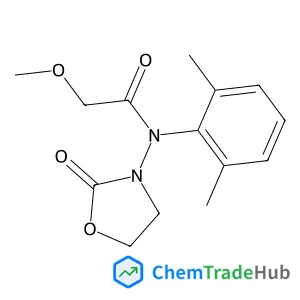
N-(2,6-Dimethylphenyl)-2-methoxy-N-(2-oxo-1,3-oxazolidin-3-yl)acetamide
CAS Number:
77732-09-3
Molecular Formula:
C14H18N2O4
Recommended Suppliers





Disclaimer
This page provides academic journal information for reference and research purposes only. We are not affiliated with any journal publishers and do not handle publication submissions. For publication-related inquiries, please contact the respective journal publishers directly.
If you notice any inaccuracies in the information displayed, please contact us at support@chemtradehub.com. We will promptly review and address your concerns.