












Mechanism of electro-oxidation of carbon monoxide on stepped platinum electrodes in alkaline media: a chronoamperometric and kinetic modeling study
Literature Information
Publication Date
2009-11-02
DOI
10.1039/B914013A
Impact Factor
3.676
Authors
Gonzalo García, Marc T. M. Koper
View Original
Abstract
From a detailed analysis of the chronoamperometry of CO stripping on stepped platinum single-crystal electrodes in alkaline solution, in combination with kinetic modeling, a mechanistic and kinetic picture of the CO oxidation mechanism is derived. On Pt(111), CO oxidation starts at defect sites (steps, kinks), following a one-dimensional nucleation-and-growth mechanism, or a Langmuir–Hinshelwood mechanism with no effective competition between CO and OH. The carbonate that is formed in this reaction blocks the active oxidation sites, so that CO adsorbed on terraces further away from the defect sites can be oxidized at defects sites only very slowly. At potentials above ca. 0.75 V vs. RHE this CO is oxidized on the Pt(111) terrace. On stepped Pt electrodes, CO oxidation is also initiated at the kink (step defects) and step sites. We postulate that carbonate partially blocks the active site, but CO from the terrace still prefers to react at the steps over the terrace sites. The oxidation of terrace-bound CO at the step sites follows a competitive Langmuir–Hinshelwood mechanism. The least reactive CO on the surface is the CO that is adsorbed on the step sites, and it is oxidized by OH on terraces. Finally, on the terrace, the Tafel slope for CO stripping is close to 60 mV dec−1, suggesting an EC mechanism, i.e. reversible OH formation followed by a chemical rate-determining step, presumably the CO + OH combination reaction. At the step site, the Tafel slope is close to 120 mV dec−1, suggesting an electrochemical rate-determining step, ascribed to slow OH formation at the step site.
Recommended Journals
Related Literature
Infrared intensities and molar refraction of amorphous dimethyl carbonate – comparisons to four interstellar molecules
Reggie L. Hudson
2019-05-13
Paper
DOI: 10.1039/C9CP01709G
Unexpected chalcogen bonds in tetravalent sulfur compounds
Antonio Franconetti, David Quiñonero, Antonio Frontera, Giuseppe Resnati
2019-05-09
Paper
DOI: 10.1039/C9CP01033E
In situ XAFS study on the formation process of cobalt carbide by Fischer–Tropsch reaction
Dongshuang Wu, Fei Yu, Ruoou Yang, Liangshu Zhong, Zheng Jiang
2019-04-30
Paper
DOI: 10.1039/C9CP01298B
Excited-state dynamics of heteroleptic copper(i) photosensitizers and their electrochemically reduced forms containing a dipyridophenazine moiety – a spectroelectrochemical transient absorption study
Linda Zedler, Michael Karnahl
2019-05-07
Paper
DOI: 10.1039/C9CP00412B
Influence of the hydrophobic domain on the self-assembly and hydrogen bonding of hydroxy-amphiphiles
Valery Andrushchenko, Walter Pohle
2019-04-29
Paper
DOI: 10.1039/C9CP01475F
Novel dehydropeptide-based magnetogels containing manganese ferrite nanoparticles as antitumor drug nanocarriers
Sérgio R. S. Veloso, Carlos A. B. Magalhães, Ana Rita O. Rodrigues, H. Vilaça, Maria-João R. P. Queiroz, J. A. Martins, Paulo J. G. Coutinho, Paula M. T. Ferreira, Elisabete M. S. Castanheira
2019-04-23
Paper
DOI: 10.1039/C9CP00352E
Exclusion principle repulsion effects on the covalent bond beyond the Born–Oppenheimer approximation
A. Sarsa, J. M. Alcaraz-Pelegrina, C. Le Sech
2019-04-18
Paper
DOI: 10.1039/C9CP01063G
Modeling the effect of surface CO coverage on the electrocatalytic reduction of CO2 to CO on Pd surfaces
Jian Liu, Bo Yang
2019-04-08
Paper
DOI: 10.1039/C8CP07427E
Furthering the reaction mechanism of cationic vanadium clusters towards oxygen
Haiming Wu
2019-05-03
Paper
DOI: 10.1039/C9CP01192G
Direct evidence for the influence of lithium ion vacancies on polaron transport in nanoscale LiFePO4
Azeem Banday, Mahboob Ali, Raghvendra Pandey, Sevi Murugavel
2019-04-15
Paper
DOI: 10.1039/C9CP00408D
You might also like
Compound Q&A
What precautions should be taken when handling 2-Chloro-1,2-bis(4-methylphenyl)ethanone (CAS: 71193-32-3)?
When handling 2-Chloro-1,2-bis(4-methylphenyl)ethanone (CAS: 71193-32-3), it is ...
71193-32-32-Chloro-1,2-bis(4-m...
Compound Q&A
What industries use 4-Ethoxy-3-(5-methyl-4-oxo-7-propyl-1,4-dihydroimidazo[5,1-f][1,2,4]triazin-2-yl)benzenesulfonyl chloride (CAS: 224789-26-8)?
4-Ethoxy-3-(5-methyl-4-oxo-7-propyl-1,4-dihydroimidazo[5,1-f][1,2,4]triazin-2-yl...
224789-26-84-Ethoxy-3-(5-methyl...
Compound Q&A
How should Methyl 3-Oxo-4-Androsten-17-Carboxylate (CAS: 2681-55-2) be stored?
Methyl 3-Oxo-4-Androsten-17-Carboxylate (CAS: 2681-55-2) should be stored in a c...
2681-55-2Methyl 3-Oxo-4-Andro...
Compound Q&A
What are the main uses of (R)-3-Amino-4-(3-hexylphenylamino)-4-oxobutylphosphonic acid (CAS: 909725-61-7)?
(R)-3-Amino-4-(3-hexylphenylamino)-4-oxobutylphosphonic acid is primarily used i...
909725-61-7(R)-3-Amino-4-(3-hex...
Compound Q&A
What regulatory guidelines apply to 2-Methyl-2-propanyl 3-amino-3-carbamoyl-1-azetidinecarboxylate (CAS: 1254120-14-3)?
2-Methyl-2-propanyl 3-amino-3-carbamoyl-1-azetidinecarboxylate (CAS: 1254120-14-...
1254120-14-32-Methyl-2-propanyl ...
Compound Q&A
Are there alternatives to (E)-4-(tert-Butoxy)-4-oxobut-2-enoic acid (CAS: 135355-96-3) in synthesis?
There are alternative reagents that can be used in synthesis instead of (E)-4-(t...
135355-96-3(E)-4-(tert-Butoxy)-...
Compound Q&A
What are the physical and chemical properties of [2-(3-Chlorophenyl)-1,3-thiazol-4-yl]methanol (CAS: 121202-20-8)?
[2-(3-Chlorophenyl)-1,3-thiazol-4-yl]methanol (CAS: 121202-20-8) is a crystallin...
121202-20-8[2-(3-Chlorophenyl)-...
Compound Q&A
What is the market or research trend for Methyl (2S)-[(4S)-2,2-dimethyl-1,3-dioxolan-4-yl]{[(4-methylphenyl)sulfonyl]oxy}acetate (CAS: 166249-17-8)?
The market and research trends for Methyl (2S)-[(4S)-2,2-dimethyl-1,3-dioxolan-4...
166249-17-8Methyl (2S)-[(4S)-2,...
Compound Q&A
What is the market or research trend for 1-Bromo-2-isocyanatoethane (CAS: 42865-19-0)?
The market for 1-Bromo-2-isocyanatoethane (CAS: 42865-19-0) is driven by its use...
42865-19-01-Bromo-2-isocyanato...
Compound Q&A
What are the main uses of 4-Nitro-D-phenylalanine hydrochloride (CAS: 147065-06-3)?
4-Nitro-D-phenylalanine hydrochloride (CAS: 147065-06-3) is primarily used in re...
147065-06-34-Nitro-D-phenylalan...
Source Journal
Physical Chemistry Chemical Physics

CiteScore:
5.5
Self-citation Rate:
10.3%
Articles per Year:
3036
Physical Chemistry Chemical Physics (PCCP) is an international journal co-owned by 19 physical chemistry and physics societies from around the world. This journal publishes original, cutting-edge research in physical chemistry, chemical physics and biophysical chemistry. To be suitable for publication in PCCP, articles must include significant innovation and/or insight into physical chemistry; this is the most important criterion that reviewers and Editors will judge against when evaluating submissions. The journal has a broad scope and welcomes contributions spanning experiment, theory, computation and data science. Topical coverage includes spectroscopy, dynamics, kinetics, statistical mechanics, thermodynamics, electrochemistry, catalysis, surface science, quantum mechanics, quantum computing and machine learning. Interdisciplinary research areas such as polymers and soft matter, materials, nanoscience, energy, surfaces/interfaces, and biophysical chemistry are welcomed if they demonstrate significant innovation and/or insight into physical chemistry. Joined experimental/theoretical studies are particularly appreciated when complementary and based on up-to-date approaches.
Recommended Compounds

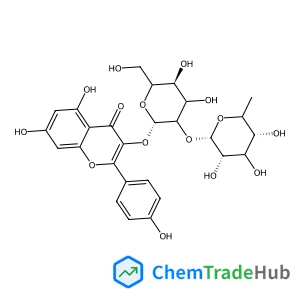
5,7-Dihydroxy-2-(4-hydroxyphenyl)-4-oxo-4H-chromen-3-yl 2-O-(6-deoxy-alpha-L-mannopyranosyl)-beta-D-glucopyranoside
CAS Number:
32602-81-6
Molecular Formula:
C27H30O15
Recommended Suppliers







Disclaimer
This page provides academic journal information for reference and research purposes only. We are not affiliated with any journal publishers and do not handle publication submissions. For publication-related inquiries, please contact the respective journal publishers directly.
If you notice any inaccuracies in the information displayed, please contact us at support@chemtradehub.com. We will promptly review and address your concerns.