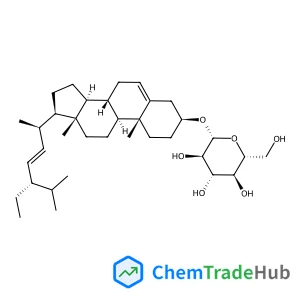
(3beta,22E)-Stigmasta-5,22-dien-3-yl beta-D-glucopyranoside
CAS Number:
19716-26-8
Molecular Formula:
C35H58O6
P. Träskelin, T. L. Kuhl, R. Faller
The properties of polystyrene brushes in dry conditions and in toluene solution are studied as a function of grafting density using molecular dynamics simulations. Both, individual brushes and double layers of opposing brushes are considered, the structural properties of which were found to be similar. The density profiles show very pronounced density oscillations which extend up to approximately 1.8 nm and fall into two groups of three peaks each. These features are observed regardless of grafting density and solvent conditions. In the absence of solvent, the chains undergo a transition from an oblate to a spherical shape as the grafting density increases. In contrast, in good solvent, the chains remain spherical independent of the grafting density. Solvation also increases the extension of the polystyrene chains roughly by a factor 2.5. Isotropic and two-dimensional radial distribution functions are used to characterize the structure of the polystyrene brushes. Toluene is observed to form up to four layers at the base of the grafted chains irrespective of grafting density.
Xiaoyang Pan, Zhiguo Yi
DOI: 10.1039/C6CP04604E
Simone Conti, Marco Cecchini
DOI: 10.1039/C6CP05249E
Xiaolei Zhang, Huimin Sui, Xiaolei Wang, Hongyang Su, Weina Cheng, Xu Wang, Bing Zhao
DOI: 10.1039/C6CP04370D
P. S. Ghosh, A. Arya, G. K. Dey, N. Kuganathan, R. W. Grimes
DOI: 10.1039/C6CP05794B
Mateus A. M. Paiva, Bárbara M. T. C. Peluzo, Jadson C. Belchior, Breno R. L. Galvão
DOI: 10.1039/C6CP05605A
Hui Zhao, Wei-xiao Ji, Chang-wen Zhang, Ping Li, Feng Li, Pei-ji Wang, Run-wu Zhang
DOI: 10.1039/C6CP06034J
DOI: 10.1039/C6CP02691E
Tian Zhang, Yuan-Yuan Qi, Xiang-Rong Chen, Ling-Cang Cai
DOI: 10.1039/C6CP05908B
Sagar Satpathi, Mandar Kulkarni, Arnab Mukherjee, Partha Hazra
DOI: 10.1039/C6CP05732B
(3.beta.)-3-Hydroxy-N,N-dimethyl-chol-5-en-24-amide (CAS: 79066-03-8) is primari...
5-(Aminomethyl)-2-methoxyphenol (CAS: 89702-89-6) is classified under GHS as a s...
Thieno[2,3-c]pyridin-7(6H)-one (CAS: 28981-13-7) is a heterocyclic organic compo...
1-[(6-Methoxy-3-pyridinyl)methyl]-4-piperidinamine dihydrochloride is generally ...
[(2E)-3-Phenyl-2-propen-1-yl]phosphonic acid (CAS: 146404-58-2) is regulated und...
6-Bromo-7-methoxyquinoline (CAS: 1620515-86-7) falls under the scope of the Glob...
This compound is primarily used in the pharmaceutical industry for the developme...
1-Ethyl-7-[2-methyl-6-(4H-1,2,4-triazol-3-yl)-3-pyridinyl]-3,5-dihydropyrazino[2...
Alternative reagents such as 2-[(dimethylamino)methyl]phenylboronic acid or rela...
3-(Piperidin-4-yloxy)pyridine (CAS: 310881-48-2) is an organic compound with the...

Physical Chemistry Chemical Physics (PCCP) is an international journal co-owned by 19 physical chemistry and physics societies from around the world. This journal publishes original, cutting-edge research in physical chemistry, chemical physics and biophysical chemistry. To be suitable for publication in PCCP, articles must include significant innovation and/or insight into physical chemistry; this is the most important criterion that reviewers and Editors will judge against when evaluating submissions. The journal has a broad scope and welcomes contributions spanning experiment, theory, computation and data science. Topical coverage includes spectroscopy, dynamics, kinetics, statistical mechanics, thermodynamics, electrochemistry, catalysis, surface science, quantum mechanics, quantum computing and machine learning. Interdisciplinary research areas such as polymers and soft matter, materials, nanoscience, energy, surfaces/interfaces, and biophysical chemistry are welcomed if they demonstrate significant innovation and/or insight into physical chemistry. Joined experimental/theoretical studies are particularly appreciated when complementary and based on up-to-date approaches.

![(1R)-3-Bromo-1,7,7-trimethylbicyclo[2.2.1]heptan-2-one structure](https://static.chemtradehub.com/structs/102/10293-06-8-dd8a.webp "(1R)-3-Bromo-1,7,7-trimethylbicyclo[2.2.1]heptan-2-one structure")