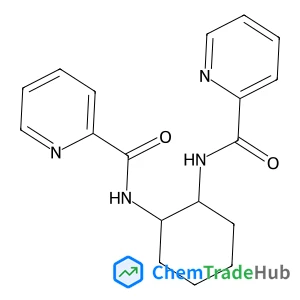
N,N'-(1R,2R)-1,2-Cyclohexanediyldi(2-pyridinecarboxamide)
CAS Number:
218290-24-5
Molecular Formula:
C18H20N4O2
C. George
The effect of kinetics of chemical reactions in the gas–liquid interface between atmospheric gases and reactive solute in dilute aqueous aerosols is analysed in order to see if such processes will affect the overall uptake rate. Accordingly, a parameterization of such heterogeneous reactions was derived, taking into account interfacial reactions. Gibbs surface excess concentration of both reactive compounds and stable compounds leads to higher heterogeneous reaction rates in comparison to aqueous phase bulk reactions. An analytical formulation shows that the surface reactions may be of considerable importance for the uptake process in the case of small liquid aerosols even in the absence of organic film on the surface. In particular, we demonstrate that the uptake rate of atmospheric gas-phase oxidants (such as OH, NO3 or O3) reacting with volatile organic compounds (such as ethanol or methanol) is increased by more than 10% for atmospheric aerosols with diameters lower than 0.1 μm. This effect is in addition intensified in the case of reactions of atmospheric oxidants with liquid aerosols containing organic surfactants, such as semi-volatile organic compounds, i.e., the chemical reactions at the gas–liquid interface may be dominant in the main uptake process for atmospheric submicron aerosols.
DOI: 10.1039/B109522F
G. Billon, B. Ouddane, L. Gengembre, A. Boughriet
DOI: 10.1039/B108638N
Karl Jug, Igor P. Gloriozov
DOI: 10.1039/B107803H
Kristóf Iván, Norbert Kirschner, Mária Wittmann, Viktor Jakab, Zoltán Noszticzius, John H. Merkin, Stephen K. Scott
DOI: 10.1039/B109016J
A. H. A. Ayyad
DOI: 10.1039/B106242P
R. Mukhopadhyay, L. L. Wong, K. K. Lo, T. Pochapsky, H. A. O. Hill
DOI: 10.1039/B108107A
DOI: 10.1039/B109391F
Jinglei Lei, Jiuli Luo
DOI: 10.1039/B108572G
DOI: 10.1039/B111564M
DOI: 10.1039/B108775D
6-Bromo-2-methylimidazo[1,2-a]pyrimidine (CAS: 1111638-05-1) falls under various...
While there are no direct alternatives, similar compounds like 1-Pyrrolidineetha...
4-Methyl-2,6-bis(2-methyl-2-propanyl)phenyl methylcarbamate (CAS: 1918-11-2) is ...
2-(3-Bromo-4-fluorophenyl)-1,3-dioxolane (CAS: 77771-04-1) should be stored in a...
4,5,6,7-Tetrahydro-1H-indazole hydrochloride is a white crystalline solid with a...
(2R)-1-Methoxy-3-phenyl-2-propanamine is a chiral organic compound with the CAS ...
Ethyl 1-(1-phenylethyl)-1H-imidazole-5-carboxylate is used in various industries...
4-[(1E,3S)-1-(4-Hydroxyphenyl)-1,4-pentadien-3-yl]phenol (CAS: 17676-24-3) falls...
(S)-3-Amino-5-phenylpentanoic acid hydrochloride is primarily used in the pharma...
7-Methoxy-1-benzothiophene-2-carboxylic acid is typically synthesized by reactin...

Physical Chemistry Chemical Physics (PCCP) is an international journal co-owned by 19 physical chemistry and physics societies from around the world. This journal publishes original, cutting-edge research in physical chemistry, chemical physics and biophysical chemistry. To be suitable for publication in PCCP, articles must include significant innovation and/or insight into physical chemistry; this is the most important criterion that reviewers and Editors will judge against when evaluating submissions. The journal has a broad scope and welcomes contributions spanning experiment, theory, computation and data science. Topical coverage includes spectroscopy, dynamics, kinetics, statistical mechanics, thermodynamics, electrochemistry, catalysis, surface science, quantum mechanics, quantum computing and machine learning. Interdisciplinary research areas such as polymers and soft matter, materials, nanoscience, energy, surfaces/interfaces, and biophysical chemistry are welcomed if they demonstrate significant innovation and/or insight into physical chemistry. Joined experimental/theoretical studies are particularly appreciated when complementary and based on up-to-date approaches.