


Mechanism of silsesquioxane growth
Literature Information
Publication Date
2002-02-06
DOI
10.1039/B107803H
Impact Factor
3.676
Authors
Karl Jug, Igor P. Gloriozov
View Original
Abstract
The mechanism of silsesquioxane growth is studied with an insertion mechanism analogous to the one previously proposed for fullerene growth. Isomers of hydridosilsesquioxanes SinO3n/2Hn with different symmetry are presented for n = 24–48 to understand the reaction pathways between highly symmetric structures from n = 24 (D6d) to n = 36 (D6h) and n = 48 (D6d) which can be considered as precursors of nanotubes. A representative calculation for the growth of Si30O45H30 to Si32O48H32 is performed with the MSINDO method. The stepwise reaction involves three intermediates and four transition structures. The studies explain the recent experimental evidence for the existence of silsesquioxanes with up to 38 Si atoms in solution.
Recommended Journals

Russian Journal of Coordination Chemistry

Current Opinion in Colloid & Interface Science

Journal of Natural Medicines

Russian Journal of Organic Chemistry

Current Opinion in Solid State & Materials Science

Russian Journal of Applied Chemistry

Drug Discovery Today

Russian Chemical Bulletin

Chemistry Education Research and Practice

Organic Process Research & Development
Related Literature
Copper-catalyzed direct amination of benzylic hydrocarbons and inactive aliphatic alkanes with arylamines
Hua Yao, Bo Xie, Xiaoyang Zhong, Shengzhou Jin, Sen Lin, Zhaohua Yan
2020-04-10
Communication
DOI: 10.1039/D0OB00491J
A hybrid polymer to target blood group dependence of cholera toxin
Diksha Haksar, Linda Quarles van Ufford, Roland J. Pieters
2019-11-28
Communication
DOI: 10.1039/C9OB02369K
Tandem transformations and multicomponent reactions utilizing alcohols following dehydrogenation strategy
Bhaskar Paul, Milan Maji, Kaushik Chakrabarti, Sabuj Kundu
2020-02-17
Review Article
DOI: 10.1039/C9OB02760B
Characterization of the promiscuous N-acyl CoA transferase, LgoC, in legonoxamine biosynthesis
Justine Renault, Laurent Trembleau, Catherine Victoria, Ming Him Tong, Shan Wang, Kwaku Kyeremeh, Hai Deng
2020-03-04
Communication
DOI: 10.1039/D0OB00320D
Visible light induced 3-position-selective addition of arylpropiolic acids with ethers via C(sp3)–H functionalization
Zi-juan Wan, Xiao-feng Yuan, Jun Luo
2020-04-07
Communication
DOI: 10.1039/D0OB00480D
A domino annulation approach to 3,4-diacylpyrrolo[1,2-a]pyrazines: decoration of pyrazine units
Anuradha Dagar, Yohan Seo, Ikyon Kim
2020-04-07
Paper
DOI: 10.1039/D0OB00444H
A Rh-catalyzed three-component reaction for the diastereoselective synthesis of pyrazolone derivatives with contiguous quaternary stereocenters
Chaoqun Ao, Jingjing Huang, Xinfang Xu, Shikun Jia, Zhenghui Kang, Wenhao Hu
2020-04-13
Communication
DOI: 10.1039/D0OB00482K
Radiopharmacological evaluation of a caspase-3 responsive probe with optimized pharmacokinetics for PET imaging of tumor apoptosis
Ke Li, Siqin Ye, Qingzhu Liu, Ying Peng, Gaochao Lv
2020-04-16
Paper
DOI: 10.1039/D0OB00690D
Stereoselective Michael additions on α-aminoacrylates as the key step to an l-Oic analogue bearing a quaternary stereocenter
Federico Maria Cecchinelli, Giuseppe Celentano, Alessandra Puglisi, Nicoletta Gaggero
2019-12-16
Paper
DOI: 10.1039/C9OB02084E
Free-base porphyrins with localized NH protons. Can substituents alone stabilize the elusive cis tautomer?
Kolle E. Thomas, Christine M. Beavers, Abhik Ghosh
2020-03-26
Paper
DOI: 10.1039/D0OB00452A
You might also like
Compound Q&A
What regulatory guidelines apply to 6-Bromo-2-methylimidazo[1,2-a]pyrimidine (CAS: 1111638-05-1)?
6-Bromo-2-methylimidazo[1,2-a]pyrimidine (CAS: 1111638-05-1) falls under various...
1111638-05-16-Bromo-2-methylimid...
Compound Q&A
Are there alternatives to 1-Pyrrolidineethanol, β-methyl-α-phenyl-, (αS,βR) (CAS: 123620-80-4) in synthesis?
While there are no direct alternatives, similar compounds like 1-Pyrrolidineetha...
123620-80-41-Pyrrolidineethanol...
Compound Q&A
Is 4-Methyl-2,6-bis(2-methyl-2-propanyl)phenyl methylcarbamate (CAS: 1918-11-2) safe?
4-Methyl-2,6-bis(2-methyl-2-propanyl)phenyl methylcarbamate (CAS: 1918-11-2) is ...
1918-11-24-Methyl-2,6-bis(2-m...
Compound Q&A
How should 2-(3-Bromo-4-fluorophenyl)-1,3-dioxolane (CAS: 77771-04-1) be stored?
2-(3-Bromo-4-fluorophenyl)-1,3-dioxolane (CAS: 77771-04-1) should be stored in a...
77771-04-12-(3-Bromo-4-fluorop...
Compound Q&A
What are the physical and chemical properties of 4,5,6,7-Tetrahydro-1H-indazole hydrochloride (CAS: 18161-11-0)?
4,5,6,7-Tetrahydro-1H-indazole hydrochloride is a white crystalline solid with a...
18161-11-04,5,6,7-Tetrahydro-1...
Compound Q&A
What is (2R)-1-Methoxy-3-phenyl-2-propanamine (CAS: 59919-07-2)?
(2R)-1-Methoxy-3-phenyl-2-propanamine is a chiral organic compound with the CAS ...
59919-07-2(2R)-1-Methoxy-3-phe...
Compound Q&A
What industries use Ethyl 1-(1-phenylethyl)-1H-imidazole-5-carboxylate (CAS: 56649-47-9)?
Ethyl 1-(1-phenylethyl)-1H-imidazole-5-carboxylate is used in various industries...
56649-47-9Ethyl 1-(1-phenyleth...
Compound Q&A
What regulatory guidelines apply to 4-[(1E,3S)-1-(4-Hydroxyphenyl)-1,4-pentadien-3-yl]phenol (CAS: 17676-24-3)?
4-[(1E,3S)-1-(4-Hydroxyphenyl)-1,4-pentadien-3-yl]phenol (CAS: 17676-24-3) falls...
17676-24-34-[(1E,3S)-1-(4-Hydr...
Compound Q&A
What industries use (S)-3-Amino-5-phenylpentanoic acid hydrochloride (CAS: 331846-97-0)?
(S)-3-Amino-5-phenylpentanoic acid hydrochloride is primarily used in the pharma...
331846-97-0(S)-3-Amino-5-phenyl...
Compound Q&A
How is 7-methoxy-1-benzothiophene-2-carboxylic acid (CAS: 88791-07-5) typically synthesized?
7-Methoxy-1-benzothiophene-2-carboxylic acid is typically synthesized by reactin...
88791-07-57-methoxy-1-benzothi...
Source Journal
Physical Chemistry Chemical Physics

CiteScore:
5.5
Self-citation Rate:
10.3%
Articles per Year:
3036
Physical Chemistry Chemical Physics (PCCP) is an international journal co-owned by 19 physical chemistry and physics societies from around the world. This journal publishes original, cutting-edge research in physical chemistry, chemical physics and biophysical chemistry. To be suitable for publication in PCCP, articles must include significant innovation and/or insight into physical chemistry; this is the most important criterion that reviewers and Editors will judge against when evaluating submissions. The journal has a broad scope and welcomes contributions spanning experiment, theory, computation and data science. Topical coverage includes spectroscopy, dynamics, kinetics, statistical mechanics, thermodynamics, electrochemistry, catalysis, surface science, quantum mechanics, quantum computing and machine learning. Interdisciplinary research areas such as polymers and soft matter, materials, nanoscience, energy, surfaces/interfaces, and biophysical chemistry are welcomed if they demonstrate significant innovation and/or insight into physical chemistry. Joined experimental/theoretical studies are particularly appreciated when complementary and based on up-to-date approaches.
Recommended Compounds
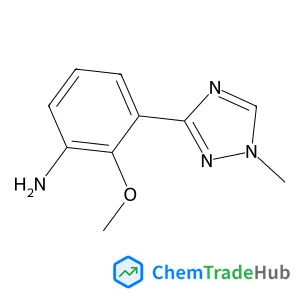
2-Methoxy-3-(1-methyl-1H-1,2,4-triazol-3-yl)aniline
CAS Number:
1609394-10-6
Molecular Formula:
C10H12N4O

Recommended Suppliers





Disclaimer
This page provides academic journal information for reference and research purposes only. We are not affiliated with any journal publishers and do not handle publication submissions. For publication-related inquiries, please contact the respective journal publishers directly.
If you notice any inaccuracies in the information displayed, please contact us at support@chemtradehub.com. We will promptly review and address your concerns.