












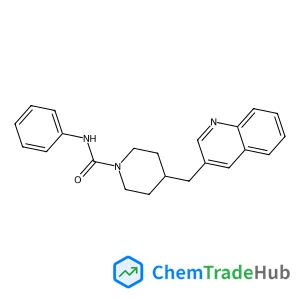
N-phenyl-4-(quinolin-3-ylmethyl)piperidine-1-carboxamide
CAS Number:
959151-50-9
Molecular Formula:
C22H23N3O
Khirud Gogoi, Anita D. Gunjal, Vaijayanti A. Kumar
The amide linkage being shorter than the natural phosphate linkage, an additional atom is introduced into oligodeoxyribonucleosides (ODNs) with sugar–thioacetamide backbone that show very good RNA recognition properties.
Daniel J. Stasko, Kevin J. Perzynski, Mark A. Wasil
DOI: 10.1039/B314475E
Judith J. van Gorp, Jef A. J. M. Vekemans, E. W. Meijer
DOI: 10.1039/B312407J
Sun-Young Kim, Giseop Kwak, Yusuke Kawakami
DOI: 10.1039/B314723A
Jung-Mo Ahn, Paul Wentworth, Jr., Kim D. Janda
DOI: 10.1039/B312662E
Bo Yang, Shoko Kamiya, Kaname Yoshida
DOI: 10.1039/B313100A
Pingàn Hu, Yunqi Liu, Lei Fu, Lingchao Cao, Daoben Zhu
DOI: 10.1039/B312708G
Naoyoshi Maezaki, Hiroaki Tominaga, Naoto Kojima, Minori Yanai, Daisuke Urabe, Tetsuaki Tanaka
DOI: 10.1039/B312362F
Ik-Hwan Um, Sang-Eun Jeon, Mi-Hwa Baek, Hye-Ran Park
DOI: 10.1039/B310055C
Rudolf Pietschnig
DOI: 10.1039/B315001A
Keitaro Yoshimoto, Chun-Yan Xu, Seiichi Nishizawa, Takanobu Haga, Hiroyuki Satake, Norio Teramae
DOI: 10.1039/B309229A
Waste containing 2-Ethyl-4-Methyl-1H-Imidazole-5-Carbaldehyde (CAS: 88634-80-4) ...
Triethoxy(octyl)silane (CAS: 1385031-14-0) is widely used in the pharmaceuticals...
Several alternatives to 3-iodo-7-nitro-1H-indazole (CAS: 864724-64-1) exist in t...
Yes, there are alternatives to Benzene, bis[(trimethoxysilyl)ethyl] (CAS: 266317...
Isothiazole-3-carbonitrile (CAS: 1452-17-1) is generally considered safe when us...
(3-Chlorophenyl)methanol (CAS: 873-63-2) is considered low to moderately toxic. ...
(2S,3S)-2-Hydroxy-3-({[(2-methyl-2-propanyl)oxy]carbonyl}amino)-3-(2-naphthyl)pr...
Proper handling of methyl 2-(bromomethyl)-5-methoxybenzoate requires the use of ...
6,8-Dibromoimidazo[1,2-a]pyridine-2-carboxylic acid (CAS: 904805-36-3) is an aro...
3-Amino-5-bromo-2-pyridinecarbonitrile is considered safe when handled under pro...

ChemComm publishes urgent research which is of outstanding significance and interest to experts in the field, while also appealing to the journal’s broad chemistry readership. Our communication format is ideally suited to short, urgent studies that are of such importance that they require accelerated publication. Our scope covers all topics in chemistry, and research at the interface of chemistry and other disciplines (such as materials science, nanoscience, physics, engineering and biology) where there is a significant novelty in the chemistry aspects. Major topic areas covered include: Analytical Chemistry Catalysis Chemical Biology and medicinal chemistry Computational Chemistry and Machine Learning Energy and sustainable chemistry Environmental Chemistry Green Chemistry Inorganic Chemistry Materials Chemistry Nanoscience Organic Chemistry Physical Chemistry Polymer Chemistry Supramolecular Chemistry
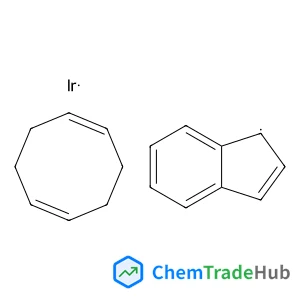
![4-(4-{4-[4-Fluoro-3-(trifluoromethyl)phenyl]-1-methyl-1H-imidazol-2-yl}-1-piperidinyl)-1H-pyrazolo[3,4-d]pyrimidine 4-methylbenzenesulfonate (1:1) structure](https://static.chemtradehub.com/structs/108/1082949-68-5-00b6.webp "4-(4-{4-[4-Fluoro-3-(trifluoromethyl)phenyl]-1-methyl-1H-imidazol-2-yl}-1-piperidinyl)-1H-pyrazolo[3,4-d]pyrimidine 4-methylbenzenesulfonate (1:1) structure")
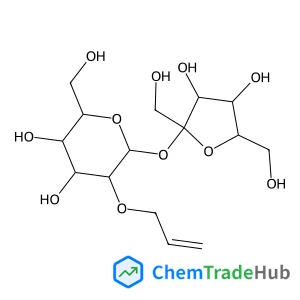
![4,4'-[2,5-Biphenyldiylbis(oxy)]dianiline structure](https://static.chemtradehub.com/structs/941/94148-67-1-24c6.webp "4,4'-[2,5-Biphenyldiylbis(oxy)]dianiline structure")





