












![N-[(9H-Fluoren-9-ylmethoxy)carbonyl]serine structure](https://static.chemtradehub.com/structs/737/73724-45-5-b0dc.webp "N-[(9H-Fluoren-9-ylmethoxy)carbonyl]serine structure")
Development of a micro dual beam fluorometric detector specific for microchip analysis of benzo[a]pyrene and benzo[k]fluoranthene in diesel exhaust particulate samples
Literature Information
Publication Date
2005-07-07
DOI
10.1039/B504440E
Impact Factor
4.616
Authors
Hiroyuki Masaki, Hironori Susaki, Takashi Korenaga
View Original
Abstract
We developed a device and some systems for detecting benzo[a]pyrene (B[a]P) and benzo[k]fluoranthene (B[k]F). The device uses a UV light-emitting diode that emits light with a wavelength of 370 nm and a violet laser diode that emits light with a wavelength of 395 nm as excitation light sources. The detection method is based on the following observation: characteristic fluorescence is emitted from both B[a]P and B[k]F, with intensities up to 10 times greater than those from 22 other polycyclic aromatic hydrocarbons (PAHs). The excitation and emission wavelengths for fluorescence from B[a]P and B[k]F are 370 and 429 nm, and 395 and 429 nm, respectively. Further, we calculated their concentrations in diesel exhaust particles by means of two calibration curves determined using a mixture of 24 PAHs. The detection limits of the proposed device with a microchip are 5.58 µg L−1 for B[a]P and 6.03 µg L−1 for B[k]F. We applied this method to analyze B[a]P or B[k]F contained in three types of diesel exhaust particles, and the results agreed well with those obtained by liquid chromatography.
Related Literature
A battery cell for in situ NMR measurements of liquid electrolytes
Simon Wiemers-Meyer, Sascha Nowak
2017-01-26
Communication
DOI: 10.1039/C6CP08653E
Erbium ion implantation into diamond – measurement and modelling of the crystal structure
Pavla Nekvindová, David Sedmidubský, Michal Hušák, Zdeněk Remeš, Marián Varga, Alexander Kromka, Roman Böttger, Jiří Oswald
2017-01-26
Paper
DOI: 10.1039/C6CP08851A
Theoretical studies on FGFR isoform selectivity of FGFR1/FGFR4 inhibitors by molecular dynamics simulations and free energy calculations
Weitao Fu, Lingfeng Chen, Zhe Wang, Chao Wu, Qinqin Xia, Zhiguo Liu, Jianmin Zhou, Guang Liang, Yuepiao Cai
2017-01-04
Paper
DOI: 10.1039/C6CP07964D
Interfacial defects induced electronic property transformation at perovskite SrVO3/SrTiO3 and LaCrO3/SrTiO3 heterointerfaces
Junjie Li, Deqiang Yin, Qiang Li, Rong Sun, Sumei Huang, Fanzhi Meng
2017-02-01
Communication
DOI: 10.1039/C6CP07691B
CH3NH3PbI3 films prepared by combining 1- and 2-step deposition: how crystal growth conditions affect properties
Muhamad Z. Mokhtar, Mu Chen, Eric Whittaker, Bruce Hamilton, Nicholas Aristidou, Ali Gholinia, Saif A. Haque, Brian R. Saunders
2017-02-17
Paper
DOI: 10.1039/C7CP00471K
Structure and dysprosium dopant engineering of gadolinium oxide nanoparticles for enhanced dual-modal magnetic resonance and fluorescence imaging
Jinchang Yin, Chaorui Li, Deqi Chen, Jiajun Yang, Huan Liu, Wenyong Hu, Yuanzhi Shao
2017-01-23
Paper
DOI: 10.1039/C6CP06712C
Facile synthesis of nanoporous Li1+xV1−xO2@C composites as promising anode materials for lithium-ion batteries
Malay Pramanik, Jaewoo Lee, Toshiaki Takei, Yusuke Ide, Md. Shahriar A. Hossain, Jung Ho Kim
2017-03-20
Paper
DOI: 10.1039/C6CP08827A
Observation of perpendicular exchange bias in an Ir-doped Fe2O3/Co ultrathin film system
S. Ye, S. P. Pati, Y. Shiokawa, M. Al-Mahdawi, T. Nozaki
2017-02-24
Paper
DOI: 10.1039/C7CP00445A
Selective-releasing-affected lubricant mechanism of a self-assembled MoS2/Mo–S–C nanoperiod multilayer film sliding in diverse atmospheres
J. Xu, T. F. He, L. Q. Chai, L. Qiao, X. Q. Zhang, P. Wang, W. M. Liu
2016-12-20
Paper
DOI: 10.1039/C6CP08356K
Effect of an acetylene bond on hydrogen adsorption in diamond-like carbon allotropes: from first principles to atomic simulation
Lei Li, Tiange Fang, YeTong Wang, Weiquan Cai, Zhonghua Xiang
2017-03-06
Paper
DOI: 10.1039/C7CP01230F
You might also like
Compound Q&A
What are the main uses of 1H-Indazole-6-carbonitrile (CAS: 141290-59-7)?
1H-Indazole-6-carbonitrile finds applications in pharmaceuticals, where it serve...
141290-59-71H-Indazole-6-carbon...
Compound Q&A
How should waste containing Dioctyl (2E)-2-butenedioate (CAS: 2997-85-5) be handled?
Waste containing Dioctyl (2E)-2-butenedioate (CAS: 2997-85-5) should be collecte...
2997-85-5Dioctyl (2E)-2-buten...
Compound Q&A
What industries use Sodium [(1,2-benzoxazol-3-ylmethyl)sulfonyl]azanide (CAS: 68291-98-5)?
Sodium [(1,2-benzoxazol-3-ylmethyl)sulfonyl]azanide is primarily used in pharmac...
68291-98-5Sodium [(1,2-benzoxa...
Compound Q&A
Are there alternatives to Dimethyl 4-(4,4,5,5-tetramethyl-1,3,2-dioxaborolan-2-yl)-2,6-pyridinedicarboxylate (CAS: 741709-66-0) in synthesis?
Dimethyl 4-(4,4,5,5-tetramethyl-1,3,2-dioxaborolan-2-yl)-2,6-pyridinedicarboxyla...
741709-66-0Dimethyl 4-(4,4,5,5-...
Compound Q&A
How should waste containing 2-Fluoro-6-hydrazinopyridine (CAS: 80714-39-2) be handled?
Waste containing 2-Fluoro-6-hydrazinopyridine (CAS: 80714-39-2) should be manage...
80714-39-22-Fluoro-6-hydrazino...
Compound Q&A
What is 6-Formyl-2-pyridinecarboxylic acid (CAS: 499214-11-8)?
6-Formyl-2-pyridinecarboxylic acid is an organic compound with the molecular for...
499214-11-86-Formyl-2-pyridinec...
Compound Q&A
What is the market or research trend for 3-(3,4-dimethoxyphenyl)-2,5-dimethyl-N-(2-morpholin-4-ylethyl)pyrazolo[1,5-a]pyrimidin-7-amine (CAS: 900874-91-1)?
Research trends for this compound indicate a focus on its potential applications...
900874-91-13-(3,4-dimethoxyphen...
Compound Q&A
How is 9H-Tribenzo[b,d,f]azepine (CAS: 29875-73-8) typically synthesized?
9H-Tribenzo[b,d,f]azepine is typically synthesized via a multi-step process invo...
29875-73-89H-Tribenzo[b,d,f]az...
Compound Q&A
How is 1-Cyclopropyl-7-ethoxy-6-fluoro-8-methoxy-4-oxo-1,4-dihydro-3-quinolinecarboxylic acid (CAS: 1797982-51-4) typically synthesized?
1-Cyclopropyl-7-ethoxy-6-fluoro-8-methoxy-4-oxo-1,4-dihydro-3-quinolinecarboxyli...
1797982-51-41-Cyclopropyl-7-etho...
Compound Q&A
How should waste containing Methyl 3-oxo-1,2,3,4-tetrahydro-6-quinoxalinecarboxylate (CAS: 671820-52-3) be handled?
Waste containing Methyl 3-oxo-1,2,3,4-tetrahydro-6-quinoxalinecarboxylate (CAS: ...
671820-52-3Methyl 3-oxo-1,2,3,4...
Source Journal
Analyst

CiteScore:
7.8
Self-citation Rate:
5.6%
Articles per Year:
653
Analyst publishes analytical and bioanalytical research that reports premier fundamental discoveries and inventions, and the applications of those discoveries, unconfined by traditional discipline barriers.
Recommended Compounds


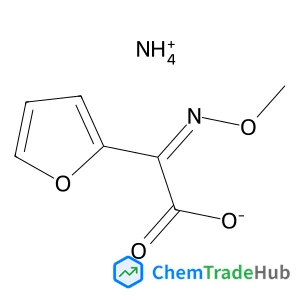
Ammonium (Z)-2-(furan-2-yl)-2-(methoxyimino)acetate
CAS Number:
97148-39-5
Molecular Formula:
C7H10N2O4
Recommended Suppliers




Disclaimer
This page provides academic journal information for reference and research purposes only. We are not affiliated with any journal publishers and do not handle publication submissions. For publication-related inquiries, please contact the respective journal publishers directly.
If you notice any inaccuracies in the information displayed, please contact us at support@chemtradehub.com. We will promptly review and address your concerns.