












Extended wet-spinning can modify spider silk properties
Literature Information
Publication Date
2005-03-30
DOI
10.1039/B500319A
Impact Factor
6.222
Authors
Zhengzhong Shao, Fritz Vollrath
View Original
Abstract
Contrary to expectation, we demonstrate that spider dragline silk spun experimentally under water displays greater stiffness and higher resilience compared to silk spun “naturally” into air. We suggest that this consequence of extended wet-spinning is due to increased molecular orientation resulting from extension of the mobile phase.
Related Literature
One-pot surface modification of rubbery polymer films
Hirofumi Tsuruta, Yoshihisa Fujii, Keiji Tanaka
2011-12-01
Communication
DOI: 10.1039/C1PY00488C
Calix[4]pyrogallolarenes as novel high temperature inhibitors of oxidative degradation of polymers
Przemyslaw Ziaja, Katarzyna Jodko-Piorecka, Rafal Kuzmicz, Grzegorz Litwinienko
2011-11-08
Communication
DOI: 10.1039/C1PY00494H
Polypeptide core–shell silicananoparticles with high grafting density by N-carboxyanhydride (NCA) ring opening polymerization as responsive materials and for bioconjugation
Tushar Borase, Marcello Iacono, Syed I. Ali, Paul D. Thornton
2012-03-20
Paper
DOI: 10.1039/C2PY00610C
Individual graphene oxide platelets through direct molecular exfoliation with globular amphiphilic hyperbranched polymers
Shi-Min Shau, Tzong-Yuan Juang, Han-Sheng Lin, Cheng-Liang Huang, Chi-Fa Hsieh, Jeng-Yue Wu, Ru-Jong Jeng
2012-03-14
Paper
DOI: 10.1039/C2PY00006G
Self-assembled amino acids and dipeptides as noncovalent hydrogels for tissue engineering
Derek M. Ryan, Bradley L. Nilsson
2011-10-07
Review Article
DOI: 10.1039/C1PY00335F
Bioactive and electroactive response of flexible polythiophene:polyester nanomembranes for tissue engineering
Luis J. del Valle
2012-02-01
Paper
DOI: 10.1039/C2PY00584K
Redox-sensitive shell cross-linked PEG–polypeptide hybrid micelles for controlled drug release
Kang Wang, Guo-Feng Luo, Yun Liu, Cao Li, Si-Xue Cheng, Ren-Xi Zhuo, Xian-Zheng Zhang
2012-02-20
Paper
DOI: 10.1039/C2PY00600F
You might also like
Compound Q&A
What industries use 4-(4-tert-Butylphenyl)-1H-pyrazol-3-amine (CAS: 1015845-73-4)?
4-(4-tert-Butylphenyl)-1H-pyrazol-3-amine finds applications in various industri...
1015845-73-44-(4-tert-Butylpheny...
Compound Q&A
What industries use H3TATAB (CAS: 63557-10-8)?
H3TATAB is used in the pharmaceutical industry for the synthesis of certain orga...
63557-10-8H3TATAB
Compound Q&A
What are the main uses of 1-Ethyl-3-fluorobenzene (CAS: 696-39-9)?
1-Ethyl-3-fluorobenzene (CAS: 696-39-9) is primarily used as a precursor in the ...
696-39-91-Ethyl-3-fluorobenz...
Compound Q&A
What are the main uses of 1-(tert-Butoxycarbonyl)-4-(4-methoxyphenyl)pyrrolidine-3-carboxylic acid (CAS: 851484-94-1)?
1-(tert-Butoxycarbonyl)-4-(4-methoxyphenyl)pyrrolidine-3-carboxylic acid is prim...
851484-94-11-(tert-Butoxycarbon...
Compound Q&A
What are the physical and chemical properties of 1-Cyclobutyl-4-piperidinone (CAS: 359880-05-0)?
1-Cyclobutyl-4-piperidinone (CAS: 359880-05-0) is a colorless or white crystalli...
359880-05-01-Cyclobutyl-4-piper...
Compound Q&A
What is Pyridine-2,6-dicarboxylic acid mono-tert-butyl ester (CAS: 575433-76-0)?
Pyridine-2,6-dicarboxylic acid mono-tert-butyl ester (CAS: 575433-76-0) is a che...
575433-76-0Pyridine-2,6-dicarbo...
Compound Q&A
What is the market or research trend for 2,3-Difluorophenylalanine (CAS: 236754-62-4)?
The market for 2,3-Difluorophenylalanine (CAS: 236754-62-4) is growing with incr...
236754-62-42,3-Difluorophenylal...
Compound Q&A
How is (2-Hydroxy-1-naphthyl)boronic acid (CAS: 898257-48-2) typically synthesized?
(2-Hydroxy-1-naphthyl)boronic acid can be synthesized through the reduction of 2...
898257-48-2(2-Hydroxy-1-naphthy...
Compound Q&A
What are the physical and chemical properties of tert-Butyl (5-bromo-6-methyl-3-(4,4,5,5-tetramethyl-1,3,2-dioxaborolan-2-yl)pyridin-2-yl)carbamate (CAS: 1315351-28-0)?
This compound is a crystalline solid with a molecular weight of approximately 52...
1315351-28-0tert-Butyl (5-bromo-...
Compound Q&A
Are there alternatives to 5,7-Dihydroxy-4-oxo-2-(3,4,5-trihydroxyphenyl)-4H-chromen-3-yl beta-D-glucopyranoside (CAS: 19833-12-6) in synthesis?
While 5,7-Dihydroxy-4-oxo-2-(3,4,5-trihydroxyphenyl)-4H-chromen-3-yl beta-D-gluc...
19833-12-65,7-Dihydroxy-4-oxo-...
Source Journal
Chemical Communications

CiteScore:
8.6
Self-citation Rate:
4.7%
Articles per Year:
2458
ChemComm publishes urgent research which is of outstanding significance and interest to experts in the field, while also appealing to the journal’s broad chemistry readership. Our communication format is ideally suited to short, urgent studies that are of such importance that they require accelerated publication. Our scope covers all topics in chemistry, and research at the interface of chemistry and other disciplines (such as materials science, nanoscience, physics, engineering and biology) where there is a significant novelty in the chemistry aspects. Major topic areas covered include: Analytical Chemistry Catalysis Chemical Biology and medicinal chemistry Computational Chemistry and Machine Learning Energy and sustainable chemistry Environmental Chemistry Green Chemistry Inorganic Chemistry Materials Chemistry Nanoscience Organic Chemistry Physical Chemistry Polymer Chemistry Supramolecular Chemistry
Recommended Compounds
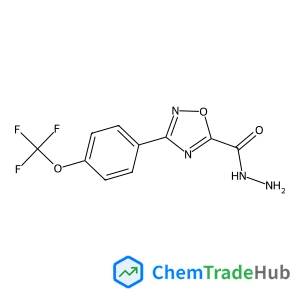
3-(4-(Trifluoromethoxy)phenyl)-1,2,4-oxadiazole-5-carbohydrazide
CAS Number:
883028-82-8
Molecular Formula:
C10H7F3N4O3
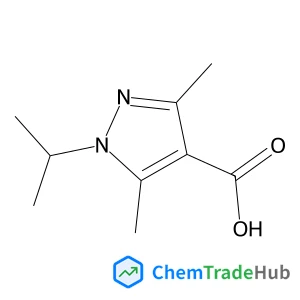
1-isopropyl-3,5-dimethyl-1H-pyrazole-4-carboxylic acid
CAS Number:
1007542-01-9
Molecular Formula:
C9H14N2O2
Recommended Suppliers




Disclaimer
This page provides academic journal information for reference and research purposes only. We are not affiliated with any journal publishers and do not handle publication submissions. For publication-related inquiries, please contact the respective journal publishers directly.
If you notice any inaccuracies in the information displayed, please contact us at support@chemtradehub.com. We will promptly review and address your concerns.