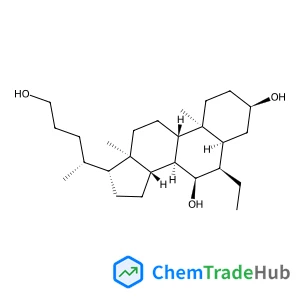
(3alpha,5beta,6alpha,7alpha)-6-Ethylcholane-3,7,24-triol
CAS Number:
1537866-49-1
Molecular Formula:
C26H46O3
Marie Humbert-Droz, Patric Oulevey, Latévi Max Lawson Daku, Sandra Luber, Hans Hagemann, Thomas Bürgi
Backscattered Raman optical activity (ROA) spectra are measured for Δ- and Λ-tris-(ethylenediamine)rhodium(III) chloride in aqueous solution. In addition, the spectra of the four possible conformers in the Λ configuration are investigated by ab initio calculations. The Λ(δδδ) conformer is in best agreement with experimental spectra and examined in more details. The two most stable conformers according to the calculations are not compatible with the experimental ROA spectrum. Insights into the origin of observed band intensities are obtained by means of group coupling matrices. The influence of the first solvation shell is explored via an ab initio molecular dynamics simulation. Taking explicit solvent molecules into account further improves the agreement between calculation and experiment. Analysis of selected normal modes using group coupling matrices shows that solvent molecules lead to normal mode rotation and thus contribute to the ROA intensity, whereas the contribution of the Rh can be neglected.
Teruaki Hasegawa, Tomohisa Fujisawa, Munenori Numata, Mariko Umeda, Takahiro Matsumoto, Taro Kimura, Shiro Okumura, Kazuo Sakurai, Seiji Shinkai
DOI: 10.1039/B407409B
Guang Yang, Raphael G. Raptis
DOI: 10.1039/B404269G
Xiao-Ti Zhou, Rich G. Carter
DOI: 10.1039/B410092A
J.-F. Colomer, L. Henrard, P. Launois, G. Van Tendeloo, A. A. Lucas, Ph. Lambin
DOI: 10.1039/B410930A
Ken Takazawa, Yasutaka Kitahama, Yasuyuki Kimura
DOI: 10.1039/B409690H
Manfred T. Reetz, Wolfgang Wiesenhöfer
DOI: 10.1039/B412049C
Sylvie Ferlay, Mir Wais Hosseini, Véronique Bulach, Jean-Marc Planeix
DOI: 10.1039/B410459P
Lionel Nicole, Cédric Boissière, David Grosso, Peter Hesemann, Joël Moreau, Clément Sanchez
DOI: 10.1039/B408869G
C. L. Aravinda, W. Freyland
DOI: 10.1039/B409861G
Roger W. Alder, Leila Chaker, François P. V. Paolini
DOI: 10.1039/B409112D
N-(4-Methoxybenzyl)-2-pyridinamine (CAS: 52818-63-0) is increasingly being used ...
When handling Ethyl 4-(2-chlorophenyl)-1,3-thiazole-2-carboxylate, appropriate p...
Diethyldiselane (CAS: 628-39-7) is classified under the Globally Harmonized Syst...
The market for oxocopper (CAS: 12053-18-8) is primarily driven by its use in cat...
The market for 5-{[(2-Methyl-2-propanyl)oxy]carbonyl}-5-azaspiro[2.4]heptane-7-c...
2-(1-Pyrrolidinyl)-4-pyridinamine is a chemical compound with the CAS number 359...
2-(3-Pyridinyl)-1-azabicyclo[2.2.2]octane (CAS: 91556-75-1) is a crystalline sol...
(S)-Alpha-allyl-proline hydrochloride is usually synthesized via a Wittig reacti...
3-Methyl-1,2-oxazole-5-carboxylic acid (CAS: 4857-42-5) is an organic compound w...
Lys-SMCC-DM1 is synthesized via a multi-step process involving the coupling of S...

Physical Chemistry Chemical Physics (PCCP) is an international journal co-owned by 19 physical chemistry and physics societies from around the world. This journal publishes original, cutting-edge research in physical chemistry, chemical physics and biophysical chemistry. To be suitable for publication in PCCP, articles must include significant innovation and/or insight into physical chemistry; this is the most important criterion that reviewers and Editors will judge against when evaluating submissions. The journal has a broad scope and welcomes contributions spanning experiment, theory, computation and data science. Topical coverage includes spectroscopy, dynamics, kinetics, statistical mechanics, thermodynamics, electrochemistry, catalysis, surface science, quantum mechanics, quantum computing and machine learning. Interdisciplinary research areas such as polymers and soft matter, materials, nanoscience, energy, surfaces/interfaces, and biophysical chemistry are welcomed if they demonstrate significant innovation and/or insight into physical chemistry. Joined experimental/theoretical studies are particularly appreciated when complementary and based on up-to-date approaches.
![N-{[(2-Methyl-2-propanyl)oxy]carbonyl}-L-methionylglycine structure](https://static.chemtradehub.com/structs/234/23446-03-9-e1e5.webp "N-{[(2-Methyl-2-propanyl)oxy]carbonyl}-L-methionylglycine structure")
![1-oxaspiro[4.4]nonan-6-one structure](https://static.chemtradehub.com/structs/134/134179-01-4-e051.webp "1-oxaspiro[4.4]nonan-6-one structure")