












Exciplex formation between pyrene and guanine in highly polar solvents
Literature Information
Publication Date
2004-02-24
DOI
10.1039/B316315F
Impact Factor
6.222
Authors
Takahiro Kawai, Masashi Ikegami, Tatsuo Arai
View Original
Abstract
Guanine derivatives connected to pyrene with methylene spacers exhibited exciplex emission in highly polar solvents such as N,N-dimethylformamide, acetonitrile, and water. The result will open up a novel approach to synthesis of fluorescent nucleic bases.
Related Literature
Hydrogen-bond memory and water-skin supersolidity resolving the Mpemba paradox
Yongli Huang, Zengsheng Ma, Yichun Zhou, Ji Zhou, Weitao Zheng, Qing Jiang, Chang Q. Sun
2014-09-09
Paper
DOI: 10.1039/C4CP03669G
Single-molecule surface-enhanced Raman spectroscopy with nanowatt excitation
Brendan L. Darby, Pablo G. Etchegoin, Eric C. Le Ru
2014-09-19
Paper
DOI: 10.1039/C4CP03422H
Noble-metal-free BODIPY–cobaloxime photocatalysts for visible-light-driven hydrogen production
Geng-Geng Luo, Kai Fang, Ji-Huai Wu, Jing-Cao Dai, Qing-Hua Zhao
2014-09-22
Paper
DOI: 10.1039/C4CP03343D
Ammonia-modified Co(ii) sites in zeolites: IR spectroscopy and spin-resolved charge transfer analysis of NO adsorption complexes
Kinga Góra-Marek, Adam Stępniewski, Mariusz Radoń, Ewa Broclawik
2014-09-11
Paper
DOI: 10.1039/C4CP03350G
Description of heteroaromaticity on the basis of π-electron density anisotropy
Rohoullah Firouzi, Sahar Sharifi Ardani
2014-04-25
Paper
DOI: 10.1039/C4CP01125B
Molecular dynamics in azobenzene liquid crystal polymer films measured by time-resolved techniques
T. Fujii, S. Kuwahara, K. Katayama, T. Ube, T. Ikeda
2014-02-28
Paper
DOI: 10.1039/C4CP00457D
Polarisation charge switching through the motion of metal atoms trapped in fullerene cages
G. Raggi, A. J. Stace, E. Bichoutskaia
2014-09-24
Paper
DOI: 10.1039/C4CP02672A
Silver nanoparticles linked by a Pt-containing organometallic dithiol bridge: study of local structure and interface by XAFS and SR-XPS
C. Battocchio, I. Fratoddi, L. Fontana, E. Bodo, F. Porcaro, C. Meneghini, S. Nappini, S. Mobilio, M. V. Russo, G. Polzonetti
2014-04-24
Paper
DOI: 10.1039/C4CP01264J
Responses of polar organic compounds to different ionic environments in aqueous media are interrelated
L. A. Ferreira, A. Chervenak, S. Placko, A. Kestranek, P. P. Madeira, B. Y. Zaslavsky
2014-09-15
Paper
DOI: 10.1039/C4CP02084G
Direct imaging of layered O3- and P2-NaxFe1/2Mn1/2O2 structures at the atomic scale
Yuesheng Wang, Pin Liu, Lin Gu, Yong-Sheng Hu, Hong Li, George P. Demopoulos, Liquan Chen
2014-08-26
Communication
DOI: 10.1039/C4CP02957G
You might also like
Compound Q&A
What is the market or research trend for N-(4-Methoxybenzyl)-2-pyridinamine (CAS: 52818-63-0)?
N-(4-Methoxybenzyl)-2-pyridinamine (CAS: 52818-63-0) is increasingly being used ...
52818-63-0N-(4-Methoxybenzyl)-...
Compound Q&A
What precautions should be taken when handling Ethyl 4-(2-chlorophenyl)-1,3-thiazole-2-carboxylate (CAS: 1050507-06-6)?
When handling Ethyl 4-(2-chlorophenyl)-1,3-thiazole-2-carboxylate, appropriate p...
1050507-06-6Ethyl 4-(2-chlorophe...
Compound Q&A
What regulatory guidelines apply to diethyldiselane (CAS: 628-39-7)?
Diethyldiselane (CAS: 628-39-7) is classified under the Globally Harmonized Syst...
628-39-7Diethyldiselane
Compound Q&A
What is the market or research trend for oxocopper (CAS: 12053-18-8)?
The market for oxocopper (CAS: 12053-18-8) is primarily driven by its use in cat...
12053-18-8oxocopper; oxo-(oxoc...
Compound Q&A
What is the market or research trend for 5-{[(2-Methyl-2-propanyl)oxy]carbonyl}-5-azaspiro[2.4]heptane-7-carboxylic acid?
The market for 5-{[(2-Methyl-2-propanyl)oxy]carbonyl}-5-azaspiro[2.4]heptane-7-c...
1268519-54-55-{[(2-Methyl-2-prop...
Compound Q&A
What is 2-(1-Pyrrolidinyl)-4-pyridinamine (CAS: 35981-63-6)?
2-(1-Pyrrolidinyl)-4-pyridinamine is a chemical compound with the CAS number 359...
35981-63-62-(1-Pyrrolidinyl)-4...
Compound Q&A
What are the physical and chemical properties of 2-(3-Pyridinyl)-1-azabicyclo[2.2.2]octane (CAS: 91556-75-1)?
2-(3-Pyridinyl)-1-azabicyclo[2.2.2]octane (CAS: 91556-75-1) is a crystalline sol...
91556-75-12-(3-Pyridinyl)-1-az...
Compound Q&A
How is (S)-Alpha-allyl-proline hydrochloride (CAS: 129704-91-2) typically synthesized?
(S)-Alpha-allyl-proline hydrochloride is usually synthesized via a Wittig reacti...
129704-91-2(S)-Alpha-allyl-prol...
Compound Q&A
What is 3-Methyl-1,2-oxazole-5-carboxylic acid (CAS: 4857-42-5)?
3-Methyl-1,2-oxazole-5-carboxylic acid (CAS: 4857-42-5) is an organic compound w...
4857-42-53-Methyl-1,2-oxazole...
Compound Q&A
How is Lys-SMCC-DM1 (CAS: 1281816-04-3) typically synthesized?
Lys-SMCC-DM1 is synthesized via a multi-step process involving the coupling of S...
1281816-04-3Lys-SMCC-DM1
Source Journal
Chemical Communications

CiteScore:
8.6
Self-citation Rate:
4.7%
Articles per Year:
2458
ChemComm publishes urgent research which is of outstanding significance and interest to experts in the field, while also appealing to the journal’s broad chemistry readership. Our communication format is ideally suited to short, urgent studies that are of such importance that they require accelerated publication. Our scope covers all topics in chemistry, and research at the interface of chemistry and other disciplines (such as materials science, nanoscience, physics, engineering and biology) where there is a significant novelty in the chemistry aspects. Major topic areas covered include: Analytical Chemistry Catalysis Chemical Biology and medicinal chemistry Computational Chemistry and Machine Learning Energy and sustainable chemistry Environmental Chemistry Green Chemistry Inorganic Chemistry Materials Chemistry Nanoscience Organic Chemistry Physical Chemistry Polymer Chemistry Supramolecular Chemistry
Recommended Compounds
![1-oxaspiro[4.4]nonan-6-one structure](https://static.chemtradehub.com/structs/134/134179-01-4-e051.webp "1-oxaspiro[4.4]nonan-6-one structure")
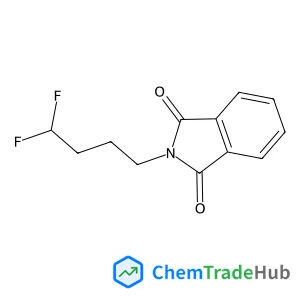
2-(4,4-Difluorobutyl)-1H-isoindole-1,3(2H)-dione
CAS Number:
1265341-14-7
Molecular Formula:
C12H11F2NO2
Recommended Suppliers






Disclaimer
This page provides academic journal information for reference and research purposes only. We are not affiliated with any journal publishers and do not handle publication submissions. For publication-related inquiries, please contact the respective journal publishers directly.
If you notice any inaccuracies in the information displayed, please contact us at support@chemtradehub.com. We will promptly review and address your concerns.