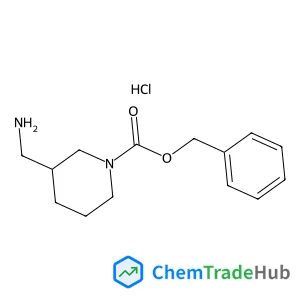
Benzyl 3-(aminomethyl)piperidine-1-carboxylate hydrochloride
CAS Number:
1186663-23-9
Molecular Formula:
C14H21ClN2O2
Joël Puibasset, Roland J.-M. Pellenq
The adsorption properties of water adsorbed on various silica substrates are investigated by way of Grand Canonical Monte Carlo simulations (GCMC). The SPC and PN-TrAZ potential are used to describe water–water and water–silica interactions. The numerical sample of mesoporous silica glass (pore size: 3.6 nm) was obtained by off-lattice reconstruction, known to reproduce in a realistic way the geometrical complexity of high specific surface Vycor. The chemistry of the surface is made realistic by hydroxylation. The simulated adsorption isotherm and isosteric differential enthalpy of adsorption compare well to experimental data for Vycor, showing the ability of the PN-TrAZ potential to describe the hydrophilic properties of silica surfaces. This study was extended to several crystallographic faces of cristobalite. Their adsorption properties differ widely from each other. It is shown that the hydrophilic properties are not simply related to surface hydroxyl density but are also related to the local structure of the silica surface. In spite of these large variations, it is possible to reproduce the adsorption isotherm of the mesoporous disordered sample by applying a natural averaging procedure over the different crystallographic faces of cristobalite.
Cong Lin, Sai Chen, Yihua Wang, Fei Gao, Liang Shen
DOI: 10.1039/D1QO01579F
Susan E. Hagen, Kun Liu, Yafei Jin, Lolita Piersimoni, Hollis D. Showalter
DOI: 10.1039/C8OB00329G
Vasiliy A. Bakulev, Vera S. Berseneva, Natalia P. Belskaia, Yury Yu. Morzherin, Andreiy Zaitsev, Wim Dehaen, Ingrid Luyten, Suzanne Toppet
DOI: 10.1039/B207854F
Liyu Li, Kunfeng Li, Guangpu Zhang, Yuan Ma, Baobin Cai, Shaohua Li, Hongmei Ding, Jiali Deng, Xiyan Nan, Jing Sun, Yun Wu, Ningsheng Shao, Lihe Zhang, Zhenjun Yang
DOI: 10.1039/C8OB01454J
Girish Singh Bisht, Akanksha M. Pandey, Moreshwar B. Chaudhari, Sandip G. Agalave, Abhishek Kanyal, Krishanpal Karmodiya, Boopathy Gnanaprakasam
DOI: 10.1039/C8OB01852A
Amarender Manchoju, Ritesh A. Annadate, Lise Desquien, Sunil V. Pansare
DOI: 10.1039/C8OB01511B
Michal März, Michal Kohout, Tomáš Neveselý, Josef Chudoba, Dorota Prukała, Stanislaw Niziński, Marek Sikorski, Gotard Burdziński, Radek Cibulka
DOI: 10.1039/C8OB01822G
Mingsheng Wu, Xianghu Zhao, Yisen Liu, Song Cao
DOI: 10.1039/C8OB02117A
Claire Empel, Katharina J. Hock, Rene M. Koenigs
DOI: 10.1039/C8OB01991F
6-(3-Fluorophenyl)picolinic acid is generally considered safe for laboratory use...
(3R)-3-Pyrrolidinol is used in the pharmaceutical industry as a precursor for dr...
When handling (4R,5R)-4,5-Diethoxycarbonyl-2,2-dimethyldioxolane (CAS: 59779-75-...
1-(6-Chloroimidazo[1,2-b]pyridazin-3-yl)ethanone is often synthesized via a mult...
The market for N-Ethyl-3,4-dimethylbenzylamine (CAS: 39180-83-1) remains steady,...
Tert-butyl 3-(pyrrolidin-1-yl)azetidine-1-carboxylate is a chemical compound wit...
1-Bromo-3-chloro-2,4-dimethoxybenzene (CAS: 1228956-93-1) falls under the classi...
The safety of 8-Bromo-2-methyl-3,4-dihydroisoquinolin-1(2H)-one (CAS: 1368622-07...
Benzyl [(3S)-2,6-dioxo-3-piperidinyl]carbamate is generally safe when handled wi...
1-{[4-(4,4,5,5-Tetramethyl-1,3,2-dioxaborolan-2-yl)phenyl]sulfonyl}pyrrolidine s...

Physical Chemistry Chemical Physics (PCCP) is an international journal co-owned by 19 physical chemistry and physics societies from around the world. This journal publishes original, cutting-edge research in physical chemistry, chemical physics and biophysical chemistry. To be suitable for publication in PCCP, articles must include significant innovation and/or insight into physical chemistry; this is the most important criterion that reviewers and Editors will judge against when evaluating submissions. The journal has a broad scope and welcomes contributions spanning experiment, theory, computation and data science. Topical coverage includes spectroscopy, dynamics, kinetics, statistical mechanics, thermodynamics, electrochemistry, catalysis, surface science, quantum mechanics, quantum computing and machine learning. Interdisciplinary research areas such as polymers and soft matter, materials, nanoscience, energy, surfaces/interfaces, and biophysical chemistry are welcomed if they demonstrate significant innovation and/or insight into physical chemistry. Joined experimental/theoretical studies are particularly appreciated when complementary and based on up-to-date approaches.