












Effect of water on the catalytic behaviour of VPO in the selective oxidation of propane to acrylic acid
Literature Information
Publication Date
2003-01-23
DOI
10.1039/B211619G
Impact Factor
6.222
Authors
G. Landi, L. Lisi, J. C. Volta
View Original
Abstract
The role of water in propane oxidation to acrylic acid is associated to slow structural modifications of VPO enhancing catalytic performances.
Recommended Journals
Related Literature
Chemometric analysis of spectroscopic data on shape evolution of silver nanoparticles induced by hydrogen peroxide
Kanet Wongravee, Tewarak Parnklang, Prompong Pienpinijtham, Chutiparn Lertvachirapaiboon, Yukihiro Ozaki, Chuchaat Thammacharoen, Sanong Ekgasit
2012-11-27
Paper
DOI: 10.1039/C2CP42758C
Rotational dynamics of thiocyanate ions in highly concentrated aqueous solutions
Heejae Kim
2012-02-27
Paper
DOI: 10.1039/C2CP23749K
Liquid state DNP of water at 9.2 T: an experimental access to saturation
Petr Neugebauer, Jan G. Krummenacker, Vasyl P. Denysenkov, Thomas F. Prisner
2013-02-19
Paper
DOI: 10.1039/C3CP44461A
Do inverse dithienylethenes behave as normal ones? A joint spectroscopic and theoretical investigation
Stéphane Aloïse, Michel Sliwa, Guy Buntinx, Stéphanie Delbaere, Aurélie Perrier, François Maurel, Denis Jacquemin, Michinori Takeshita
2013-02-25
Paper
DOI: 10.1039/C3CP43806F
Ion-specific effect on dynamics of polyelectrolyte chains
Zhenli Luo, Xiaoyan Wang
2012-03-21
Paper
DOI: 10.1039/C2CP40077D
Investigation of spin-flip reactions of Nb + CH3CN by relativistic density functional theory
Qiang Li, Yi-Xiang Qiu, Xian-Yang Chen
2012-03-22
Paper
DOI: 10.1039/C2CP23225A
Complete conformational space of the potential HIV-1 reverse transcriptase inhibitors d4U and d4C. A quantum chemical study
Alla G. Ponomareva, Roman O. Zhurakivsky, Tanja van Mourik
2012-03-13
Paper
DOI: 10.1039/C2CP40290D
Time-resolved, laser initiated detonation of TATP supports the previously predicted non-redox mechanism
Valery Bulatov, Ruslan Grinko, Israel Schechter
2013-03-05
Paper
DOI: 10.1039/C3CP44662J
Pressure and temperature dependent photolysis of glyoxal in the 355–414 nm region: evidence for dissociation from multiple states
Robert J. Salter, Mark A. Blitz, Dwayne E. Heard, Michael J. Pilling, Paul W. Seakins
2013-03-18
Paper
DOI: 10.1039/C3CP43596B
You might also like
Compound Q&A
What precautions should be taken when handling 4-(2-Furylmethyl)thiomorpholine 1,1-dioxide (CAS: 79206-94-3)?
When handling 4-(2-Furylmethyl)thiomorpholine 1,1-dioxide (CAS: 79206-94-3), it ...
79206-94-34-(2-Furylmethyl)thi...
Compound Q&A
What precautions should be taken when handling 4-Chloro-N-[2-(4-morpholinyl)ethyl]benzamide (CAS: 71320-77-9)?
When handling 4-Chloro-N-[2-(4-morpholinyl)ethyl]benzamide (CAS: 71320-77-9), it...
71320-77-94-Chloro-N-[2-(4-mor...
Compound Q&A
How should waste containing 2-[2-(2-Methoxyethoxy)ethoxy]ethyl 4-methylbenzenesulfonate (CAS: 62921-74-8) be handled?
Waste containing this compound (CAS: 62921-74-8) should be handled according to ...
62921-74-82-[2-(2-Methoxyethox...
Compound Q&A
How should waste containing (S)-Methyl 2-amino-3-cyclohexylpropanoate be handled?
Waste containing (S)-Methyl 2-amino-3-cyclohexylpropanoate should be collected i...
40056-18-6(S)-Methyl 2-amino-3...
Compound Q&A
How is 5-({4-[(2S,4R)-4-Hydroxy-2-methyltetrahydro-2H-pyran-4-yl]-2-thienyl}sulfanyl)-1-methyl-1,3-dihydro-2H-indol-2-one (CAS: 166882-70-8) typically synthesized?
This compound can be synthesized using a multi-step process involving the conjug...
166882-70-85-({4-[(2S,4R)-4-Hyd...
Compound Q&A
Are there alternatives to (2E)-3-(3,4-Dichlorophenyl)acrylic acid (CAS: 7312-27-8) in synthesis?
There are several alternatives to (2E)-3-(3,4-Dichlorophenyl)acrylic acid in syn...
7312-27-8(2E)-3-(3,4-Dichloro...
Compound Q&A
How should Ethyl 6-(2-nitrophenyl)imidazo[2,1-b][1,3]thiazole-3-carboxylate (CAS: 925437-84-9) be stored?
Ethyl 6-(2-nitrophenyl)imidazo[2,1-b][1,3]thiazole-3-carboxylate (CAS: 925437-84...
925437-84-9Ethyl 6-(2-nitrophen...
Compound Q&A
How should waste containing 2-(1,3-Thiazol-2-yl)ethanamine (CAS: 18453-07-1) be handled?
Waste containing 2-(1,3-Thiazol-2-yl)ethanamine (CAS: 18453-07-1) should be coll...
18453-07-12-(1,3-Thiazol-2-yl)...
Compound Q&A
How is Methyl 5-iodo-2-methylbenzoate (CAS: 103440-54-6) typically synthesized?
Methyl 5-iodo-2-methylbenzoate can be synthesized through the iodination of meth...
103440-54-6Methyl 5-iodo-2-meth...
Compound Q&A
How is 5-Chloro[1,2,4]triazolo[1,5-a]pyridine (CAS: 1427399-34-5) typically synthesized?
5-Chloro[1,2,4]triazolo[1,5-a]pyridine is commonly synthesized via the condensat...
1427399-34-55-Chloro[1,2,4]triaz...
Source Journal
Chemical Communications

CiteScore:
8.6
Self-citation Rate:
4.7%
Articles per Year:
2458
ChemComm publishes urgent research which is of outstanding significance and interest to experts in the field, while also appealing to the journal’s broad chemistry readership. Our communication format is ideally suited to short, urgent studies that are of such importance that they require accelerated publication. Our scope covers all topics in chemistry, and research at the interface of chemistry and other disciplines (such as materials science, nanoscience, physics, engineering and biology) where there is a significant novelty in the chemistry aspects. Major topic areas covered include: Analytical Chemistry Catalysis Chemical Biology and medicinal chemistry Computational Chemistry and Machine Learning Energy and sustainable chemistry Environmental Chemistry Green Chemistry Inorganic Chemistry Materials Chemistry Nanoscience Organic Chemistry Physical Chemistry Polymer Chemistry Supramolecular Chemistry
Recommended Compounds
![[4-(Heptyloxy)phenyl]boronic acid structure](https://static.chemtradehub.com/structs/136/136370-19-9-ad33.webp "[4-(Heptyloxy)phenyl]boronic acid structure")
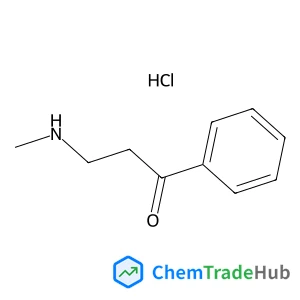
3-(Methylamino)-1-phenyl-1-propanone hydrochloride (1:1)
CAS Number:
2538-50-3
Molecular Formula:
C10H14ClNO
Recommended Suppliers






Disclaimer
This page provides academic journal information for reference and research purposes only. We are not affiliated with any journal publishers and do not handle publication submissions. For publication-related inquiries, please contact the respective journal publishers directly.
If you notice any inaccuracies in the information displayed, please contact us at support@chemtradehub.com. We will promptly review and address your concerns.