



Ion-specific effect on dynamics of polyelectrolyte chains
Literature Information
Publication Date
2012-03-21
DOI
10.1039/C2CP40077D
Impact Factor
3.676
Authors
Zhenli Luo, Xiaoyan Wang
View Original
Abstract
The sedimentation of quaternized poly(4-vinyl pyridine) (QP4VP) or poly(N-methyl 4-vinyl pyridine iodide) in aqueous solution has been investigated by using an analytical ultracentrifuge (AUC) via sedimentation velocity (SV). When NaI is introduced, either the sedimentation coefficient (s) or apparent molar mass (Mw) of QP4VP increases with NaI concentration because the polyelectrolyte chains aggregate or even form precipitates due to hydrophobic interaction. Upon addition of NaCl, either s or Mw exhibits a maximum as NaCl concentration increases. The sedimentation in NaBr solution falls in between. Besides, the diffusion coefficient (D) shows a minimum as the added salt concentration increases when either of the salts is added. Isothermal titration calorimetry (ITC) measurements show that the enthalpy change increases from NaI over NaBr to NaCl when each of them is mixed with QP4VP, revealing that the order of the strength of the anion–pyridinium interaction is I− > Br− > Cl−. When I− ions are added, they only screen the electrostatic interaction and no counterion competition happens. Upon addition of Cl− or Br− ions, the original counterions (I−) win the competition at low Cl− or Br− concentration, so that the added anions only screen the electrostatic interaction. When the concentration of Cl− or Br− ions is high enough, they replace I− ions to interact with the polyelectrolyte chains due to osmotic pressure. The present study demonstrates that the complex dynamics of the polyelectrolyte is greatly influenced by the ion-specific effect.
Recommended Journals

Herald of the Russian Academy of Sciences

Journal of Chemical Sciences

Critical Reviews in Solid State and Materials Sciences

Chinese Journal of Chemistry

Polycyclic Aromatic Compounds

Main Group Chemistry

Bioorganic & Medicinal Chemistry

Atomization and Sprays

Journal of Asian Natural Products Research

Electroanalysis
Related Literature
Screening of hepatocellular carcinoma via machine learning based on atmospheric pressure glow discharge mass spectrometry
Yuze Li
2022-11-23
Paper
DOI: 10.1039/D2AN01756C
UV-PEDD photometry dedicated for bioanalytical uses
Łukasz Tymecki, Luiza Brodacka, Beata Rozum, Robert Koncki
2009-03-13
Paper
DOI: 10.1039/B822025E
Chronocoulometric signalling of BNP using a novel quantum dot aptasensor
Samantha F. Douman, Onyinyechi V. Uhuo, Kefilwe V. Mokwebo, Nelia Sanga, Emmanuel I. Iwuoha
2022-09-15
Paper
DOI: 10.1039/D2AN01357F
Sensitive and selective detection ofcysteine using gold nanoparticles as colorimetric probes
Li Li, Baoxin Li
2009-04-02
Paper
DOI: 10.1039/B819842J
Fabrication of an amperometric bienzyme biosensing system with neutral red functionalized carbon nanotubes
D. R. Shobha Jeykumari, S. Sriman Narayanan
2009-05-19
Paper
DOI: 10.1039/B820040H
Culture-independent susceptibility determination of E. coli isolated directly from patients’ urine using FTIR and machine-learning
George Abu-Aqil, Uraib Sharaha, Manal Suleiman, Klaris Riesenberg, Itshak Lapidot, Ahmad Salman, Mahmoud Huleihel
2022-09-22
Paper
DOI: 10.1039/D2AN01253G
Slab waveguide-based particle plasmon resonance optofluidic biosensor for rapid and label-free detection
Devesh Barshilia, Akhil Chandrakanth Komaram, Pin-Chuan Chen
2022-08-18
Paper
DOI: 10.1039/D2AN01092E
An ultra-fast UV-electrochemical sensor based on Cu-MOF for highly sensitive and selective detection of ferric ions
Xiaoqin Wu, Juanli Xi, Xuehong Wei, Caixia Yin
2022-12-09
Paper
DOI: 10.1039/D2AN01865A
Multivalent SnO2 quantum dot-decorated Ti3C2 MXene for highly sensitive electrochemical detection of Sudan I in food
Lin Mei, Yanmei Shi, Yange Shi, Pengpeng Yan, Chunlei Lin, Yue Sun, Bingjie Wei, Jing Li
2022-10-27
Paper
DOI: 10.1039/D2AN01432G
Label-free fibre optic Raman spectroscopy with bounded simplex-structured matrix factorization for the serial study of serum in amyotrophic lateral sclerosis
Visakan Kadirkamanathan, Martin R. Turner, Andrea Malaspina, John C. C. Day
2022-09-28
Paper
DOI: 10.1039/D2AN00936F
You might also like
Compound Q&A
What precautions should be taken when handling 4-(2-Furylmethyl)thiomorpholine 1,1-dioxide (CAS: 79206-94-3)?
When handling 4-(2-Furylmethyl)thiomorpholine 1,1-dioxide (CAS: 79206-94-3), it ...
79206-94-34-(2-Furylmethyl)thi...
Compound Q&A
What precautions should be taken when handling 4-Chloro-N-[2-(4-morpholinyl)ethyl]benzamide (CAS: 71320-77-9)?
When handling 4-Chloro-N-[2-(4-morpholinyl)ethyl]benzamide (CAS: 71320-77-9), it...
71320-77-94-Chloro-N-[2-(4-mor...
Compound Q&A
How should waste containing 2-[2-(2-Methoxyethoxy)ethoxy]ethyl 4-methylbenzenesulfonate (CAS: 62921-74-8) be handled?
Waste containing this compound (CAS: 62921-74-8) should be handled according to ...
62921-74-82-[2-(2-Methoxyethox...
Compound Q&A
How should waste containing (S)-Methyl 2-amino-3-cyclohexylpropanoate be handled?
Waste containing (S)-Methyl 2-amino-3-cyclohexylpropanoate should be collected i...
40056-18-6(S)-Methyl 2-amino-3...
Compound Q&A
How is 5-({4-[(2S,4R)-4-Hydroxy-2-methyltetrahydro-2H-pyran-4-yl]-2-thienyl}sulfanyl)-1-methyl-1,3-dihydro-2H-indol-2-one (CAS: 166882-70-8) typically synthesized?
This compound can be synthesized using a multi-step process involving the conjug...
166882-70-85-({4-[(2S,4R)-4-Hyd...
Compound Q&A
Are there alternatives to (2E)-3-(3,4-Dichlorophenyl)acrylic acid (CAS: 7312-27-8) in synthesis?
There are several alternatives to (2E)-3-(3,4-Dichlorophenyl)acrylic acid in syn...
7312-27-8(2E)-3-(3,4-Dichloro...
Compound Q&A
How should Ethyl 6-(2-nitrophenyl)imidazo[2,1-b][1,3]thiazole-3-carboxylate (CAS: 925437-84-9) be stored?
Ethyl 6-(2-nitrophenyl)imidazo[2,1-b][1,3]thiazole-3-carboxylate (CAS: 925437-84...
925437-84-9Ethyl 6-(2-nitrophen...
Compound Q&A
How should waste containing 2-(1,3-Thiazol-2-yl)ethanamine (CAS: 18453-07-1) be handled?
Waste containing 2-(1,3-Thiazol-2-yl)ethanamine (CAS: 18453-07-1) should be coll...
18453-07-12-(1,3-Thiazol-2-yl)...
Compound Q&A
How is Methyl 5-iodo-2-methylbenzoate (CAS: 103440-54-6) typically synthesized?
Methyl 5-iodo-2-methylbenzoate can be synthesized through the iodination of meth...
103440-54-6Methyl 5-iodo-2-meth...
Compound Q&A
How is 5-Chloro[1,2,4]triazolo[1,5-a]pyridine (CAS: 1427399-34-5) typically synthesized?
5-Chloro[1,2,4]triazolo[1,5-a]pyridine is commonly synthesized via the condensat...
1427399-34-55-Chloro[1,2,4]triaz...
Source Journal
Physical Chemistry Chemical Physics

CiteScore:
5.5
Self-citation Rate:
10.3%
Articles per Year:
3036
Physical Chemistry Chemical Physics (PCCP) is an international journal co-owned by 19 physical chemistry and physics societies from around the world. This journal publishes original, cutting-edge research in physical chemistry, chemical physics and biophysical chemistry. To be suitable for publication in PCCP, articles must include significant innovation and/or insight into physical chemistry; this is the most important criterion that reviewers and Editors will judge against when evaluating submissions. The journal has a broad scope and welcomes contributions spanning experiment, theory, computation and data science. Topical coverage includes spectroscopy, dynamics, kinetics, statistical mechanics, thermodynamics, electrochemistry, catalysis, surface science, quantum mechanics, quantum computing and machine learning. Interdisciplinary research areas such as polymers and soft matter, materials, nanoscience, energy, surfaces/interfaces, and biophysical chemistry are welcomed if they demonstrate significant innovation and/or insight into physical chemistry. Joined experimental/theoretical studies are particularly appreciated when complementary and based on up-to-date approaches.
Recommended Compounds
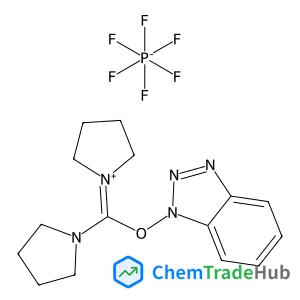
(1H-Benzotriazol-1-yloxy)(di-1-pyrrolidinyl)methylium hexafluorophosphate
CAS Number:
105379-24-6
Molecular Formula:
C15H21F6N5OP
Recommended Suppliers




Disclaimer
This page provides academic journal information for reference and research purposes only. We are not affiliated with any journal publishers and do not handle publication submissions. For publication-related inquiries, please contact the respective journal publishers directly.
If you notice any inaccuracies in the information displayed, please contact us at support@chemtradehub.com. We will promptly review and address your concerns.